Can your living annuity income last 30 years?
8 June 2026
Building blocks to a lasting Living Annuity
Our panel of experts discusses living annuities, sustainable drawdown rates, offshore investing, and everything else one might need to consider to ensure a comfortable retirement. Read more
![Building blocks to a lasting Living Annuity [webinar + transcript]](/_next/image?url=https%3A%2F%2Fimages.ctfassets.net%2Fyqvz0zwovkbq%2F4dZzwtwSkZ19hmRrVa6Zyb%2F770741ecc4b2ae3deda48fa06da42718%2FWebinar_recording_cover_1920X1080.webp&w=828&q=75)
The retirement years can often last much longer than many retirees anticipate, which means your living annuity often needs to provide for an extended period of time. A living annuity may need to last you 30 years or more, considering most South Africans tend to retire in their 60s.
There are a few factors, such as asset allocation, drawdown rate, the inflation rate and investor behaviour, that can play a big role in determining the sustainability of your living annuity in the long run. In this article, we look at the importance of these factors and how to manage them to help maintain your living annuity's sustainability.
What is a living annuity?
A living annuity is a flexible long-term investment product that invests in the market while allowing you to draw an income from your capital. Your annuity is funded by your retirement savings from products such as a retirement annuity or a preservation fund. The income you draw from your annuity is determined by the drawdown rate you select. This is the percentage of the total value of your living annuity that you draw as income.
You can select from a range of 2.5% to 17.5% per annum. This drawdown rate can be amended each year at the policy anniversary date. You can also select your preferred payment frequency from annual, biannual, monthly, or quarterly. You may also select the underlying funds within your living annuity “wrapper” to ensure they are best suited to your needs, long-term financial plan, and retirement goals.
A major appeal of living annuities is the ability to pass on the remaining capital to your beneficiaries outside of your estate when you pass, so tax-free.
Plan for a comfortable retirement with our
Living Annuity calculatorWhy longevity risk matters more than ever
Longevity risk is the risk that you outlive your living annuity’s capital. This is a greater risk than it ever was before, as people are generally living much longer than in the past due to advances in medicine, medical treatment and quality of life.
As such, many retirees may spend 25 to 30 years in retirement, and in some cases even longer. This means that your annuity may need to provide a sustainable income for several decades. While this is positive from a longevity perspective, it also places greater pressure on your savings to last throughout your retirement years.
It’s also important to factor in healthcare costs and the impact of inflation. Healthcare costs may increase as you age, while inflation can gradually reduce the purchasing power of your income over time. Market volatility can also affect your investment returns along the way, making it even more important to ensure that your living annuity is structured with the long term in mind.
This is why longevity risk should be a central consideration when planning your retirement income strategy. Factors such as your drawdown rate, asset allocation, fees, and retirement goals should all be carefully aligned to help ensure your annuity remains sustainable for as long as you may need it.
The importance of choosing your drawdown rate
Your drawdown rate is one of the most important decisions you will make when managing your living annuity, as it directly affects how long your retirement capital may last. The drawdown rate is the percentage of your annuity that you withdraw as income each year.
While a higher drawdown rate may provide more income in the short term, it also means that less capital remains invested and available to grow and compound over time. It also places greater pressure on your portfolio to generate strong returns in order to sustain your income needs. A lower drawdown rate, on the other hand, leaves more capital invested in your living annuity, and this can then potentially build and compound over the long term.
A sustainable drawdown rate is generally considered to be about 4% by financial experts, but nothing can be guaranteed. The appropriate rate depends on your age, retirement goals, investment strategy and financial circumstances. Where possible, choosing a lower drawdown rate may help reduce longevity risk and improve the chances that your living annuity will continue to provide you with an income during your retirement years.
The 4% retirement rule isn't dead (but your investment fees might kill it)
4% has historically been a good rule of thumb when it comes to income drawn down from retirement investments such as a living annuity. But is it still relevant, and when might it be too much? Read more

Why asset allocation is key
Living annuities offer investors flexibility to choose how their retirement capital is invested through asset allocation. These are the different asset classes that your savings are invested in. You will usually choose a mix of equities, real estate (property) and cash. Your selection should be based on both your investor profile and your long-term financial plan and goals.
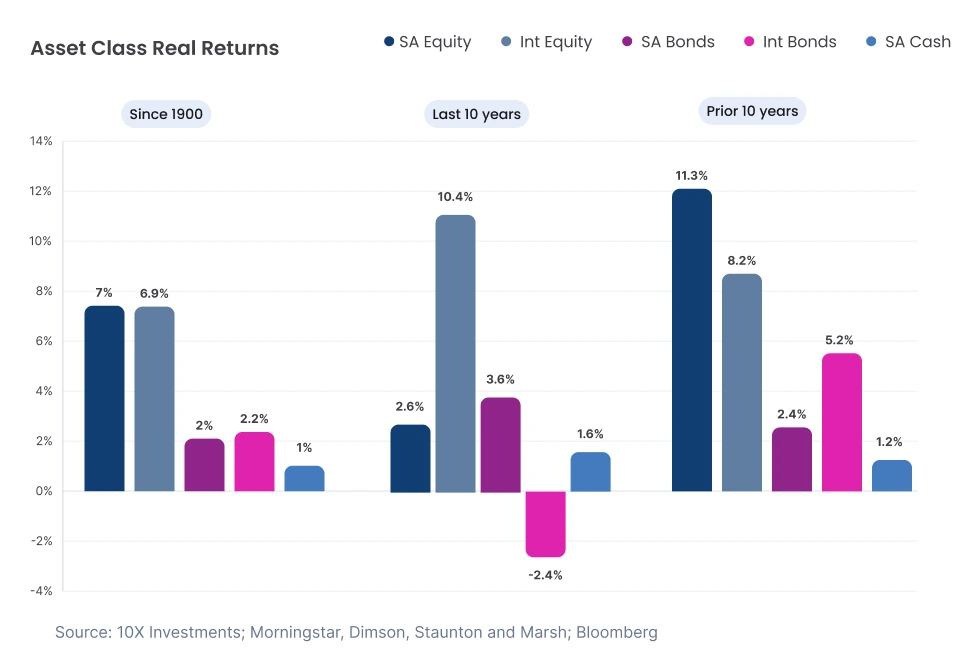
Your investor profile considers your investment timelines as well as your risk tolerance levels; in other words, your appetite for risk. You would ideally want your asset allocation to balance growth and stability. Asset allocation plays the biggest role in the performance of your living annuity, accounting for over 90% of returns, as seminal research from Brinson, Singer and Beebower shows.
At 10X, you have the freedom to adjust your underlying portfolio by choosing from a selection of carefully curated investment funds, each with a different mix of assets and geared towards different investor profiles.
Equities are considered the most volatile of the asset classes, but they are likely to generate the strongest returns in the long term. As data suggest, equities have historically produced returns above inflation by around 7% annually, over the long term (based on JSE All Share Index performance versus CPI from 1960-2020), although past performance does not guarantee future results.
Real estate may also generate some strong returns while serving as a hedge against inflation. Bonds may provide some stability in your portfolio, but may generate lower returns. While bonds are seen as a more conservative option, they may still outperform expectations. Cash is the most stable and liquid asset class, but it may also produce the lowest returns. Diversifying your portfolio across the various asset classes is a good way to balance both risk and reward.
You may also wish to invest offshore. Living annuities are not subject to Regulation 28 of the Pension Funds Act, meaning that you are able to invest offshore without any restrictions. You will, however, need to ensure that your service provider is able to offer this. 10X is able to offer a living annuity that may be invested 100% offshore. Diversifying your portfolio offshore allows greater access to a range of different industries and companies. It may also be a good hedge against local market instability in South Africa and any depreciation of the Rand which may occur.
As mentioned, 10X offers a range of well-diversified funds to suit a variety of different kinds of investors. Please visit our funds page for the most up-to-date fund information.
Why fees matter
Fees can play an important role in the growth and sustainability of your living annuity. Higher fees may reduce the returns that are available to reinvest and potentially grow your annuity. Lower fees may mean there are more returns available to reinvest, potentially compounding and building over the long term.
You would also want to consider your Effective Annual Cost (EAC). This useful metric allows you to see the total fees and costs associated with owning an investment product over a one-year period of time. All factors being equal, you may find that a higher EAC means that there are fewer returns to be reinvested and allowed to compound over time. A lower EAC may result in there being more returns available to be reinvested and allowed to compound over the long term.
The EAC of your investment would be just one factor to consider when choosing between service providers. We offer clients a free EAC calculator, which is a part of our online suite of tools that is available to clients on our 10X website. This can be a useful tool to compare and evaluate the fees that you are being charged with those of other service providers.
Let’s look at an example comparing lower fees and higher fees per annum. We will assume the following information in this example:
- Investment amount: R4 million
- Investment period of 25 years
- Drawdown rate: 4% (annual payments)
- Return of 12% per annum
- An inflation rate of 6%
Example 1 (0.86% Fees): Real investment value is approximately R4.7 million.
Example 2 (3% Fees): Real investment value is approximately R2.9 million.
What may appear to be a small difference in fees can have an impact on the potential growth of your annuity, especially when this is compounded over the long term. This example is for illustrative purposes only, and actual results may vary. You can find out more about how fees affect retirement outcomes here. Let’s have a look at some of the common fees that you may see charged:
- Administration fees: There will be fees charged for the administration-related activities. This will be for tasks like compliance, reporting, tax and similar.
- Advisor fees: If you decide to make use of an advisor, they will charge fees for their services. There may be both an initial and an ongoing fee charged.
- Management fees: These are the fees charged for the running and management of the fund.
At 10X, our fees are kept low, transparent and simple. There are also no hidden costs. Fees charged on retirement products are usually 1% or less, depending on the product selected and how much you invest. Please explore our products for the most up-to-date fee information.
How inflation impacts retirement income
Inflation reduces money’s purchasing power over time, meaning the same amount of income will buy fewer goods and services in the future than it does today. It is one of the biggest long-term risks that retirees face. The effects of inflation need to be taken into consideration when planning for your retirement. For example, expenses such as healthcare, food, utilities, and insurance are likely to become more expensive over time. If your retirement income does not keep pace with inflation, you may find that your standard of living gradually declines as your retirement progresses. As such, you would ideally want to target inflation-beating returns in your portfolio in order for your capital to grow.
Including growth assets such as equities in your living annuity may help you to outperform inflation. Of course, the appropriate asset allocation should always line up with your investor profile, income needs and long-term retirement goals. When it comes to living annuity sustainability, your capital needs to grow faster than inflation to help maintain your purchasing power throughout your retirement years.
How these factors work together
It’s important to be aware of how your drawdown rate, asset allocation, fees, and inflation interact. These factors are closely interconnected.
For example, a high drawdown rate reduces the amount of capital that remains invested, while high fees further reduce the returns available for potential compounding. If this is combined with an overly conservative asset allocation that is heavily invested in cash, your portfolio may struggle to maintain the growth needed to keep pace with inflation and support your future income needs. This combination essentially increases longevity risk.
On the other hand, a lower drawdown rate, low fees and a well-diversified portfolio that includes exposure to growth assets can improve the long-term sustainability of your annuity. More capital remains invested, allowing greater opportunities to grow and compound, helping offset the effects of inflation over time. While inflation is outside of your control, your drawdown rate, asset allocation, and fees are decisions that you can actively manage. These factors can work together to help you reduce longevity risk and improve the likelihood of your living annuity lasting over 30 years.
Practical ways to improve living annuity sustainability
While no one can predict future market performance, there are a few steps that retirees can take to improve the long-term sustainability of their living annuity. Let’s take a look at some of these:
- Ensure that the fees that you are paying are low: Fees can have a huge impact on long-term returns, especially over a retirement that may last several decades. Lower fees may leave more of your investment returns available for reinvestment and compounding.
- Choose a sustainable drawdown: Your drawdown rate should balance your current income needs with the long-term sustainability of your retirement capital. A drawdown rate of around 4% is considered sustainable by financial experts.
- Stay focused on your long-term financial plan and goals: Living annuities are long-term investment vehicles, and short-term market movements shouldn’t distract you from your retirement goals.
- Maintain an appropriate asset allocation: Ensure a diversified asset allocation that is well-aligned with your long-term financial goals and investor profile.
- Review your living annuity annually: Make sure to review your living annuity annually before your policy anniversary date. An annual review is needed to reassess your drawdown rate, asset allocation, fees and retirement goals.
- Avoid being distracted by any short-term market noise: Market volatility is a normal part of investing. Making emotional or knee-jerk decisions can negatively affect long-term outcomes.
Final thoughts on sustainable living annuities
You may need your living annuity to provide for you for 30 years or more. It is therefore essential that you focus on the sustainability of your living annuity. There are a few key factors that can influence your annuity, such as asset allocation, drawdown rate, and investor behaviour. If managed carefully and thoughtfully, these factors can improve your retirement outcomes. At 10X, we have transparent, low-fee pricing and aim to deliver superior long-term returns for our clients. To learn more about the 10X Living Annuity, speak to one of our investment consultants today!
Related articles


How can we 10X Your Future?
Begin your journey to a secure future with 10X Investments. Explore our range of retirement products designed to help you grow your wealth and achieve financial success.