How an investment scam gets its tentacles around you
26 October 2026
The views and opinions expressed in this article are those of the author and do not necessarily reflect the official policy or position of 10X Investments.
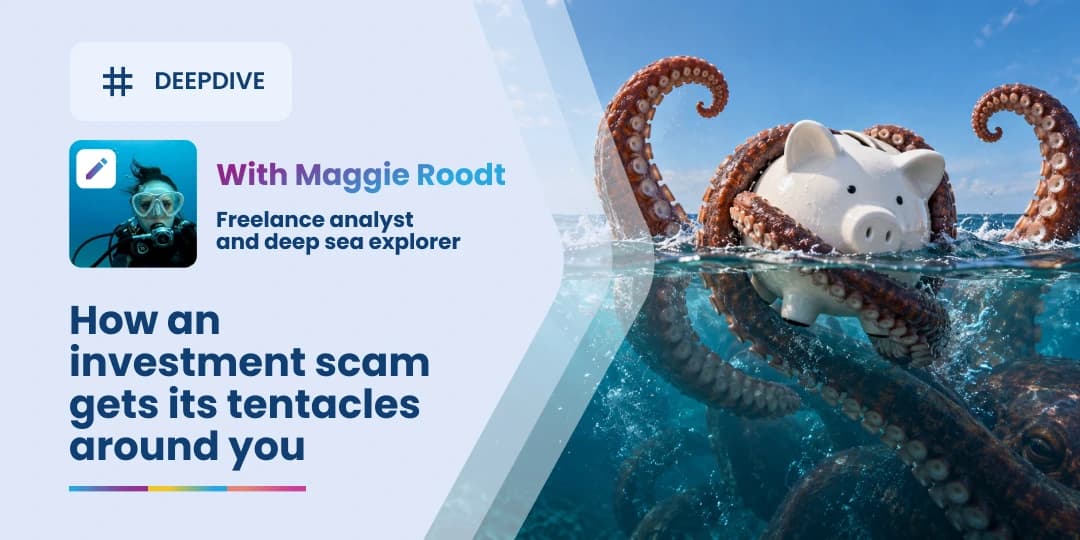
In December 2020, a man from Stellenbosch stopped answering his phone. Johann Steynberg, founder of Mirror Trading International (MTI), disappeared as his company failed to honour clients' withdrawal requests. According to the Western Cape High Court, about 16,000 requests were still in the queue, worth roughly 2,600 Bitcoin. Not one was ever paid.
That's 16,000 times someone clicked "withdraw" and waited... and waited...
Very few of those people would have expected themselves to fall victim to a scam. Hardly anyone does. We tend to think scam victims are gullible, because that keeps the rest of us safely on the other side of the line. But there's gullibility, and then there's intelligent scams that use a variety of carefully thought-through mechanisms to separate people from their money. Ordinary, otherwise careful people.
And scam tactics keep improving. In 2020, the pitch came with a trading bot. By 2024, it came with a video of Elon Musk supporting the product. But, most investment scams follow a recognisable pattern, and it can be broken down into four stages: the approach, the trap, the squeeze and the aftermath. This is what that pattern looks like, from the moment it targets you to the day a court finally catches up.
9 out of 10 people do better with 10X
The approach...
Case study | Mirror Trading International, 2018 to 2021
Every scam starts with the approach, which is how it reaches you and earns your trust. Scammers rarely build that trust from scratch. They borrow it from people you already know, from technology that sounds too clever to question, or from a famous face. And they time it well, because the approach works best when people are under financial pressure, like in 2020.
South Africa was in lockdown since March of that year. The number of employed South Africans in just three months. Many of those who kept their jobs had their pay or hours cut. But their debit orders kept coming. You, like everyone, were doing whatever it took to get through the month.
Then someone you know and trust sent you a YouTube clip.
The clip explained a Bitcoin "club" with an AI bot that traded forex around the clock. You deposit Bitcoin, the bot trades it, and your account shows a daily profit. Your friend’s dashboard showed a growing number, and they'd already made a successful withdrawal.
It's slightly too good to be true, but you probably didn't think about it too much, because it didn't feel like a scam. Why?
- The messenger: It came from someone you trust, who had already been paid and earned a bonus for bringing you in. They most likely believed in it too.
- The technology: In 2020, an AI bot trading crypto sounded like the future and too technical to question.
- The numbers: Daily profit reports arrived like clockwork, which felt a lot like proof.
- The payouts: Early members really did withdraw Bitcoin, paid with money from later members (that’s how a Ponzi scheme works).
By the end, MTI had about 200,000 investors, including at least 23,000 in the United States, according to the . The High Court later found there was no AI bot behind the trading results and that every daily profit report was false.
The bot was the story and your friend delivered it to you.
Higher fees very likely means lower returns (and here's the maths to prove it)
Paying high fees on your retirement investments (such as a retirement annuity or a living annuity) almost always means less money in your pocket, and less money for your retirement. Read more

The trap...
Case study | Banxso, 2024
The trap is when you make the first payment and get something back that looks like proof. It’s built from three things: a platform that looks real, a dedicated contact person, and early profits that cost the scammer nothing to show. MTI’s court record says little about this stage, so to illustrate this part we need to turn to a different scam. Banxso, an online trading platform, has no connection to MTI, except that the shape of their con is similar.
According to her court papers, a woman named Wentzel came across a Facebook advert in early July 2024 showing what appeared to be an SABC presenter interviewing Elon Musk. They were promoting an investment called Immediate Matrix that promised to turn R4,700 into R34,300 within a week.
She entered her details and received a phone call almost instantly. Anyone who has spent 30 minutes on hold with the bank knows how rare that is. The caller told her she could start with R1,800 and earn about R800 to R900 a week. She paid in and was assigned a “success manager” to guide her trades by phone and WhatsApp. On 29 July, he called to say she’d already made about R900.
Every piece of the experience feels like evidence:
- A celebrity who seems to vouch for it
- A platform you can log into, with charts and a balance
- A person who knows your name and calls you back
- A profit you didn't have to do anything to earn
But none of it shows that your money is invested anywhere, and that’s the trap. On a fraudulent platform, the balance, the charts, and the profits all sit on a screen the operator controls. Showing you a profit chart costs them nothing. It only becomes money when you can take it out, and you never get that chance.
Why I'm saving for my kids' university with a Unit Trust and not a Tax-Free Savings Account
A unit trust is more flexible than a tax-free savings account, and the tax burden might not be as bad as you think. Don't make the wrong choice when it comes to medium vs long term savings for your kids. Read more

The squeeze...
Case study | Banxso, 2024
Once the money is in, the job changes. Now that you're in, they've got to keep you paying. This is how the next month unfolded, in Wentzel’s account.
- 25 and 27 August 2024: Under pressure to deposit R30,000 urgently, she pays in R10,000, then another R20,000.
- 6 September: She deposits R470,000.
- 7 September: The platform shows a profit of R200,000. She feels assured that her investment is in good hands.
- 24 September: Her margin levels drop. She asks to withdraw and is advised not to withdraw her capital. Instead, she's offered a R45,000 recovery bonus if she fills in a form, which she sends back via WhatsApp. By that evening, her entire capital investment is drained in apparent trading losses.
- 25 September: She's told the bonus can't be applied because the form should have been emailed.
- 26 September: She's told she can trade her way back if she will deposit a further R500,000. Then access to her account is blocked. After that, every call is only met with a response to invest further funds.
That’s how they squeeze every last drop out of victims. Once you believe the balance on the screen is yours, every new request can be framed as protecting it. The timing is deliberate too. The pressure on Wentzel started after her first profit, and the exit only closed once almost everything was in.
The last move is making you pay to get your money out. The FBI calls that demand, whether it’s labelled a tax, a fee or a recovery deposit, . By then, the money is likely already gone.
Retirement Annuity vs Tax-free Savings Account vs Bond: Where Should Your Extra Money Go?
Got extra money to invest? Compare three powerful options: Retirement Annuity, Tax-Free Savings Account (TFSA), or paying off your bond faster. Learn the pros and cons of each to make an informed choice for your financial future. Read more

The aftermath...
The aftermath of these stories usually plays out the same way: regulators and courts act, often years later, and very little of the money comes back. For many victims, there can even be one more step: the recovery scam. Someone who knows about your loss, often posing as a lawyer, an investigator or a regulator, offers to get your money back for a fee. But paying them only adds to the loss.
MTI
MTI’s case ended about as firmly as a case can. The Western Cape High Court declared it an unlawful Ponzi scheme, and a US court ordered . The CFTC itself warns that orders like these may not necessarily return any money to victims.
Steynberg fled to Brazil and before he could stand trial. A $1.7 billion order looks good on paper, but it’s an open question whether it shows up in the victim’s bank account.
Banxso
Banxso’s reckoning came faster. South Africa’s financial markets regulator, the Financial Sector Conduct Authority (FSCA), fined the company and two of its directors a combined for misappropriating client funds and banned five people from the industry. The High Court then placed Banxso in . Liquidators have recovered about R113 million, but a legal challenge has , and investors are still waiting.
A finding, a penalty, a restitution order and a liquidation are four different things. None of them necessarily mean that victims get their money back.
For its part, Banxso told the court it had refunded R67.57 million to clients, but the court found the payouts were small compared with what investors had put in. Banxso denies any link to the deepfake adverts, and no criminal conviction has been recorded against it.
Seeing the scam pattern
Neither MTI’s members nor Banxso’s clients handed over everything at once. They were led there one reasonable-looking step at a time: a message from someone they trusted, a screen showing a profit, a request framed as protecting what they had already put in.
The technology will keep changing, but those steps change far more slowly, if at all. If you’ve been caught in a scam like this, the earlier you recognise which stage you’re in, the less it costs to walk away. And of course, the best situation is never to be pulled in by this pattern in the first place.
The 60-Second Check
These questions help you make sense of exactly what is being offered.
- Is it who it says it is? Check that the ad, the caller and the account you pay all name the same company, then look it up on the .
- Can you explain where the return on my investment comes from in one sentence? “An AI trading bot” isn’t an answer. As a rule, returns that seem too good to be true generally are, and magical AI trading bots generally aren’t magical, or even trading bots.
- Who actually holds my money? A dashboard is just a picture. Find out which regulated institution holds your funds.
- Is that face real? A celebrity video, or a friend’s withdrawal, proves nothing about where your money goes.
- Are you being asked to pay to get your money out? Stop and call your bank.
If it’s already happening...
- Stop paying!! Don’t send any more money, even if it’s to 'unlock' your balance.
- Call your bank’s fraud line immediately The number is on the back of your card. If you call soon enough, the bank may be able to stop or recall a payment, but that is not guaranteed.
- Keep the evidence Take screenshots of messages, adverts, the platform, and your account balance. Save your proof of payment and every name, number, and website you dealt with.
- Report it to the police Open a case at your nearest police station and ask for a case number. You can also call SAPS Crime Stop on 08600 10111 or use the MySAPS app.
- Report it to the FSCA Use the regulator’s anonymous fraud tip-off line on 0800 31 36 26, or email fsca@behonest.co.za.
- Protect your identity If you shared your ID or bank details, apply for free protective registration with the Southern African Fraud Prevention Service on 011 867 2234 or at protection@safps.org.za. It alerts banks and retailers to check anyone using your details.
Related articles

How can we 10X Your Future?
Begin your journey to a secure future with 10X Investments. Explore our range of retirement products designed to help you grow your wealth and achieve financial success.