Living annuity income planning: Balancing today's needs with tomorrow's goals
9 September 2026
The Living Annuity Masterclass: How to maximise your retirement income


Building blocks to a lasting Living Annuity
Our panel of experts discusses living annuities, sustainable drawdown rates, offshore investing, and everything else one might need to consider to ensure a comfortable retirement. Read more
![Building blocks to a lasting Living Annuity [webinar + transcript]](/_next/image?url=https%3A%2F%2Fimages.ctfassets.net%2Fyqvz0zwovkbq%2F4dZzwtwSkZ19hmRrVa6Zyb%2F770741ecc4b2ae3deda48fa06da42718%2FWebinar_recording_cover_1920X1080.webp&w=828&q=75)
Retirement marks a new phase of investing, often involving a living annuity. Managing this annuity requires careful planning to balance income needs with capital preservation for the future. Early decisions regarding fees, asset allocation, and drawdown rates can influence the sustainability of your living annuity. It’s crucial to consider how to balance capital preservation and growth over time to ensure your annuity's longevity. In this article, we’ll cover key considerations to help your living annuity last, helping you balance your immediate needs with your retirement goals.
Plan for a comfortable retirement with our
Living Annuity calculatorUnderstanding the purpose of a living annuity
A living annuity is a flexible post-retirement income option that allows you to withdraw income while your capital stays invested, potentially compounding and growing over time. As noted, living annuities give you, the investor, the flexibility to choose your drawdown rate and the funds in which your capital is invested. Your drawdown rate is the income you take from the annuity.
You can also change your fund choices to match any new circumstances. However, this flexibility requires responsible management from the investor. You need to oversee your living annuity carefully to ensure it supports you throughout your retirement years. One major advantage of a living annuity is that the remaining capital can be passed to your beneficiaries outside of your estate, subject to tax and product rules.
A guaranteed annuity, also known as a life annuity, is an insurance product bought from an insurer. It provides a fixed monthly income for your lifetime. When purchasing it, you can select different payout options, such as level income or inflation-linked payments. There is no market risk involved, as that burden falls on the insurance company. Additionally, there is no longevity risk because the income is assured for life.
The challenge of balancing present and future needs
It can be challenging for retirees to balance both present income needs with potential future needs. It is crucial that future needs are also taken into account when planning your living annuity. It’s unknown how long your retirement phase will last and how long you will need your living annuity to provide you with an income, but you will need to factor in that your living annuity may last several decades.
It’s important to consider what this means for the income that you are hoping to draw from it in the present, as well as in the future. You will also need to bear in mind factors such as future medical expenses and the effects of inflation on your living annuity income and purchasing power.
Why your drawdown rate plays a critical role
Your drawdown rate is the percentage of your living annuity capital that you draw as income. This drawdown rate may be amended each year on your policy anniversary date to accommodate any changes in needs or circumstances. Your drawdown rate may range from 2.5% to 17.5%, depending on your preferences. An important consideration is the longevity of your living annuity.
The 4% retirement rule isn't dead (but your investment fees might kill it)
4% has historically been a good rule of thumb when it comes to income drawn down from retirement investments such as a living annuity. But is it still relevant, and when might it be too much? Read more
For this reason, the drawdown rate that you select should be carefully managed. A drawdown rate that is too high may mean that your capital is depleted too quickly. A lower drawdown rate may mean that more capital remains invested to potentially grow and build over time. A drawdown rate of 4% is generally considered sustainable by financial experts, but this is not a guarantee. If you are able to select a lower drawdown rate, it is advised.
Why retirees still need growth in their portfolios
Growth in your portfolio remains important, even in retirement. Retirement does not mean investing stops: your living annuity needs to be carefully managed to balance sustainability and potential growth.
By including growth assets in your portfolio, such as equities, you can help focus on the long-term growth of your capital. It’s important to remember that you are drawing an income from your living annuity, so ensuring some growth in your capital may help with sustainability. You would also want your portfolio to outpace inflation, as inflation reduces the purchasing power of your money.
In other words, the ‘bag’ of goods and services that you are able to buy with a certain sum of money is reduced over time. The inflation rate may vary, but it is usually around 5-6% per annum in South Africa (remember, there are no guarantees). When you plan for retirement income, you should include future spending requirements as well as your anticipated current spending.
The importance of asset allocation
Asset allocation is the distribution of an investment portfolio across various asset classes, including equities, bonds, property, cash, and offshore investments. It determines the balance of growth, income, and defensive assets within the portfolio. This mix influences how the investment reacts to inflation, interest rate shifts, economic growth, and market downturns. The ideal allocation depends on your time horizon, income needs, risk capacity, and ability to stay invested through volatility. Research by Brinson, Singer, and Beebower indicates that asset allocation plays a major role in the performance of your living annuity, making it a key factor in investment outcomes.
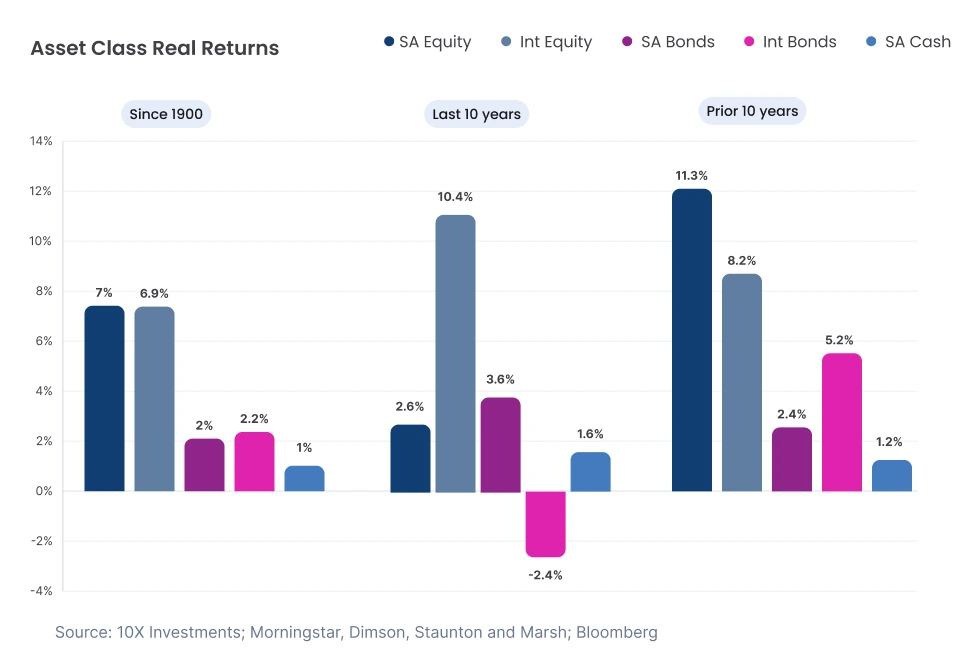
It is essential that your asset allocation is carefully selected. You would aim to align your selection with your long-term goals and plans. You would also consider your ‘investor profile’ in your selection exercise. Your investor profile comprises both your risk profile and your investment timelines. This is referred to as your ‘investor profile.’ An investor with a longer investment horizon and a stronger tolerance for short-term volatility may be comfortable with a higher allocation to growth assets. An investor who needs greater stability or expects to access the money sooner may prefer a portfolio with a larger allocation to bonds and cash.
As an investor with 10X, you do not need to choose individual shares, bonds, or properties. Instead, investors may select from a range of diversified 10X investment funds. Each fund has a predetermined combination of asset classes and is designed for a specific type of investor, risk profile, and investment horizon. You may choose the fund that most closely aligns with your financial goals, time horizon and investment risk.
Describing the asset classes
Equities are generally included in a portfolio to provide long-term capital growth and the potential to earn returns above inflation. Equities give investors exposure to companies and economic growth, but they may also experience significant market declines. Value may fluctuate considerably over short periods, making it generally more appropriate for investors with longer time horizons and the ability to tolerate volatility.
Bonds can provide income, diversification, and a measure of stability within a portfolio. They are usually less volatile than equities, but they are not risk-free. Bond values can be affected by changes in interest rates, inflation expectations, and the issuer's ability to repay its debt. While they’re seen as more conservative, they still may outperform expectations.
Real estate provides exposure to real assets and economic activity, while generating income through rentals and distributions. It may contribute to long-term portfolio growth. However, listed property can be volatile and may be affected by interest rates, economic conditions, occupancy levels and changes in the property market. Real estate often serves as a good hedge against inflation.
Cash is generally seen as the most liquid and stable of the asset classes. It is less likely to experience the same levels of volatility as equities or real estate. Cash returns may, however, struggle to keep pace with inflation over long periods, thereby reducing purchasing power.
Offshore assets provide investors with exposure to a broader range of industries, businesses, currencies and economies outside of South Africa. This can improve diversification and reduce reliance on the local market's performance. Offshore investing also introduces additional risks such as currency fluctuations, changes in global markets, geopolitical events and different regulatory or tax considerations.
Money mistakes to avoid during retirement
Retirement should be a time for relaxation. These tips will help you reduce the stress of your golden years, and retire better! Read more

A living annuity is not subject to Regulation 28 of The Pension Funds Act, meaning that there is no limit to the percentage of your portfolio that you may invest in equities or offshore. Offshore investing may be of particular interest to you if you already have a portfolio that is heavily invested in the local South African market. Investing offshore may provide a good hedge against local market instability and Rand depreciation.
At 10X, you can expect to find a wide range of funds that are well-diversified across the asset classes. We can also offer a living annuity that may be invested 100% offshore. Explore our funds page for up-to-date fund information.
How fees can affect income sustainability
Future market returns are uncertain, but product charges can be seen. This makes fees one of the few factors an investor can control, allowing investors to compare service providers. The lower the fees, the more returns can be reinvested and potentially compound over time. Fees are especially important with income being withdrawn. The portfolio must support the drawdown rate, absorb costs and still attempt to maintain pace with (or ideally, outpace) inflation. A higher cost base may potentially reduce the margin available for all of the above needs. There are some typical fees that you may see charged:
- Management fees: These are the fees charged for the fund's operation.
- Administration fees: There will also be administration-related fees charged. These will be tasks such as reporting, compliance, and tax.
- Advisor fees: An advisor charges for the advice and services that they offer. There will often be both an initial and an ongoing fee charged.
Let’s look at an example that helps compare the difference between low fees of 0.86% per annum and higher fees of 3% per annum on your living annuity, when compounded over a 25-year investment term. We will assume the following information:
- Investment amount: R4 million
- Investment period of 25 years
- Drawdown rate: 4% (annual payments)
- Return of 12% per annum
- An inflation rate of 6%
Example 1 (0.86% Fees): Real investment value is approximately R4.7 million.
Example 2 (3% Fees): Real investment value is approximately R2.9 million.
What may seem like only a small difference in fees can have a striking impact on the potential growth of your living annuity when fees are compounded over the long term. This example is for illustrative purposes only, and actual results may vary. You can find out more about fees here. As an investor, it’s also important to understand the following terms:
- TER (Total Expense Ratio): Ongoing expenses within an investment fund, calculated according to the applicable standard. (A way to compare the operating costs of similar funds, but it is not the final cost)
- TIC (Total Investment Charge): The total investment charge, which combines the TER with transaction costs within the fund. (A way to compare the full cost of the investment portfolio itself)
- EAC (Effective Annual Cost): An annualised estimate of the impact of product, investment management advice, administration fees, and all other applicable charges.
The Effective Annual Cost gives investors a standardised way to understand the full cost of holding an investment over time. Introduced by ASISA, the EAC combines various charges linked to an investment into a single annual percentage. Depending on the product, this may include investment management fees, administration costs, advice fees, penalties, guarantees and the effect of loyalty bonuses. As such, investors can more easily compare the cost structures of different products and providers on a more consistent basis. At 10X, our fees are low-cost and transparent, allowing investors to easily see what they are being charged. Explore our products for the most up-to-date fee information.
10X fund options
Unlike retirement annuities and preservation funds, living annuities are not subject to Regulation 28. As such, investors have greater flexibility when choosing their underlying investments, including the ability to allocate up to 100% of their living annuity offshore. The additional freedom that comes with a living annuity means that fund selection, diversification and risk management require careful consideration. The right fund depends on the investor’s income needs, investment horizon, tolerance for market volatility, and need for long-term capital growth. A retiree may still have an investment horizon of several decades, so the most suitable portfolio shouldn’t be chosen purely based on age.
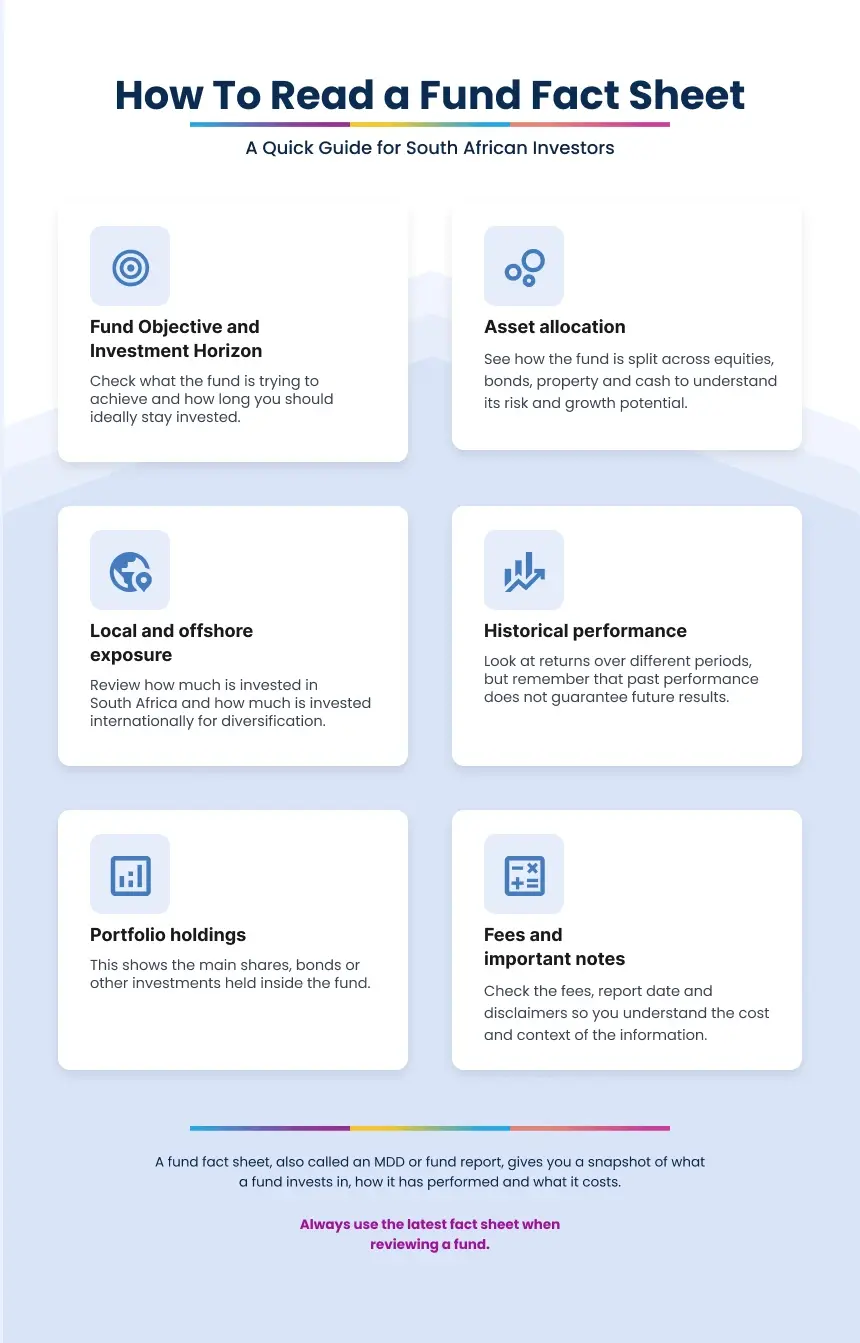
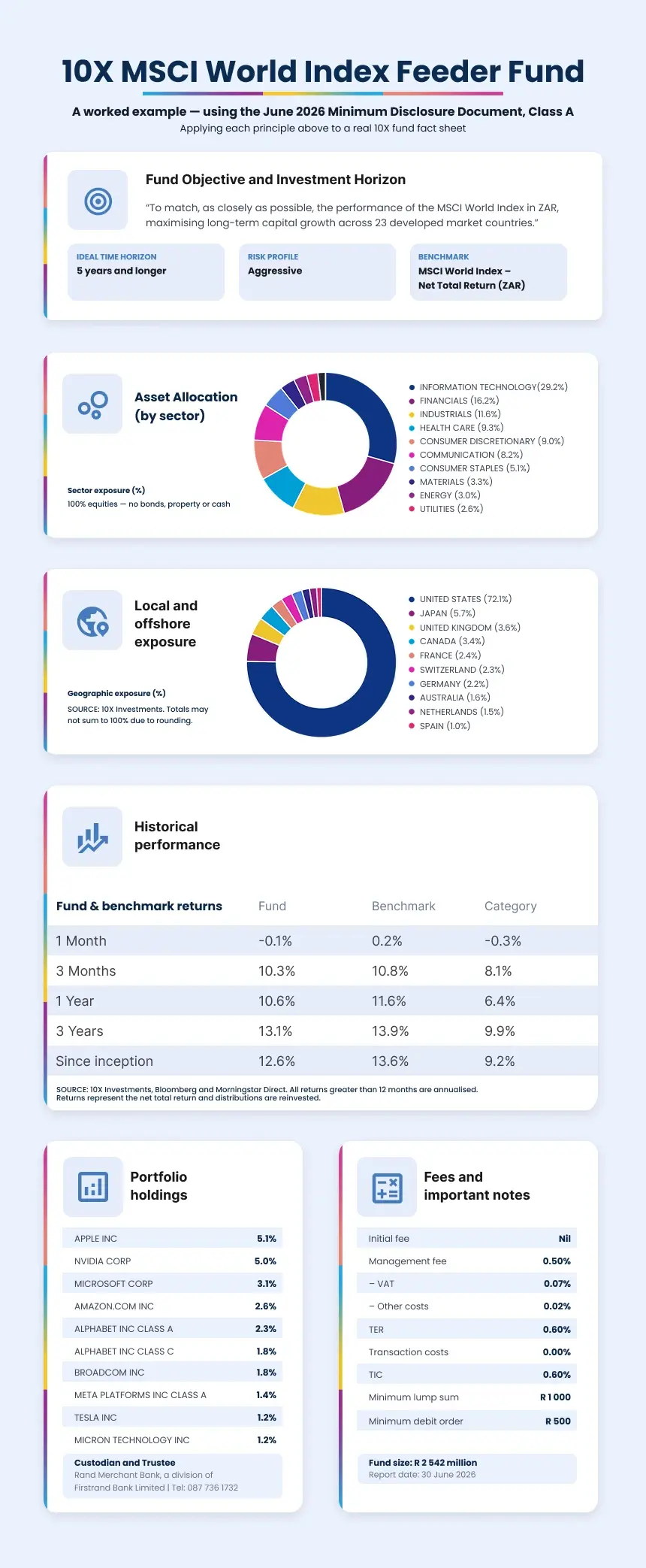
At 10X, living annuity investors can choose from a range of index-based, multi-asset and offshore funds. Each fund has its own mix of equities, property, bonds, cash and geographical exposure. Instead of choosing individual investments, the investor chooses a fund with an existing asset allocation aligned with their risk profile and retirement objectives. Let’s take a closer look at some of 10X’s living annuity fund options. View all of our funds here. See the graphics below highlighting how to read a fund fact sheet, as well as an example of an MDD.
10X Your Future Fund
The 10X Your Future Fund is our flagship offering. It is a diversified, multi-asset high-equity fund that invests across both local and international markets. The fund has a greater allocation to growth assets, such as equities and properties, while also including defensive assets for diversification.
The fund is best suited to investors with a higher tolerance for short-term volatility who want their living annuity capital to continue targeting long-term growth. The intended investment horizon is at least five years, and it may be appropriate for investors who expect their living annuity to remain invested for many years ahead.
The fund delivered a return of 8.6% over the past year, with annualised returns of 11.5% over three years and 11% over five years. Fund information is correct as of July 26th 2026.
10X Moderate Fund
The 10X Moderate Fund invests across local and international asset classes, holding a larger proportion of growth assets than defensive assets. The moderate fund’s equity exposure and expected volatility are lower than those of a high-equity portfolio.
The fund is best suited to investors who still need capital growth but are less comfortable with the level of volatility in a high-equity fund. The recommended investment horizon is three years or longer.
The fund delivered a return of 8.6% over the past year, with annualised returns of 11.4% over three years and 10.7% over five years. Fund information is correct as of July 26th 2026.
10X Defensive Fund
The 10X Defensive Fund holds a larger allocation to defensive assets, such as bonds and cash, than to growth assets like equities and property. The fund provides exposure to both local and offshore markets, but most of the fund is invested locally.
The fund is best suited to cautious investors seeking capital growth and income with a lower expected level of volatility. Investors with a shorter investment horizon or lower capacity to absorb market declines may also want to consider this fund. The recommended investment period is generally between one and three years or longer.
The fund delivered a return of 8.7% over the past year, with annualised returns of 11% over three years and 9.8% over five years. Fund information is correct as of July 26th 2026.
10X MSCI World Index Feeder Fund
The 10X MSCI World Index Feeder Fund is a 100% offshore equity fund that tracks the MSCI World Index. The fund provides exposure to large and medium-sized companies across 23 developed-market countries.
This option is best suited to aggressive investors who want long-term capital growth and full offshore exposure. Because the fund is invested entirely in global equities, it carries greater market and currency risk than a diversified multi-asset fund. The ideal investment horizon is five years or longer, and the fund is intended for investors who can tolerate significant short-term fluctuations.
The fund delivered a return of 8.7% over the past year, with annualised returns of 15% over three years and 13.6% over five years. Fund information is correct as of July 26th 2026.
Final thoughts on living annuities
Managing your living annuity as a retiree involves balancing current income needs with the sustainability of your capital and future income. Investment remains important during retirement and requires careful planning.
Key factors impacting your living annuity include drawdown rate, fees, asset allocation, and inflation. Regular annual reviews are essential to ensure your annuity aligns with your long-term financial goals. If you need guidance, feel free to contact our experienced 10X investment consultants who are ready to answer any queries you may have.
Related articles



How can we 10X Your Future?
Begin your journey to a secure future with 10X Investments. Explore our range of retirement products designed to help you grow your wealth and achieve financial success.