My dad’s pension was enough. Mine might not be.
10 September 2026
The Living Annuity Masterclass: How to maximise your retirement income


The views and opinions expressed in this article are those of the author and do not necessarily reflect the official policy or position of 10X Investments.

I’ve had some version of the same retirement conversation with my dad many times. My parents reached retirement with pensions they could depend on, and there was a reassuring simplicity to the way he could talk about it. Work for long enough, contribute along the way and, when the salary eventually stops, a pension takes its place.
It is tempting to use that experience as a benchmark for my own retirement. My dad managed, I’m saving and I still have plenty of working years ahead of me, so surely I should be broadly okay too. The problem is that many people my age are preparing for retirement under a very different system, where much more of the responsibility for making sure there is enough money at the end sits with us.
9 out of 10 people do better with 10X
The pension promise has changed
One of the biggest shifts has been from traditional defined-benefit pension schemes towards defined-contribution funds. The difference sounds technical, but it changes who carries much of the responsibility.
Under a defined-benefit arrangement, retirement income is generally linked to factors such as salary and years of service, with the employer carrying much of the funding risk. Under a defined-contribution arrangement, what you eventually retire with depends on how much was contributed, how long it remained invested, how those investments performed and what was paid in fees.
Recent reforms have made that responsibility even more visible. Since South Africa’s two-pot retirement system came into effect in September 2024, members have been able to access part of their retirement savings before retirement, while the rest remains preserved. National Treasury says the system is intended to provide some flexibility during financial distress without undermining long-term retirement savings.
The shows why that matters, with people over 50 who had a retirement plan, about 29% said it was probably or definitely not on track, while 72% of those whose plans were off track said they were unable to save enough. That makes the question less about what pension will arrive one day, and more about how much you are building, preserving and ultimately able to live on.
The uncomfortable truth about retirement in South Africa - Rands and Sense by 10X [video]
We sit down with 10X Investment Consultant lead Andre Tuck and discuss the retirement savings crisis in South Africa. We also delve into living annuities, retirement annuities, TFSAs and everything in between. Read more
![The uncomfortable truth about retirement in South Africa - Rands and Sense by 10X [video]](/_next/image?url=https%3A%2F%2Fimages.ctfassets.net%2Fyqvz0zwovkbq%2F5ipSTnRq5Dp25fyghm5kGQ%2F02c801c78d5e1ca9280bfd34d7602368%2FAndre_Tuck_podcast_cover_image__1_.webp&w=828&q=75)
What that responsibility looks like in rands
Consider someone who is 35 today, earns R60,000 a month and contributes R8,000 towards retirement every month. That can feel like a substantial commitment, particularly when a bond, children, school fees and everyday household costs are all competing for the same salary.
Assume, purely for illustration, that those contributions continue for 30 years and earn an average return of 5% a year above inflation after fees. By 65, the monthly contributions would have grown to roughly R6.7 million in today’s money. Increase the contribution to R12,000 and the figure becomes about R10 million, while R15,000 a month produces roughly R12.5 million.
These figures are illustrative and will vary depending on existing savings, future salary increases, changes in contributions and actual investment returns. What the numbers illustrate is how much responsibility is hidden inside a seemingly simple monthly contribution. Moving from R8,000 to R12,000 a month in this example adds roughly R3.3 million over 30 years.
There is also the income you expect that accumulated capital to replace. A current puts the commonly used South African replacement ratio at around 70% to 75% of pre-retirement income. For someone earning R60,000 a month immediately before retirement, 70% would mean targeting an income of about R42,000 a month.
Looking at retirement this way is very different from simply knowing that money disappears from your salary into a pension or retirement annuity every month.
Build the retirement of your dreams with our
Retirement Annuity calculatorMore control means paying more attention
There are advantages to the system many of us have inherited. Retirement savings are less dependent on remaining with one employer for most of a career, and we have more flexibility around where and how we save. That flexibility also places more responsibility on us to understand whether we are saving enough, how the money is invested and what we are paying in fees.
For men in their 30s, 40s and 50s, those decisions often arrive during the most expensive years of life. The same income that needs to fund retirement may also be covering a home, children and ageing parents, which makes it easy to postpone higher contributions until finances feel less stretched. In practice, those demands tend to change rather than disappear.
There is at least some help from the tax system. For the 2026/27 tax year, to be deducted within prescribed limits, generally up to 27.5% of remuneration or taxable income and subject to an annual cap of R430,000. That does not determine how much anyone should save, but it does provide an incentive to put more towards retirement where circumstances allow.
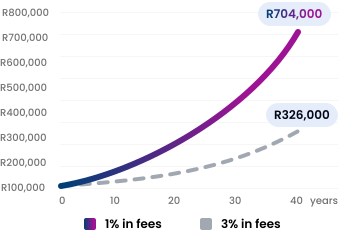
Higher fees very likely means lower returns (and here's the maths to prove it)
Paying high fees on your retirement investments (such as a retirement annuity or a living annuity) almost always means less money in your pocket, and less money for your retirement. Read more
Dad’s retirement is not my retirement plan
None of this means the previous generation had retirement easy, nor did everyone retire with a dependable pension. But for those of us whose parents did, their experience can create a reassuring but increasingly unreliable benchmark.
There is plenty I can learn from my dad about saving consistently throughout a working life. What I cannot assume is that because his pension was enough, mine will somehow take care of itself. The more useful comparison is between the retirement I want and the amount I am actually building towards it. For many of us, there is no predetermined pension waiting at the end of our careers. There is instead a pool of money that has to be built over decades, and whether it is enough will depend far more on the decisions we make before we get there.
Why I'm saving for my kids' university with a Unit Trust and not a Tax-Free Savings Account
A unit trust is more flexible than a tax-free savings account, and the tax burden might not be as bad as you think. Don't make the wrong choice when it comes to medium vs long term savings for your kids. Read more

Related articles


How can we 10X Your Future?
Begin your journey to a secure future with 10X Investments. Explore our range of retirement products designed to help you grow your wealth and achieve financial success.