Retirement annuity and a salary increase: Should you increase your contributions?
29 October 2026
An increase in salary presents you with a great opportunity to improve your potential retirement outcomes via your retirement annuity. It’s fairly common for people to use a salary increase to better their lifestyle, go on a trip, or purchase a particular item they have had their eye on. These are all considerations, but another option is to increase your RA contributions in order to potentially improve long-term retirement savings.
Even a small increase to your retirement annuity contributions can be effective in the long-term. In this article, we will have a look at some of the most important considerations to think about when it comes to increasing your RA contributions and the impact this could potentially have on your retirement savings in the long run.
We will focus on fees, asset allocation, RA contributions and tax benefits. We’ll also look at the benefits of 10X support and the importance of reviews in order to stay on track to meet your long-term retirement objectives.
Build the retirement of your dreams with our
Retirement Annuity calculatorHow a salary increase can benefit your retirement annuity
A retirement annuity is a long-term retirement savings vehicle allowing you to save for retirement while also offering you some strong tax benefits. You will also notice that all growth within your RA is exempt from tax, so you won’t need to pay interest, dividends or capital gains tax.
You can contribute to your RA via a regular monthly debit order or, if you prefer, ad hoc lump sum contributions. Debit orders can be amended in order to cater to any changes in your financial situation. They also allow you to stay disciplined in terms of your retirement savings with minimal effort.
A salary increase is generally a good time to consider increasing your contributions, as you can boost your savings without it affecting your existing lifestyle. Yearly bonuses can also be added to your RA, partially or fully. The goal is to find the right balance between living the lifestyle you want and maintaining a consistent and disciplined approach to retirement.
At retirement age (from age 55 in South Africa), you can move your RA across to an annuity, either a life annuity or living annuity. This annuity will then provide you with an income for your retirement years. Depending on the applicable retirement fund rules and Two-Pot components, you may also be able to take a portion of your savings as a cash lump sum.
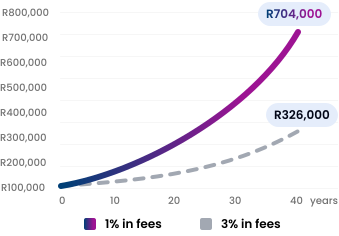
Higher fees very likely means lower returns (and here's the maths to prove it)
Paying high fees on your retirement investments (such as a retirement annuity or a living annuity) almost always means less money in your pocket, and less money for your retirement. Read more
Should you increase your RA contributions after a salary increase?
Increasing your RA contributions after an increase in your salary may be beneficial, but it is something that should first be carefully considered. You should carefully review your long-term financial goals and plan, as well as your current financial situation, before making any major decisions.
Ask yourself the following questions:
- What is your salary increase? How much will you have after tax?
- Do you have any pressing debt?
- Do you have any outstanding expenses?
- Do you have accessible savings available in case of an emergency?
- What are your current RA contributions?
- What are your investment timelines and how long do you have until your anticipated retirement date?
The answers to these questions can serve as a guideline. It is key to ensure that your RA contribution amount is sustainable over the long term, so that you can consistently contribute to your RA without any worry. An option, for example, could be to contribute a portion of your salary increase to your RA, instead of the entire increase amount. This can often make it more manageable.
How much of your salary increase should go towards retirement?
As mentioned above, an increase in salary doesn’t necessarily mean the whole increase needs to be added to your RA contributions. You’ll have to look at your existing circumstances to work out how much of your salary increase should ideally be used for your RA contributions. This will vary from person to person. It should preferably be an amount that is manageable and sustainable, so you can stay consistent with your contributions over time.
Always review your RA before deciding on how much you want to increase your RA contributions by. You would also want to assess your current income, expenses, your ideal retirement income and your long-term retirement goals and plan. If you are able to increase your RA contributions earlier on in your career, this can be more beneficial over time, as this will allow you more time to potentially grow and compound these retirement savings over time.
RA tax benefits when your salary increases
As mentioned, one of the main benefits of retirement annuities is the tax relief available. Current regulations allow you to deduct qualifying contributions to retirement annuities, pension funds and provident funds from your taxable income, subject to certain limits. For the 2026/27 tax year, the deduction is generally limited to 27.5% of the greater of your remuneration of taxable income, subject to an annual cap of R430,00 and other applicable restrictions. Increasing your RA contributions may therefore reduce your taxable income, depending on your circumstances.
It’s important to note that this 27.5% will apply to all of your retirement products. Increasing your RA contributions may mean that you are able to reduce your taxable income, although this should not be your primary goal when it comes to increasing your contributions.
The main focus should be on your long-term retirement savings goals and saving for your retirement years. As previously mentioned, your returns within your RA are tax-exempt during the accumulation period. This means that all returns earned are able to be reinvested without any tax deductions, which can result in more returns available to build and grow over the long-term.
How fees affect your additional retirement annuity contributions
Fees may reduce the returns that you have to reinvest and potentially compound and grow over time. Therefore, it’s important that you are aware of the fees that you are paying to ensure that these aren’t too high and don’t impact the returns that you have available to reinvest.
- Administration fees: Fees are charged for the admin tasks that are related to the fund. Some of the admin tasks will include: compliance, tax and reporting.
- Management fees: These are fees charged for the running and management of the fund.
- Advisor fees: These are fees charged by your advisor for their advice and services.
You should also understand the following terms when reviewing costs:
- TER (Total Expense Ratio): These are the ongoing expenses within an investment fund, calculated according to the applicable standard.
- TIC (Total Investment Charge): The total investment charge is the TER and transaction costs within the fund.
- EAC (Effective Annual Cost): This is an annualised estimate of the total costs.
The EAC was introduced by ASISA in 2015. It is an annualised estimate of the impact of product, investment management advice, administration fees, as well as any other applicable charges. Your EAC is shown as a percentage value. Depending on the product, this may include management fees, administration costs, advice fees, penalties, guarantees and more. Using the EAC value, you can compare the cost structures of different products and providers more easily and consistently.
Assuming all other factors are equal, a lower EAC may mean that a larger portion of your capital remains invested and available to potentially grow and compound over time. A higher EAC may mean less returns available to be reinvested to grow and build over time. Remember, costs shouldn’t be considered in isolation, as additional factors like risk, investment strategy, service and product features can also play an important role. Here is an example to help illustrate the effect of fees on your RA, when compounded over a 30 year time period. We will assume the following information for our example:
- Starting capital: R0
- Monthly contributions: R3,200 at the end of each month
- Investment period: 30 years
- Gross annual return: 10%
- No withdrawals are made during the investment period and contributions remain fixed
Scenario 1 - 1% fees: After 30 years, your retirement annuity will grow to an estimated value of R5.86 million.
Scenario 2 - 3% fees: After 30 years, your retirement annuity will grow to an estimated value of R3.90 million.
In the above example, a small difference in fees ends up leading to major differences in retirement outcomes, highlighting the importance of reviewing your RA fees.
This example highlights the effects of fees, but let’s also look at how increasing your monthly contributions can make a significant difference. Let’s consider an investor who receives a salary increase that provides an additional R3,000 in monthly take-home pay. They decide to allocate R1,000 of this increase towards their retirement annuity, increasing monthly contributions from R3,200 to R4,200.
Assuming the same 30-year investment period, a gross annual return of 10%, annual fees of 1% and monthly compounding, the investors RA can grow to approximately R7.69 million, compared to R5.86 million if they maintained the original contributions without increasing.
These example is for illustrative purposes only and real results may vary. You can learn more about fees from this article. We focus on keeping fees clear, simple and transparent at 10X. You are able to find out more on our RA fees on our RA product information page.
The importance of asset allocation
Asset allocation remains as important as always. It can be an important determinant in the growth of your RA, as the research from Brinson, Singer and Beebower highlights. As an investor, you always want to carefully consider your asset allocation, especially when it comes to increasing your RA contributions. This is the mix of different asset classes that your funds are invested in within the RA “wrapper”. This is usually a mix of equities, real estate, bonds and cash.
Equities are included to provide long-term capital growth in your portfolio and potentially inflation-beating returns. Equities offer both economic growth and exposure to companies, but there may also be market declines in the short term. They may be more suited for investors with longer time horizons and the ability to tolerate volatility, as values may fluctuate over shorter time periods.
Real estate contributes income through distributions and rentals whilst providing exposure to real assets and economic activity. It may also help with long-term growth in your portfolio. It is important to note that listed property can be volatile and may be affected by interest rates, economic conditions, occupancy levels and changes in the property market. Real estate may also provide a good hedge against inflation.
Bonds can be less volatile but they may still come with some risk. They will provide income, diversification, and a measure of stability within a portfolio. Values may be impacted by interest rate changes, inflation expectations and the ability of the issuer to repay its debt. They are more conservative but they may still provide some good returns.
Cash is usually the most liquid and stable of the asset classes. It is less likely to be as volatile as equities or real estate. Returns may not be able to keep up with inflation over the long term, which can impact purchasing power.
Retirement annuities are governed by the Pension Funds Act. This means that there is a limit placed on how much exposure you are permitted to both equities and offshore. Current regulations state that you are allowed a maximum of 75% exposure to equities and 45% offshore exposure. The reasoning behind Regulation 28 is to help investors to avoid poorly-diversified portfolios.
At 10X, we offer you a range of well-diversified funds that are also Regulation 28 compliant. Please visit our funds page to find out more on our funds on offer. H2: How to increase your retirement annuity contributions When it comes to increasing your RA contributions, consider the following:
- Always carefully calculate how much additional income you will now have after your salary increase and after taking tax into account.
- Review your current RA contributions and any other retirement savings that you are making.
- Decide whether you are going to do a regular debit order or if you would prefer to do a lump sum ad hoc contribution.
- Review your fund selection to check if this still aligns with your investor profile and long-term financial plan and goals.
- Always review your fees and make sure it is not unnecessarily reducing your potential long-term returns.
- Check the minimum contribution amounts with your service provider, if you are not sure.
At 10X, you are able to adjust your debit order contributions, as required and make additional contributions as and when money is available.
How 10X can support RA investors
10X is flexible when it comes to investors and supporting those who are looking to adjust and change debit orders as salary changes. You can expect fees kept simple, transparent and low. You will also have access to a range of well-diversified funds that include a mix of the different asset classes, so you can select a fund that aligns with your investor profile and long-term financial goals and plan. We follow an index-based investment strategy alongside a more active approach to asset allocation.
You can also use our free online tools found on our website. The retirement annuity calculator can help you do some planning with different contribution amounts to see the effect that these can have on your retirement outcomes, the EAC calculator allows you to compare costs with different providers whilst the Two-Pot calculator will help illustrate the effect of withdrawals from your savings pot on your retirement savings. Our investment consultants are also on call to assist you, should you need support when it comes to managing your RA or speaking through the available options.
Final thoughts on increasing your retirement annuity contributions
A salary increase may be a great time to increase your RA contributions. Before doing this, you would look to review your emergency savings, your debt, expenses, sustainability of increased contributions and your long-term retirement goals and plans.
Even a small increase in your regular contributions may have an impact on your retirement outcomes when these contributions are allowed to potentially compound and grow over time. It’s important to regularly review your RA to ensure that you are on track with your retirement plan and goals. If it has been a while since you have last looked at your RA, now is a good time to review it and make use of the retirement annuity calculator to help you make some informed decisions.
Get in touch with the 10X Investment Consultants today for any queries you may have surrounding your RA planning.
Related articles



How can we 10X Your Future?
Begin your journey to a secure future with 10X Investments. Explore our range of retirement products designed to help you grow your wealth and achieve financial success.