The high cost of your retirement annuity is buried in how it’s built
26 June 2026
The views and opinions expressed in this article are those of the author and do not necessarily reflect the official policy or position of 10X Investments.
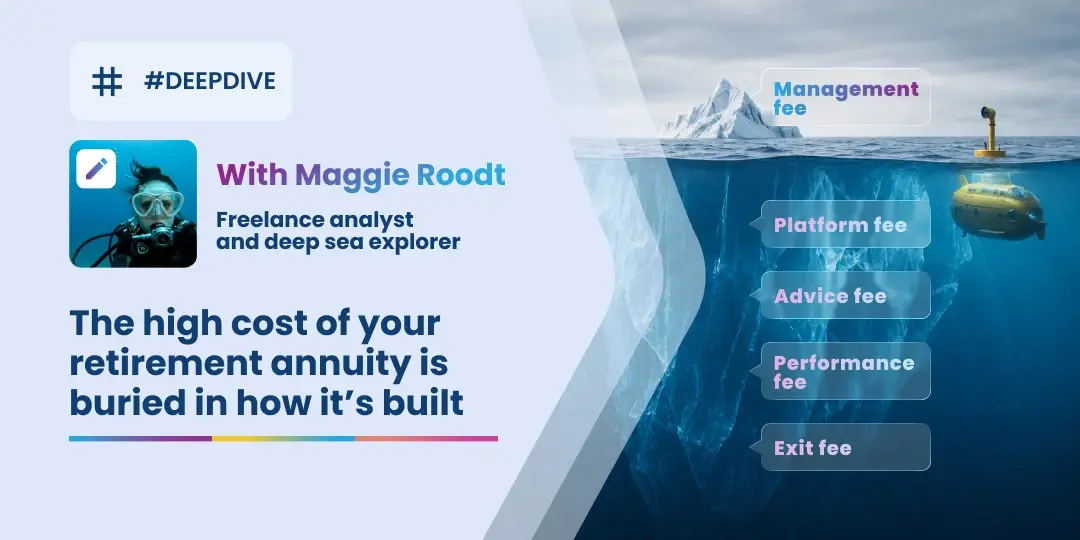
Ask any of South Africa's retirement product providers what their fees cost you, and the advertised answer is, in nearly every case, not much. The marketing language backs this up, but the reality underneath does not. The way these providers charge differs so substantially that two investors putting the same R500,000 into retirement annuities that look almost identical on a marketing page can retire with savings that differ by around R1.8 million.
More South Africans will be exposed to that gap this year. On 25 February 2026, Finance Minister Enoch Godongwana announced from the floor of parliament that the tax-deductible cap on retirement fund contributions would rise from R350,000 to R430,000. It was one line in a long speech, and the reaction was muted. An R80,000 expansion of the deductible window is not, on the surface, dramatic news.
But for South Africans with the income to use it, that line opens a wider door than it appears to. The new cap applies to the 2027 tax year, which began on 1 March 2026 and runs to 28 February 2027, giving contributors nine months of runway to plan rather than the familiar pre-deadline scramble. The 27.5% of taxable income ceiling still applies, and contributions above the cap roll forward to future tax years.
More deductible room means more capital exposed to fee structures, often for decades. The tax break on the way in is only as good as the fees that compound against it on the way through. And the architecture of the fees, not the percentages, is where the real difference sits.
This is the first piece in the Fee Architecture Series, a deep dive that goes past the marketing pages and headline percentages to set out how South African retirement providers actually charge, and what those charges cost over time. We begin where the demand is highest and the season is upon us: the retirement annuity.
Build the retirement of your dreams with our
Retirement Annuity calculatorMethodology
I asked five South African retirement annuity providers what they would charge me on a R500k retirement annuity investment. My questions covered fees in percentage and rand terms, the fee structure breakdown, minimum investment, advisor model, transfer process, and one-, three-, and five-year net returns of a recommended fund. Three of the five responded in writing within seven days, and a fourth supplied a personalised quotation the following week. The fifth did not respond to two written enquiries. The figures I’ve used for that provider throughout this piece are drawn from its own published cost profile rather than a personalised quote.
Retirement Annuity vs Tax-free Savings Account vs Bond: Where Should Your Extra Money Go?
Got extra money to invest? Compare three powerful options: Retirement Annuity, Tax-Free Savings Account (TFSA), or paying off your bond faster. Learn the pros and cons of each to make an informed choice for your financial future. Read more

The focus on fees is deliberate. Returns are uncertain. Market conditions are uncertain. An investor's own circumstances over the next thirty years are uncertain. Fees, once locked in, are not. They arrive every year, on time, in proportion to the portfolio's value. Over a long enough horizon, the fee structure plays a huge part in determining investment outcomes. Small differences become big piles of money.
This is only a measurement and not a recommendation. The cheapest fee structure is not, on its own, the right choice for every investor, and circumstances matter. The figures that follow reflect each provider's standard quoted offering. Some providers also operate alternative direct platforms with different fee structures, and a flat monthly subscription model has emerged on a smaller scale in the SA market more recently. What the measurement showed was five distinct fee architectures: five different ways of charging for the same product.
A note on the headline figures that follow: they are not measured on a like-for-like basis, because the providers themselves do not disclose on a like-for-like basis. Some headline rates fold in the cost of the underlying fund; others leave it out. Some include trading costs; others charge them separately. That inconsistency is not a flaw in the comparison. It is the finding. Where a figure is incomplete, we specify what it leaves out.
The smart parent's secret to building wealth for their children
Every parent wants to leave a legacy for their children. But did you know you could do that with a retirement annuity (RA)? Read more

Five ways to pay for the same thing
The five providers in this comparison were each asked to identify a high-equity multi-asset fund inside their retirement annuity and supply the total annual fees on R500,000 invested in it. The structures they came back with did not look alike. What follows is the same product priced five different ways.
- The layered fee Two components, stacked: a 0.40% administration fee plus a 0.40% fund management fee, both including VAT. On R500,000, that comes to R4,373 in the first year. A low headline, though not the lowest in the group. The structure is clean once you see it. The catch is that the direct route, the one without an external advisor's fee added on top, is not what most prospective investors find first.
- The performance-linked active fee A management fee that moves with the fund's performance. In a typical year, the total expense ratio (or what the investment manager charges to cover operational, management and administrative costs) is 1.69%, roughly 1.00% base fee plus a performance component that adjusts according to how the fund has done against its benchmark. On R500,000, that totals approximately R8,450 in Year 1, though the performance fee will vary year to year. The figure above is the fund's total expense ratio; once separately disclosed trading costs are added, the all-in figure is marginally higher again. In strong years, investors pay more; in weak years, they pay less. The fee is built into the unit price of the fund, not charged separately.
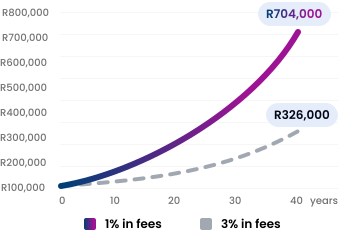
Higher fees very likely means lower returns (and here's the maths to prove it)
Paying high fees on your retirement investments (such as a retirement annuity or a living annuity) almost always means less money in your pocket, and less money for your retirement. Read more
- The transaction-based platform fee The lowest headline figure in the group at 0.55%, comprising a 0.30% administration fee plus a 0.25% platform fee. On R500,000, that totals R2,750 in Year 1 as a base. The number is the cheapest in the comparison, but it is also the most incomplete. Per-transaction brokerage is charged separately. The underlying fund's TER (total expense ratio) sits outside the platform fee entirely. And the investor, not the provider, selects the funds. The platform supplies access; the investment thesis is the investor's own.
- The advice-led upfront fee A 2.88% advice fee, charged once at the point of investment, before any ongoing fee structure begins. On R500,000, that comes to R14,400 paid upfront and deducted before the capital is invested. After that, an ongoing administration fee of 0.52% applies, and if the investor elects to keep the advisor relationship in place, a further 0.86% per year for ongoing advice. Year 1 total: roughly R17,000, mostly accounted for by the upfront figure. Advice, in this model, is treated as central to the product rather than optional.
- The single all-in fee One number, charged annually on the portfolio value. At 10X, that figure is 1.04% including VAT for a retirement annuity on the first R1 million, reducing as the portfolio grows. On R500,000, that totals R5,200 in Year 1. Trading costs, which apply across every fund regardless of provider, are disclosed separately at 0.12% to 0.18% per year. There is no performance fee, no advice fee, and no separate platform charge.
In summary, it’s the same R500,000 in the same product, with year 1 costs ranging from R2,750 to R17,000, which is a sixfold spread.
The headline isn't the bill
The five figures above are headline numbers. What they include, and what they leave out, is not consistent. Performance fees can sit inside the unit price of a fund and never appear in the advertised charge. Trading costs are disclosed separately by some providers, absorbed into the headline by others, and not specified at all by a third. Per-transaction brokerage is part of the price for some structures and outside it for others. The same percentage, from two providers, can mean two different bills.
This is exactly what ASISA's Effective Annual Cost standard was built for. A decade after EAC came into force in 2016, it is still rarely the figure a prospective investor sees first. An investor would need a reliable EAC calculator to run their own numbers against the standard.
Compare your retirement investments
Effective annual cost calculatorThe 30-year projection
What an RA costs in one year is not what it costs over a lifetime. Across a thirty-year retirement horizon, small Year 1 gaps become very large ones.
The benchmark: R500,000 invested in a high-equity multi-asset retirement annuity, returning 10% gross annually for thirty years, with no further contributions and fees deducted yearly. Same starting capital, same return, same horizon. Across the five architectures, the bill over thirty years ranges from R694,000 to over R1.1 million.
| Fee Structure | Headline fee | Year 1 cost | Total fees, 30 yrs | Final portfolio value |
|---|---|---|---|---|
Layered | 0.81% | R4,373 | R694,000 | R6,592,000 |
Transaction-based platform | 0.55% | R2,750 | R766,000 | R6,343,000 |
Single all-in | 1.04% | R5,200 | R842,000 | R6,092,000 |
Performance-linked active | 1.69% | R8,450 | R1,110,000 | R5,122,000 |
Advice-led (with ongoing advisor) | 2.88% + 0.86% | R17,000 | R1,138,000 | R4,795,000 |
Three observations from the projection:
- The architecture alone accounts for R1.8 million. The cheapest structure leaves R6.6 million in the portfolio at year thirty; the most expensive leaves R4.8 million.
- The lowest Year 1 fee does not produce the lowest 30-year cost. The transaction-based platform, cheapest at R2,750 in Year 1, finishes mid-table on total fees, because per-transaction costs and the underlying fund's TER continue to compound outside its headline rate.
- The largest visible charge does not do most of the damage. The R14,400 upfront fee in the advice-led model, dramatic as it appears, is dwarfed over thirty years by the recurring 0.86% ongoing advisor fee that follows it.
The principle behind the projection is settled. John Bogle's Cost Matters Hypothesis in the Financial Analysts Journal frames the math: gross returns in financial markets minus the costs of intermediation equal the net returns delivered to investors. Morningstar's Predictive Power of Fees analysed thousands of funds and found expense ratios to be among the most reliable predictors of fund returns.
Over thirty years, architecture beats percentage. Our retirement annuity calculator lets investors model their own contribution patterns and time horizons against the same compounding logic.
The uncomfortable truth about retirement in South Africa - Rands and Sense by 10X [video]
We sit down with 10X Investment Consultant lead Andre Tuck and discuss the retirement savings crisis in South Africa. We also delve into living annuities, retirement annuities, TFSAs and everything in between. Read more
![The uncomfortable truth about retirement in South Africa - Rands and Sense by 10X [video]](/_next/image?url=https%3A%2F%2Fimages.ctfassets.net%2Fyqvz0zwovkbq%2F5ipSTnRq5Dp25fyghm5kGQ%2F02c801c78d5e1ca9280bfd34d7602368%2FAndre_Tuck_podcast_cover_image__1_.webp&w=828&q=75)
A closer look at fee architecture
The 30-year projection on a R500,000 investment makes the point clearly. Fee architecture, not the headline percentage, decides what an investor keeps.
The rest of this series takes a deep dive into each one in turn: the advice-led model, the performance-linked active fee, the layered fee, and the self-directed platform. For each, we look at how the fees are constructed, what the recommended fund has returned net of those fees, what investors have experienced, and who the model is built for. Next is the advice-led model: what R14,400 upfront actually buys, and what advice costs across thirty years.
Related articles


How can we 10X Your Future?
Begin your journey to a secure future with 10X Investments. Explore our range of retirement products designed to help you grow your wealth and achieve financial success.