The power of patience in preservation fund investing
8 June 2026
Switching jobs? The maths shows that preserving your pension is much smarter
Thinking about cashing out your pension when you move jobs? The maths shows that preserving your retirement savings is much smarter. Read more

As an investor, it is easy to feel pressured to act swiftly with your preservation fund, especially during periods of political uncertainty or market volatility. However, the best course of action for your long-term investing is to rely on patience, consistency and discipline while taking a long-horizon view.
A preservation fund is a long-term investment vehicle that may benefit most from a patient, long-term approach to investing, which includes avoiding emotional decision-making and reacting to any short-term market noise. In this article, we will take a closer look at the importance of patience when investing in your preservation fund.
See your pension savings grow with our
Preservation Fund calculatorWhat is a preservation fund?
A preservation fund is a long-term investment vehicle that allows you to continue to preserve your savings from your employer-sponsored pension or provident fund when changing roles. This can be done without causing a tax event, meaning that the transfer will not require any tax to be paid.
The growth within your preservation fund “wrapper” is tax-free, allowing more of your returns to be reinvested and to continue growing and compounding over time, potentially resulting in greater capital accumulation. When you do the paperwork, you will need to ensure that your provident fund is transferred to a provident preservation fund and your pension fund is transferred to a pension preservation fund.
From age 55, your preservation fund may be moved across to a life or living annuity. This will then provide you with an income for your retirement.
Why patience matters in long-term investing
Throughout your investment journey, you can expect to encounter various market cycles and periods of volatility. There will inevitably be periods of short-term market volatility when you may experience some loss of capital, but this usually recovers fairly quickly. Your focus should always be on your financial plan and investment goals.
It’s important that your capital remains invested to take advantage of compound growth over time. Emotional decision-making or reacting emotionally in times of volatility may be detrimental to the long-term growth and outcomes of your fund. Instead, taking a more patient and disciplined approach will help you stay focused on your long-term goals.
Patience is especially important when investing for retirement, as meaningful growth often takes place over many years rather than months. Those who remain committed to the end goal are generally better positioned to benefit from the effects of potential compound growth and the recovery that often follows periods of market weakness.
It may be tempting to react to short-term events or negative market sentiment, but keeping a disciplined approach and trusting the investment process can help improve long-term outcomes.
The role of asset allocation in patient investing
Your choice of asset allocation can play a major role in the performance of your preservation fund over time. Preservation funds aren’t able to receive further contributions, which means that your asset allocation is even more important for pursuing growth in your preservation fund. In fact, asset allocation plays the biggest role in the performance of your preservation fund, accounting for over 90% of returns, as seminal research from Brinson, Singer and Beebower shows.
At 10X, you can adjust your underlying portfolio by choosing from a selection of carefully curated funds, each with a different mix of the different asset classes, namely equities, real estate, bonds and cash. Each fund is geared towards different investor profiles.
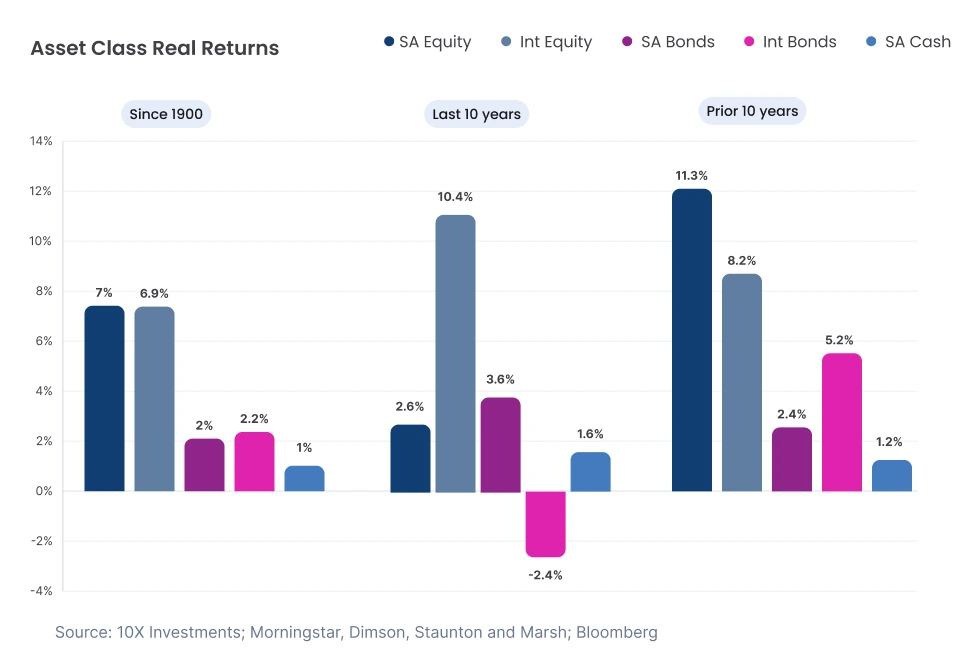
Equities are the most volatile of the asset classes, but they are also likely to generate the best returns over time. As data suggests, equities have historically produced returns above inflation by around 7% annually, over the long term (based on JSE All Share Index performance versus CPI from 1960-2020), although past performance does not guarantee future results.
Real estate can generate some strong returns as well as be a good hedge against inflation. Bonds are likely to generate some lower returns while also adding stability to your portfolio. This doesn’t mean that bonds will never outperform expectations; it just means they are seen as a more conservative option. Cash is the most stable, but it is also likely to generate the lowest returns of all the asset classes.
It’s important to align your portfolio selection with your long-term financial goals as well as your investor profile. Your investor profile considers your investment timelines and your risk tolerance levels. Your risk tolerance levels look at your appetite for risk, i.e. how comfortable you are with short-term market volatility.
Including growth assets, like equities, in your portfolio is generally considered an important part of a long-term investment strategy, as they have historically provided strong long-term growth potential. If your portfolio is too heavily invested in cash, this may mean that your portfolio struggles to generate sufficient growth over time, especially when we take inflation into account.
You may also like to include some offshore exposure in your portfolio. Offshore investments can provide access to a broader range of markets, industries and companies, while serving as a hedge against local market volatility and depreciation of the Rand. A well-diversified portfolio will allow you to balance the risk and return in your portfolio while supporting long-term goals.
Preservation funds are subject to Regulation 28 of the Pension Funds Act, which places a limit on the percentage of both equities and offshore assets that you may be invested in. Current regulations state that you may invest a maximum of 75% in equities and a maximum of 45% in offshore assets. These limits are in place to help promote diversification and manage risk while still giving investors meaningful exposure to growth assets that may support long-term growth.
At 10X, we offer you a well-diversified range of funds that includes both local and offshore assets. Please visit our funds page for the most up-to-date fund information.
Why fees matter over time
High fees, when compounded over time, may impact the growth of your capital. If your fees are lower, this may mean that there are more returns available to reinvest and compound, allowing for more potential growth of your capital.
Let’s look at an example to help illustrate the impact of fees. We will assume the following information for our example:
- Investment period of 30 years
- Investment of R150,000
- Return of 12% per annum
- An inflation rate of 6%
Example 1 (1% Fees): Real investment value is approximately R598,000.
Example 2 (3% Fees): Real investment value is approximately R347,000.
Switching jobs? The maths shows that preserving your pension is much smarter
Thinking about cashing out your pension when you move jobs? The maths shows that preserving your retirement savings is much smarter. Read more
A 2% difference in fees can have a potential impact on the investment value of your preservation fund. This is especially evident when fees are compounded over time. This example is for illustrative purposes only, and actual results may vary. You can find more information on how fees impact final investment value here. There are a few fees that you may see deducted. Let’s have a look at some of these:
- Advisor fees: If you make use of an advisor, they will charge fees for any advice, services or other work that they do for you. There may be both an initial and an ongoing fee charged.
- Management fees: There may be a fee charged for the running and management of the fund.
- Administration fees: There will be administration fees for admin-related tasks. These will be tasks such as reporting, compliance, and tax.
The Effective Annual Cost (EAC) is a standardised metric. It was introduced by ASISA in 2015. It will show you the total fees and costs associated with an investment product over a one-year period. You can use this to compare and evaluate different service providers. All factors being equal, you may find that a higher EAC means that there are fewer returns to be reinvested and allowed to compound over time. A lower EAC may result in more returns being available for reinvestment and compounding over the long term. The EAC of your investment would be just one factor to consider when evaluating service providers. Our fees are kept low and transparent at 10X. You can expect fees of 1% or less on our retirement products. This will depend on the amount invested and the product selected. Please explore our products for the most up-to-date fee information.
How simplicity can support patience
You may find that greater complexity in your investing can lead to emotional decision-making and knee-jerk reactions. It may be beneficial to keep your strategy simpler, which could allow for a patient, long-term approach that involves fewer changes to your preservation fund. An index-tracking investment strategy mirrors a benchmark index, such as the S&P 500, to seek returns similar to those of that index. This approach focuses on simplicity and consistent long-term returns. There may be fewer costs involved as there won’t be activities such as research, analysis or trading involved. This may then mean lower fees for you, as the investor.
An active investment strategy is one where you have a manager who is actively involved in looking for the stocks that will give the best returns. Along with this kind of approach, there will be activities, such as research, analysis and buying and selling, which may mean higher costs - and these costs are inevitably passed on to the investor. This approach may not always work as intended, either, as data from the SPIVA Scorecards suggest.
The S&P Indices Versus Active (SPIVA) Scorecards track the performance of actively managed funds against their benchmarks globally. According to the latest SPIVA South Africa Scorecard (as of June 2025), 67.61% of South African actively managed equity funds underperformed the S&P South Africa DSW Capped Index over the ten-year period ending June 30, 2025.
The Two Pot Retirement System
The Two-Pot Retirement System was implemented by the South African National Treasury in September 2024. This new system has changed how withdrawals from and contributions to retirement vehicles are treated. Contributions to retirement products are now split between two pots. One-third of contributions will go to the savings pot and two-thirds to the retirement pot. There may also be a ‘vested’ component. This portion covers all savings invested before the Two-Pot System takes effect and remains governed by the old rules.
Keep in mind, however, that preservation funds do not allow for new contributions, so the contribution split won’t apply in the same way that it does for products like retirement annuities or pension funds. The savings component of the preservation fund will grow at the same rate as the total fund, though. If the total fund doubles, both the savings pot and the vested pot will also double.
Withdrawals are allowed from the savings pot in accordance with the stipulated rules. You may withdraw once a year from your savings pot for a minimum withdrawal amount of R2,000. You will be taxed at your marginal tax rate, and an administrative fee will also be deducted. Generally, it’s best to leave your savings invested in order to properly benefit from potential compound growth. Staying patient and allowing your savings to grow can lead to much stronger retirement outcomes. Please consult the latest FSCA guidance on the Two-Pot Retirement System.
Practical ways to stay patient with your preservation fund
There are a few practical steps you can take to help you remain patient with your preservation fund.
- Keep your focus on your long-term goals and financial plan.
- Avoid being distracted by any short-term market noise or volatility which may occur.
- Ensure your asset allocation is appropriate and well-aligned with your investor profile and financial goals.
- Make sure that your fees are kept low.
- Review your preservation fund each year and refrain from reviewing it too often.
- Keep your savings invested and avoid withdrawing cash.
A patient and consistent approach to investing can pay off in the long term. While market volatility and uncertainty are, of course, inevitable, reacting emotionally to short-term market events can disrupt your long-term retirement goals. Staying focused on your retirement objectives, keeping an appropriate asset allocation, and allowing your capital time to potentially grow and compound is generally the best way to improve your long-term preservation fund outcomes. H2: How 10X supports patient long-term investing At 10X, we like to support a patient, long-term investment approach that is consistent and disciplined. Here are a few ways in which we help to do this:
- We offer a diversified range of funds, allowing you to choose a fund that best suits your needs and investor profile.
- Our fees are low, simple and transparent, allowing for more of your returns to be reinvested and potentially to compound over time.
- We use an index-tracking investment approach alongside a more active approach to asset allocation, which means we are able to keep fees lower.
- Our investment strategy is focused on long-term investment outcomes.
- Simplicity, consistency and discipline are key to our investment strategy.
Final thoughts on preservation fund patience
A preservation fund is a long-term investment that can benefit from a patient, consistent approach that is not over-complicated. A focus on the long term may help to reduce emotional decision-making, which can affect your preservation fund outcomes.
Generally, your savings should be kept invested to grow and compound over time, while you focus on low fees, a diversified portfolio, and a patient approach to investing. 10X can help set you up for retirement success, so don’t hesitate to get in touch with our experienced investment consultants, who are just a phone call away!
Related articles

How can we 10X Your Future?
Begin your journey to a secure future with 10X Investments. Explore our range of retirement products designed to help you grow your wealth and achieve financial success.