What role does a preservation fund play in your retirement plan in South Africa?
12 October 2026
The Living Annuity Masterclass: How to maximise your retirement income


- A preservation fund can help South Africans preserve and potentially grow retirement savings after changing jobs, while avoiding immediate taxation when the transfer is done properly.
- Cashing out early can reduce long-term retirement outcomes, as investors may lose the future compound growth that withdrawn capital could have earned over time.
- Asset allocation, fees and long-term planning all play an important role in how a preservation fund contributes to retirement income, especially when used alongside products like a life annuity or living annuity.
Many South Africans worry about whether they will have enough money to retire comfortably, and it’s important to consider how a preservation fund can help. This long-term retirement savings vehicle allows you to continue saving and growing your capital when you change jobs. You may also have the option to withdraw money, which can make the decision difficult. Investors may find themselves weighing a short-term purchase against long-term capital preservation. In this article, we’ll explore the role a preservation fund can play in your retirement outcomes and the factors that can affect its growth potential.
See your pension savings grow with our
Preservation Fund calculatorWhat is a preservation fund and how does it fit in?
A preservation fund is a savings product that allows investors to continue growing their hard-earned savings previously held in an employer-sponsored provident or pension fund. You can transfer capital from either fund without triggering a tax event, and growth within the is also tax-free. This could help your fund grow over the long term. However, you’ll need to transfer your pension fund to a pension preservation fund and your provident fund to a provident preservation fund. Preservation funds don’t allow new contributions; their focus is on preserving and potentially growing what you’ve already invested.
Savvy RA investors let SARS fund their Tax-Free Savings Account (or their kid's one)
Being responsible with your retirement annuity (RA) could mean you get a maxed out tax-free savings account for free. Here's how. Read more

Preservation funds and the Two-Pot Retirement System
The Two-Pot Retirement System, introduced on 1 September 2024, divides retirement savings into components with different access rules. New contributions are generally allocated one-third to a savings pot and two-thirds to a retirement pot. Although preservation funds don’t allow for new contributions, existing fund savings may still be split into the applicable Two-Pot components, depending on the fund rules and the member’s savings. Any pre-reform savings remain in a vested component, subject to the rules that were in place before the new system was introduced.
- Savings Component: The savings component is made to give investors limited access before retirement. A withdrawal is generally allowed once per tax year, subject to a minimum amount of R2,000, marginal income tax and the fund’s administration charge. Capital that is not withdrawn will remain invested.
- Retirement Component: The retirement component is intended to remain preserved until retirement and generally must be used to provide retirement income, subject to the applicable retirement rules.
- Vested Component: The vested component holds pre-1 September 2024 savings and preserves the rights attached to those amounts.
Please consult the latest FSCA guidance on the Two-Pot Retirement System.
What does “retiring comfortably” mean?
“Retiring comfortably” may mean different things to different people. For some, it may mean covering the basics, while for others it may include maintaining a certain standard of living, which could include being able to travel or go on holidays abroad. Some key considerations when it comes to your retirement years would be: how much income you anticipate needing, how long you will need your retirement income to last, and how inflation will impact your retirement income. Many South African investors don’t realise how much money they may require for retirement, and they may also underestimate how long retirement may last.
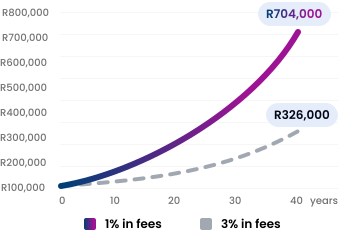
Higher fees very likely means lower returns (and here's the maths to prove it)
Paying high fees on your retirement investments (such as a retirement annuity or a living annuity) almost always means less money in your pocket, and less money for your retirement. Read more
The biggest risk: Cashing out early
Many people will withdraw a cash lump sum when they change jobs, instead of preserving the money in a preservation fund. Deciding to withdraw cash, instead of investing all the available capital in a preservation fund, may impact your retirement income, as you might lose out on this potential compounding growth opportunity. The visible cost of an early withdrawal is the tax deducted. The less visible cost is the future return that the withdrawn capital no longer has the opportunity to earn. As such, there is lost growth potential that an investor may suffer from. Early withdrawals from a your fund are taxed according to the retirement lump sum withdrawal tax table, as seen below.
| Taxable income (R) | Rate of tax |
|---|---|
1 – 27 500 | 0% of taxable income |
27 501 – 726 000 | 18% of taxable income above 27 500 |
726 001 – 1 089 000 | 125 730 + 27% of taxable income above 726 000 |
1 089 001 and above | 223 740 + 36% of taxable income above 1 089 000 |
Asset allocation inside a preservation fund
Your asset allocation is a vital component of your preservation fund. Asset allocation plays a major role in the performance of retirement products, as seminal research from Brinson, Singer and Beebower shows. Careful thought should be given to the mix of different assets that your savings are invested in. This will usually be selected from equities, real estate, bonds and cash. Your asset allocation should be well-aligned with your risk tolerance and investment timelines. Together, these make up your investor profile. You should also always consider your long-term financial plan and goals when structuring your asset allocation.
A well-diversified portfolio, spread across different asset classes, may help you balance risk and return in your portfolio. As an investor with 10X, you do not need to choose individual shares, bonds or properties. Instead, you may select from a range of diversified 10X investment funds. Each fund has a predetermined mix of asset classes and is designed for a specific type of investor, risk profile and investment horizon. You may choose the fund that most closely aligns with your financial goals, time horizon and risk tolerance.
Equities are typically included in a portfolio to provide long-term capital growth and the potential for returns above inflation. They give investors exposure to companies and economic growth, but they can also experience significant market declines. Their value may fluctuate considerably over shorter periods, making them generally more appropriate for investors with longer time horizons and the ability to tolerate volatility.
Bonds can provide income, diversification, and a measure of stability within a portfolio. They are usually less volatile than equities, but they are not risk-free. Bond values can be affected by changes in interest rates, inflation expectations, and the issuer’s ability to repay its debt. While they’re seen as more conservative, they can still outperform expectations.
Real estate provides exposure to real assets and economic activity while generating income through rents and distributions. It may contribute to long-term portfolio growth. However, listed property can be volatile and may be affected by interest rates, economic conditions, occupancy levels and changes in the property market. Real estate often serves as a good hedge against inflation.
Cash is generally regarded as the most liquid and stable of the asset classes. It is less likely to experience the same levels of volatility as equities or real estate. However, cash returns may struggle to keep pace with inflation over long periods, which can erode purchasing power.
Offshore assets provide investors with exposure to a broader range of industries, businesses, currencies and economies outside of South Africa. This can improve diversification and reduce reliance on the local market's performance. Offshore investing also introduces additional risks such as currency fluctuations, changes in global markets, geopolitical events and different regulatory or tax considerations.
Fees: The hidden impact on your retirement outcome
Fees may impact the growth of your fund, and ultimately your retirement outcomes. Higher fees may result in fewer returns available for reinvestment and potential long-term growth. Lower fees may mean that there are more returns available to build and grow your portfolio over time. There are a few fees which you can expect to see deducted. These are as follows:
- Management fees: These are the fees charged for the running of the fund.
- Advisor fees: You may see that your advisor charges an initial and ongoing fee. These are the fees charged for the advice and other services they provide you with.
- Administration fees: These are the fees charged for tasks that relate to the administration of the fund. For example, compliance, tax and reporting activities.
There are also a few key terms you’ll need to understand when looking at fees:
- TER (Total Expense Ratio): Ongoing expenses within an investment fund, calculated according to the applicable standard. (A way to compare the operating costs of similar funds, but it is not the final cost)
- TIC (Total Investment Charge): The total investment charge, which combines the TER with transaction costs within the fund. (A way to compare the full cost of the investment portfolio itself)
- EAC (Effective Annual Cost): An annualised estimate of the impact of product, investment management advice, administration fees, and all other applicable charges.
Let’s look at an example to illustrate the impact of fees. We will assume the following information:
- Starting capital: R500,000
- Investment period: 20 years
- Gross annual return: 10%
- No withdrawals
Scenario 1 - 1% fees: The fund would grow to a value of approximately R2.80 million after 20 years.
Scenario 2 - 3% fees: The fund would grow to a value of approximately R1.93 million after 20 years.
As no further contributions can be made to the preservation fund, the effect of fees on the existing capital and its potential compound growth is particularly important. A fee difference of just 2% can significantly impact the investment value of your fund. This example is for illustrative purposes only, and actual results may vary. You can learn more about fees in this fee maths article.
The Effective Annual Cost gives investors a standardised way to understand the total cost of holding an investment over time. Introduced by ASISA, the EAC brings together the charges associated with an investment into a single annual percentage. Depending on the product, these may include investment management fees, administration costs, advice fees, penalties, guarantees and the impact of loyalty bonuses. This makes it easier for investors to compare the cost structures of different products and providers consistently.
At 10X, we are careful to keep our fees on the low side of the spectrum, allowing more of your returns to be reinvested and potentially grow over time. You can expect to see fees of 1% or less charged for retirement products. This will depend on the amount invested and the product chosen. Explore our products for up-to-date fee information.
How preservation funds contribute to retirement income
At retirement age, which is from age 55 in South Africa, you are able to use your retirement savings for an annuity. You may select either a life annuity or a living annuity. A life annuity is purchased from an insurance company. It guarantees you an income for your retirement years. You are able to select your payout when you purchase your life annuity, and this is generally not flexible once the product is in place. There is no longevity risk with a life annuity as any risk lies with the provider.
A living annuity is a flexible post-retirement product that allows you to select both your drawdown rate and the underlying funds that you invest in. These can both be amended to cater to changing needs over time. Your living annuity needs to be carefully managed, as the responsibility lies with you as the investor to ensure that the living annuity is able to provide you with an income for your retirement years.
Is a preservation fund enough on its own?
A preservation fund can be a key part of your retirement plan, but you will most likely need to include other products along with it, such as a retirement annuity, TFSA and others, as it may not be enough on its own. Preservation funds don’t allow for any further contributions, so you would aim to maximise growth within the fund by focusing on strategic fund selection and low fees, whilst keeping in mind the effects of inflation risk and always focusing on your long-term investment plan and goals. The 10X Preservation Fund is a great choice for investors, offering low fees, a straightforward investment approach and diversified fund options.
How to maximise your chances of retiring comfortably
Let’s have a look at a few practical steps that you can take to help improve your retirement outcomes. Keep in mind that while there are no guarantees, these steps may be able to lead to more positive outcomes.
- Make use of a preservation fund when changing roles.
- Avoid any cash withdrawals, if possible.
- Be strategic when it comes to your asset allocation, ensuring you include some equities and align with your investor profile and long-term investment plan.
- Review fees regularly and ensure that these are kept low.
- Make use of other retirement savings products along with your preservation fund for a more complete offering.
- Review your fund annually to ensure it is still well-aligned with your goals and broader financial plan.
A disciplined and consistent approach to investing can help to improve your overall retirement outcomes in the long term.
Final thoughts on preservation funds
A preservation fund can play an important role in your overall retirement plan, but it often needs to be coupled with other retirement products to get the best results for your retirement years. Your preservation fund should be strategically managed to deliver the best long-term results, with a primary focus on a well-planned asset allocation and low fees. If you need help with managing your preservation fund, get in touch with the experienced and helpful 10X investment consultants today!
Related articles


How can we 10X Your Future?
Begin your journey to a secure future with 10X Investments. Explore our range of retirement products designed to help you grow your wealth and achieve financial success.