Four things to do immediately in 2026 (that your retired self will thank you for)
9 December 2025
The uncomfortable truth about retirement in South Africa - Rands and Sense by 10X [video]
We sit down with 10X Investment Consultant lead Andre Tuck and discuss the retirement savings crisis in South Africa. We also delve into living annuities, retirement annuities, TFSAs and everything in between. Read more
![The uncomfortable truth about retirement in South Africa - Rands and Sense by 10X [video]](/_next/image?url=https%3A%2F%2Fimages.ctfassets.net%2Fyqvz0zwovkbq%2F5ipSTnRq5Dp25fyghm5kGQ%2F02c801c78d5e1ca9280bfd34d7602368%2FAndre_Tuck_podcast_cover_image__1_.webp&w=828&q=75)
It's 2026. You're roughly 15 years from retirement, give or take. Close your eyes and picture yourself at 67. What does a good month look like?
Are you relaxing with your grandkids, comfortable and independent, or are you counting Rands and clipping digital coupons? The good news is you can make the difference between being able to help with a grandchild's education and depending on your kids for support right now.
Because the difference between those two futures isn't luck. It's what you do in the next few months.
Here's the uncomfortable truth: you can't change what you did (or didn't do) in the past. Those years are gone. But right now is your best chance to fix what needs fixing. No none likes to tell themselves this as they look in the mirror, but the longer you wait, the harder it becomes to close the gap. Every year of delay means you need bigger contributions and bigger sacrifices, just to break even.
This isn't about New Year's resolutions or vague intentions to "save more." This is about four concrete actions that will compound into your future. Actions that take days or weeks, not years. Actions that your future self will thank you for. And the tax year ending on 28 February gives you a specific deadline to act.
Build the retirement of your dreams with our
Retirement Annuity calculator1. Find Out What You're Really Paying
You can't fix what you don't measure.
Most people have no idea what their retirement savings actually cost them. If I asked you right now, you'd probably say something like, 'I think it's around 1%'. But investment and advisor statements are designed to hide the real number, splitting fees across multiple line items, using confusing terminology, or just not showing them at all.
Higher fees very likely means lower returns (and here's the maths to prove it)
Paying high fees on your retirement investments (such as a retirement annuity or a living annuity) almost always means less money in your pocket, and less money for your retirement. Read more
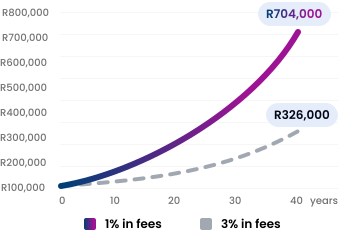
Why do fees matter? Let's say you have R2 million saved for retirement and you're not making any further contributions. If you're paying 2% in total fees versus 1%, that difference compounds over 15 years into at least R500,000 less at retirement—and that's in today's money, accounting for inflation.
At least R500,000 just gone. Simply because you paid too much.
And that's the conservative estimate. If you're still contributing monthly (which you should be), the fee impact grows even larger. Every extra percentage point in fees is working against you, compounding negatively while your money should be compounding positively.
So what should you actually be paying? A good benchmark is 1% or less in total costs. Anything significantly above that and you're likely paying too much.
The question is: do you know your real number?
Here's your first action: contact your current provider or financial adviser and ask for your EAC—your Effective Annual Cost. This is the total percentage you're paying each year, including all fees, not just the obvious ones. Most providers are required to disclose this, so insist on getting it. And then use 10X’s EAC calculator.
Compare your retirement investments
Effective annual cost calculatorIf you're paying 1.5%, 2%, or more, you need to ask yourself: am I getting value for this? Is my fund outperforming low-cost alternatives enough to justify the extra cost?
For most people, the answer is no. And that's R500,000 or more you're leaving on the table.
2. Get Clear on Where You Actually Stand
Now that you know what you're paying (or suspect you're paying too much), it's time to get the full picture. This isn't about doing a painful 'audit' or spending hours with spreadsheets. It's about getting honest with yourself by answering three simple questions:
- Are your funds doing what you expected? You probably chose your current provider years ago based on vague promises about great performance. Have they delivered? Or have you just assumed things are 'going okay' without actually checking?
- Are your costs giving you what you paid for? If you're paying higher fees for active management, are you getting better returns than you would from a low-cost index fund? Most people aren't.
- Do you have better options? The retirement savings landscape has changed dramatically in the past decade. Lower-cost options that didn't exist when you started are now available. But you won't know unless you look.
Most people operate on assumptions from years ago. But assumptions don't make for comfortable retirements. Healthy numbers do.
What will you discover when you actually look? Usually at least one uncomfortable truth. Maybe your fund has underperformed its benchmark for five straight years. Maybe your 'comprehensive' advisor is charging 2.5% for sending you a quarterly statement. Maybe you're not as far along as you thought.
The simplest way to answer all three questions at once is to request a comparison report. It shows your current provider's performance and costs side-by-side with low-cost alternatives. No jargon, no hidden fees, just the truth about where you stand. It takes five minutes to request.
9 out of 10 people do better with 10X
You might not like what you see. But at least you'll know. And knowing means you can do something about it.
3. Picture Your Retirement, Then Work Backwards
Most people approach retirement savings backwards. They contribute some amount each month and hope it'll be enough. Then they get to 64 and discover it isn't.
Let's flip that around.
Start with the life you actually want. What does a comfortable month in retirement look like for you? R30,000? R50,000? More? Be honest. This is your life we're talking about—not some generic retirement brochure with couples walking on beaches.
Retirement Annuity vs Tax-free Savings Account vs Bond: Where Should Your Extra Money Go?
Got extra money to invest? Compare three powerful options: Retirement Annuity, Tax-Free Savings Account (TFSA), or paying off your bond faster. Learn the pros and cons of each to make an informed choice for your financial future. Read more

Now work backwards:
Step 1: Figure out your gross income need. If you want R40,000 net per month, you'll need roughly R50,000 gross (accounting for tax on retirement income).
Step 2: Calculate total savings needed. Using a sustainable drawdown rate of 4-5% per year, you'll need your gross monthly income × 240 to 300. So for R50,000 per month, that's R12 million to R15 million in total retirement savings.
Right now, you're probably thinking: 'That's a lot of money'. And you'd be right. Most people are shocked when they see this number for the first time. But that's exactly why you need to know it. Because hoping you'll have 'enough' without knowing what 'enough' actually means is how people end up running out of money at 75.
Step 3: Ask the critical question: Will you get there?
Use the Retirement Annuity calculator with your real numbers. Your current savings, monthly contributions and years to retirement. Be honest about the fees you're paying (see point 1). For many people, this is where reality hits. The gap between where you're headed and where you need to be is often bigger than expected. Maybe significantly bigger.
“I hate retirement annuities," say investors. Here’s why they're wrong.
Retirement annuities are an excellent long term savings vehicle. But poor investment management, high fees and incorrect asset allocation give RAs a bad name. Read more

But you do have options.
You could increase your monthly contributions. You could switch to a lower-cost provider and let the fee savings compound (see point 1 again). You could make lump sum contributions when bonuses come in. You could do all three.
The worst option is to do nothing and hope it works out. Hope isn't a retirement plan.
Your future self, that 67-year-old you who wants independence, dignity, and the ability to help their grandkids, is hoping you'll make the right decision today. Don't let them down.
An introduction to investments in South Africa [video] - Rands and Sense by 10X
Want to know about offshore investing, property as an asset class, tax-free savings accounts and everything in between? Rands and Sense by 10X is here to help you understand investment fundamentals. Read more
![An introduction to investments in South Africa [video] - Rands and Sense by 10X](/_next/image?url=https%3A%2F%2Fimages.ctfassets.net%2Fyqvz0zwovkbq%2F7qzuglRSuERVXYEw569szC%2Ffd490209f27286680c8f3916f8aac2a0%2FRands___Sense_Podcast_-_Episode_1-2.webp&w=828&q=75)
4. Two Time-Sensitive Moves Before 28 February
The tax year ends on 28 February. That makes right now the perfect time for two specific actions:
Make a Lump Sum RA Contribution
Every rand you contribute to your Retirement Annuity before 28 February reduces your taxable income for this year. If you're in the 45% tax bracket, the government effectively gives you 45 cents back for every rand you contribute (up to the legal limits).
Got a bonus coming? Year-end savings sitting in a money market account? This is how you turn it into retirement wealth while paying less tax. It's one of the few legal ways to make the government subsidise your retirement.
Use the Retirement Annuity calculator to see how a lump sum contribution today grows over the next 15 years. The numbers might surprise you.
Consider Switching If You Need To
If you've discovered your current provider is expensive, underperforming, or both, every additional month you stay costs you money. Not just in fees, but in lost compound growth on those fees.
The first step is the easiest: request a comparison report. It takes five minutes. You'll see exactly what switching would mean for your retirement. Then you decide.
Making this decision now means more years of lower fees compounding in your favour.
The Hard Truth
Nobody else is going to do this for you.
Your employer won't. Your bank won't. The adviser who set up your retirement fund ten years ago and hasn't called since definitely won't.
This is on you.
These aren't nice-to-have optimisations. They're the difference between retiring comfortably and running out of money. Between maintaining independence and depending on your kids. Between living the retirement you pictured and living the retirement you can afford.
You don't need to do everything perfectly. You just need to be intentional. To actually look at the numbers instead of assuming they're okay. To make decisions based on reality instead of hope.
Start with one action today:
- Request a comparison report to see what you're really paying
- Use the RA calculator to see if you're on track
- Speak with a consultant if you want help making sense of it all
2026 can be the year you took control of your retirement. But only if you actually do something.
The clock is ticking. The tax year ends on 28 February. Your future self is watching.
What are you going to do?
Related articles


How can we 10X Your Future?
Begin your journey to a secure future with 10X Investments. Explore our range of retirement products designed to help you grow your wealth and achieve financial success.