How a low-fee retirement annuity can add more to your retirement income
2 February 2026
It’s common for performance and returns to be a main focus for investors when it comes to a retirement annuity, but the importance of fees should not be neglected. Fees may impact the long-term growth of your retirement annuity, especially when these fees are compounded over many years.
By choosing a low-fee retirement annuity, you may be able to significantly improve your final investment amount. In this article, we will explain in more detail how fees work, the importance of your EAC, as well as how 10X’s transparent, low-fee approach can maximise the potential growth of your retirement annuity when compounded over the long term.
The uncomfortable truth about retirement in South Africa - Rands and Sense by 10X [video]
We sit down with 10X Investment Consultant lead Andre Tuck and discuss the retirement savings crisis in South Africa. We also delve into living annuities, retirement annuities, TFSAs and everything in between. Read more
![The uncomfortable truth about retirement in South Africa - Rands and Sense by 10X [video]](/_next/image?url=https%3A%2F%2Fimages.ctfassets.net%2Fyqvz0zwovkbq%2F5ipSTnRq5Dp25fyghm5kGQ%2F02c801c78d5e1ca9280bfd34d7602368%2FAndre_Tuck_podcast_cover_image__1_.webp&w=828&q=75)
Understanding retirement annuities
A retirement annuity (RA) is a tax-efficient retirement savings investment vehicle designed to help people build capital with the goal of generating income later in retirement. As it’s a personal retirement product, it remains in your name regardless of where you work, making it a powerful and consistent way to save over time.
It can be especially useful if you do not have an employer-sponsored pension or provident fund and wish to save efficiently for your retirement, such as self-employed individuals who need a structured way to save for retirement. It’s also often used by those who want to supplement their employer retirement fund contributions.
Contributions can be made via a monthly debit order or a lump sum deposit, depending on your preferences. With this flexibility, you can adjust contributions as your financial situation changes, while still maintaining a long-term focus on retirement.
Build the retirement of your dreams with our
Retirement Annuity calculatorTo illustrate the effect of how compound growth can work in your favour with retirement annuities, let’s take a look at a quick example.
Scenario 1: In this scenario, you start with a R100K lump sum and generate 6% real return over 30 years (real returns refer to returns minus costs such as fees and inflation).
Scenario 2: In this scenario, you start with a R100K lump sum, and add a R1,000 per month to it for 30 years at the same 6% real return.
In the first scenario, you end up with around R482,000.
In the second scenario, you end up with approximately R1.5 million.
Over time, small contributions add up and can make a major difference. Note that this example is for illustrative purposes only, and real results may vary.
Retirement annuities also offer some attractive tax benefits. Contributions that you make to your retirement annuity are tax-deductible to certain limits. This means that contributing to a retirement annuity can reduce your taxable income in the current tax year. These limits are up to 27.5% of your income, and with a limit of up to R430 000 per annum.
Investment returns within the retirement annuity ‘wrapper’ are also exempt from income tax, dividends tax and capital gains tax while invested. Because no tax is deducted on growth inside the RA, your investment returns can potentially compound more effectively over time, boosting the long-term value of your retirement savings.
Why fees matter more in a retirement annuity than most investors realise
RAs are long-term, decades-long savings plans
A small difference in fees when compounded over the long term - as would quite likely be the situation with a long-term product such as a retirement annuity - can significantly impact the long-term growth potential of your retirement annuity.
For example, a difference of just 1%, when compounded over, say, 30 years, can impact your final investment value quite substantially. Over a 40-year investment horizon, research suggests that just a 0.5% increase in fees could reduce your final retirement savings by up to 20%, assuming all other factors remain the same, highlighting the compounding effect that fees can have over time.
Inflation requires higher real returns
Inflation in South Africa is usually around 5% to 6% per annum. In order for your retirement annuity to see growth, you need your returns to outperform both inflation and fees. You would, therefore, ideally look to minimise the fees that you are paying as much as possible. Fees are a factor that you have total control over, especially when compared to inflation, which is a factor which you would have no control over, and always needs to be accounted for.
The 10X advantage
Lower fees allow for more returns to be potentially reinvested and compounded over the long term. 10X focuses on cost-effectiveness with our transparent, index-tracking strategy and low-fee retirement annuity, allowing for potentially more growth over time.
As mentioned above, retirement annuities are long-term investments; cost differences that may initially seem small in a single year can become significant when compounded over decades. Our low-fee structure and disciplined, rules-based investment approach help us to reduce unnecessary costs while keeping portfolios aligned to long-term objectives.
Understanding retirement annuity fees
EAC (Effective Annual Cost) — The only number that matters
The Effective Annual Cost (EAC) is a standardised metric which allows you, as the investor, to compare and evaluate the total fees and costs of owning an investment over a one-year period of time. It is a standardised measure, which was introduced by ASISA in 2015. It includes management fees, advisor fees, administration fees and any other fees that may be applicable.
All factors being equal, a higher EAC may mean that less of your investment returns can be reinvested and potentially grow and compound over time, compared to a lower EAC, which may mean that more of your returns may be reinvested and potentially grow over the long term. The EAC of an investment is just one factor to consider when comparing service providers.
The typical fees you may see, as mentioned above, are as follows:
Management fees: These are the fees charged for the management of the fund.
Advisor fees: Your advisor may charge both an initial and an ongoing fee for the advice and services that they provide regarding your financial plan.
Administration fees: There may be charges related to administration tasks related to the fund. This will be for tasks such as tax, compliance and similar.
Other: There may be other fees applicable to certain products.
10X offers a useful EAC calculator. This calculator forms a part of our free online suite of tools on offer to investors. The EAC calculator allows you to compare and evaluate your EAC. Your EAC can be found on your investment statement, or this may be requested from your service provider.
10X charges transparent and cost-effective fees. There are no hidden costs. Fees are generally less than 1% for most of our retirement products. Please explore our products for the most up-to-date fee information.
How a low-fee retirement annuity adds more to your retirement
Let’s look at an example to compare higher fees (3%) with lower fees (1%) to help illustrate the effect that fees may have on your retirement annuity’s final investment value.
- Investment period of 30 years
- Initial lump sum investment of R50,000
- Monthly contributions of R2,000
- Return of 12% per annum
- An inflation rate of 6%
Example 1 (1% Fees): Real investment value is approximately R1.8 million
Example 2 (3% Fees): Real investment value is approximately R1.3 million
This example illustrates that a small difference in fees can make a sizeable impact on your final investment value. Please note that this example is for illustrative purposes only, and real results may vary. You can learn more about how high fees can impact your retirement outcomes here.
Asset allocation + low fees = maximum RA growth
A strategically selected asset allocation can help drive your retirement annuity returns in the long term. A well-diversified asset allocation, which includes a range of different asset classes, is advised. This allows you to take advantage of good returns that may come about in certain asset classes whilst mitigating against any losses that may occur in other asset classes. At 10X, you can choose from a range of carefully curated funds, each with a different mix of assets and geared towards different investment profiles.
Equities, real estate, bonds and cash are the typical asset classes that you would select from. Equities are the most volatile of the asset classes, but also likely to produce the best returns in the long term. As data suggests, equities have historically produced returns above inflation by around 7% annually - over the long term (based on JSE All Share Index performance versus CPI from 1960-2020) - but bear in mind that past performance does not guarantee future results. Real estate may provide a good hedge against inflation. Bonds will add some stability to your portfolio but may provide some lower returns; this is not to say that bonds never outperform, simply that they are normally seen as a more conservative option. Cash is the most liquid and stable of the asset classes, but will likely also generate the lowest returns of the asset classes.
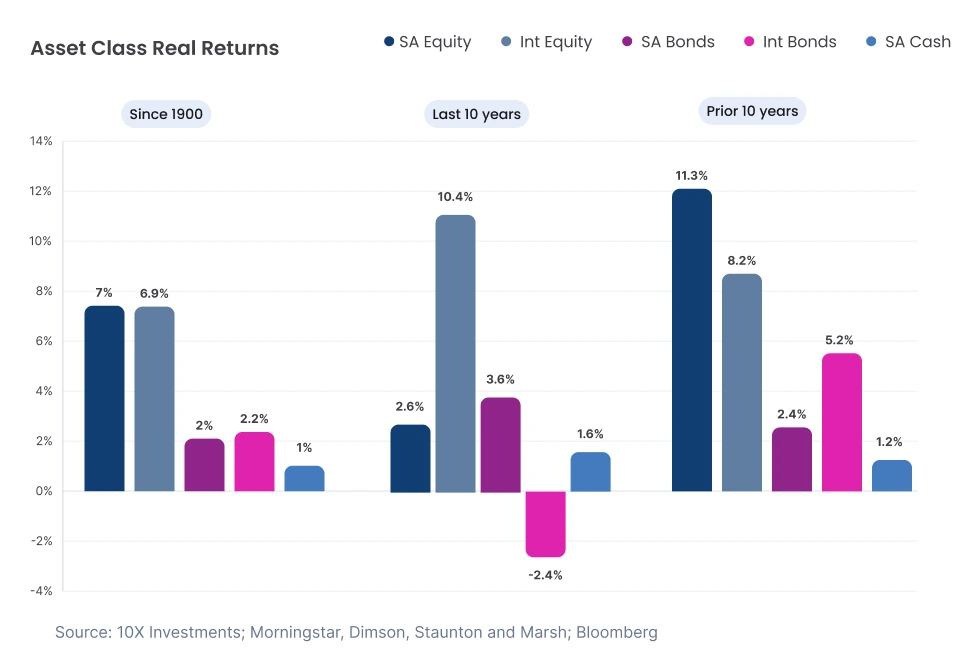
Your selected asset allocation should align with your investor profile, which looks at your risk tolerance levels and investment timelines. You would also always consider your long-term financial plan. Asset allocation plays the biggest role in the performance of your retirement annuity, accounting for over 90% of returns, as seminal research from Brinson, Singer and Beebower shows.
Retirement products, like retirement annuities, are subject to Regulation 28 of The Pension Funds Act. This act stipulates the limits of both equities and offshore. The limit for equities is 75%, and the limit for offshore 45%. These limits are to help you, as an investor, to avoid a poorly diversified portfolio.
10X’s index-based strategy
10X makes use of an index-based investment strategy alongside a more active approach to asset allocation decisions. This strategy focuses on consistent returns and may be more cost-effective as there are fewer activities involved. A benchmark index is mirrored in an effort to generate the same returns as this benchmark index. The inverse would be an actively-managed strategy, which may be less cost-effective due to the higher number of activities involved. You can expect activities such as research, analysis and buying and selling costs, as a fund manager would look to select the best-performing stocks and also ‘time’ the market.
Data from the SPIVA Scorecards suggests that index tracking may outperform active management most of the time. According to the latest SPIVA South Africa Scorecard (as of 31 December 2024), 60.84% of South African actively managed equity funds underperformed the S&P South Africa DSW Capped Index over the ten-year period ending 31 December 2024.
10X is able to be more cost-effective due to its index-based investment strategy, combined with a more active approach to asset allocation. We offer a selection of carefully constructed funds that allow investors to choose a fund that aligns with their investor profile and financial plan. These funds are well diversified, including exposure to a range of assets, along with both local and offshore assets, doing the hard work for you.
How to evaluate your RA’s fee structure
Let’s have a look at the steps involved when evaluating your RA’s fee structure.
Step 1 — Request your EAC statement
Viewing your EAC is the first step in the process. Your EAC will be expressed as a percentage. You will find your EAC on your investment statement, or you may obtain it from your service provider. This figure gives you a single, standardised number reflecting the overall cost of your investment each year.
Step 2 — Identify any hidden fees or costs
Identify any hidden fees or costs that might appear on your EAC. If required, you may query these with your service provider. Make sure you understand what each fee covers, and whether you’re receiving value for the services being charged.
Step 3 — Compare with 10X
Compare the EAC of your current service provider with the EAC that is charged by 10X. You can make use of the EAC calculator in order to do this. Even a small difference in percentage fees can have a big impact when compounded over the years.
Step 4 — Decide if changing providers makes sense
Evaluate the EAC of both providers and decide if it makes sense to change service providers. Transferring across to a new service provider is done by means of a formal retirement annuity transfer process between providers. It’s important to consider both costs and investment approach when making this decision.
Why 10X’s RA structure maximises growth
Index-tracking philosophy
10X makes use of an index-tracking strategy that is cost-effective. This focuses on consistent returns that may avoid any errors that may potentially occur on the fund manager’s side.
Single, transparent fee
You can expect a clear and transparent fee structure with no hidden costs. We like to keep things simple to avoid any ambiguity.
Global diversification
10X offers a wide range of well-diversified funds, which offer both local and offshore exposure. Including some offshore exposure in your portfolio can provide some protection against any local market instability and depreciation of the Rand. It also opens up more opportunities with the international market being larger than our local South African market, allowing for access to different industries and regions.
Checklist: Is your RA optimised for maximum growth?
Let’s have a look at a useful checklist which can help ensure that your RA is structured for maximum growth.
- What is your current EAC? How does it compare to the EAC that is charged by 10X?
- Do you understand the fees that you are being charged? Are the fees clear and easy to understand?
- Is your portfolio well-diversified across the different asset classes?
- Does your asset allocation include a percentage of equities?
- Are you contributing regularly to your RA and ensuring a disciplined and consistent investment strategy?
- Is your service provider transparent when it comes to their reporting and statements?
This checklist can be a useful litmus test in order to get an idea of where you stand when it comes to the structure of your RA when looking to maximise growth.
Final thoughts on retirement annuity fees
Fees are one of the most important factors to consider when it comes to investing and the potential impact that fees can have on the growth of your RA. A small difference in fees, when compounded over time, can have a significant impact on the growth of your RA. Partnering with 10X, which is transparent and cost-effective, potentially allows for more of your savings to be available to potentially grow over time. Please speak to the helpful 10X investment consultants to find out more about minimising fees with the 10X RA!
Related articles



How can we 10X Your Future?
Begin your journey to a secure future with 10X Investments. Explore our range of retirement products designed to help you grow your wealth and achieve financial success.