How a preservation fund protects your future income
2 February 2026
South Africans sometimes choose to cash out their employer-sponsored pension or provident fund, instead of making use of a preservation fund, without realising the long-term effects of this decision. Withdrawing early instead of preserving funds can have a significant impact on the long-term growth of your retirement savings and, ultimately, the capital that you have available for your retirement years.
A preservation fund is a vehicle which allows for further potential growth of your savings over time by preserving them. In this article, we look in further detail at preservation funds and asset allocation, tax efficiency, growth potential and some useful tips to help you along your investing journey.
The uncomfortable truth about retirement in South Africa - Rands and Sense by 10X [video]
We sit down with 10X Investment Consultant lead Andre Tuck and discuss the retirement savings crisis in South Africa. We also delve into living annuities, retirement annuities, TFSAs and everything in between. Read more
![The uncomfortable truth about retirement in South Africa - Rands and Sense by 10X [video]](/_next/image?url=https%3A%2F%2Fimages.ctfassets.net%2Fyqvz0zwovkbq%2F5ipSTnRq5Dp25fyghm5kGQ%2F02c801c78d5e1ca9280bfd34d7602368%2FAndre_Tuck_podcast_cover_image__1_.webp&w=828&q=75)
Preservation fund: A quick recap
A preservation fund is a long-term retirement savings product that allows you to invest savings from a former employer’s pension or provident fund, in order to continue saving and growing this capital. Your savings can be transferred without triggering a tax event, as long as you ensure that you transfer your provident fund to a provident preservation fund and your pension to a pension preservation fund.
Growth within the preservation fund is tax-free, meaning that more of your returns can be reinvested and potentially grow and compound over time. When it comes to the asset allocation of your investment, you want to ensure that you carefully select your underlying funds within the preservation fund ‘wrapper’, as well as to ensure you minimise the fees that you are paying, to potentially grow your capital over the long term. Preservation funds do not allow for further contributions, so returns and fees can play a crucial role in its long-term growth.
With people living longer, and retirement lasting 25-30 years or more, protecting your accumulated savings has become even more important. Many South Africans will change jobs several times over the course of their careers, and each transition presents a decision point that can either strengthen or weaken long-term retirement security.
Choosing preservation instead of cashing out allows your savings to remain invested and continue benefiting from potential compound growth. Over time, even small amounts saved can make a major difference to your eventual retirement income. Today, fewer employers offer guaranteed pensions, and individuals carry more responsibility for their own retirement outcomes. Preservation funds can help make sure that short-term career changes don’t derail long-term financial stability.
See your pension savings grow with our
Preservation Fund calculatorThe true cost of cashing out early
It can be tempting to want to withdraw capital when this option becomes available upon a job change, but it’s important to realise the impact this might have on your retirement outcomes. Withdrawing capital from your pension or provident fund early instead of preserving them means that you may miss out on the potential long-term growth and compounding of your capital.
Savings that are moved across to a preservation fund may be able to compound and potentially grow over time. Early withdrawals may also be taxed at a higher rate, as you can see from the SARS tax tables below:
| Taxable income (R) | Rate of tax |
|---|---|
1 – 27 500 | 0% of taxable income |
27 501 – 726 000 | 18% of taxable income above 27 500 |
726 001 – 1 089 000 | 125 730 + 27% of taxable income above 726 000 |
1 089 001 and above | 223 740 + 36% of taxable income above 1 089 000 |
Preservation funds and the Two-Pot Retirement System
The Two-Pot Retirement System is a system that was introduced by the National Treasury in September 2024. This changes the way preservation funds, as well as other retirement products, contributions and withdrawals are governed.
Under the Two-Pot Retirement System, all contributions are split between two pots, namely the ‘savings pot’ and ‘retirement pot’. One-third of contributions will go to the savings pot, and two-thirds of contributions will go to the retirement pot. There is also a third pot known as the “vested pot”, which only applies to preservation funds opened prior to September 2024.Withdrawals are allowed from the savings pot once per year. This is for a minimum amount of R2000. Withdrawals from the savings pot should be kept for emergencies only, and savings should generally rather be kept invested, if possible. All withdrawals will be taxed at your marginal tax rate and are also subject to an administration fee.
It’s important to keep in mind that while the savings pot provides more flexibility than before, it is not designed to replace long-term retirement planning. Using these savings too frequently can reduce the power of compounding and may potentially leave you with less income security later in life, when your savings need to last the longest.
The retirement pot capital will remain invested until retirement age, which is from age 55 in South Africa. Contributions to a preservation fund are not allowed, but the savings component will grow at the same rate as the total fund. For example, if the total fund grows by double its size, then both the savings pot and the vested pot will also grow by double the size. Please consult the latest FSCA guidance for more on the Two-Pot Retirement System.
Staying invested: The growth potential of a preservation fund
A preservation fund allows you to keep your capital, which has been previously saved in an employer-sponsored pension or provident fund, invested when changing employers or jobs. This means that your hard-earned savings, which have likely been growing and accumulating within your pension or provident fund, are potentially able to continue growing in this manner. You would, therefore, ideally want to avoid any withdrawals.
The more capital you have invested, the more capital there is to generate returns. Compound growth is a powerful tool when it comes to the fund’s growth. This means that you will experience growth on the initial capital amount that is invested in your preservation fund, and also on all returns that are generated and reinvested. This will continue to happen for the duration that your funds are invested - potentially boosting your final retirement outcomes.
Asset allocation: Diversification for long-term security
When it comes to asset allocation, you would typically look to invest in a variety of different assets such as equities, real estate (property), bonds or cash. Diversifying across the asset classes allows you to potentially balance both risk and reward. You can take advantage of the opportunities on offer in the different asset classes while also ensuring that you aren’t too heavily invested in any of the asset classes in case of a downturn. At 10X, you can choose from a selection of carefully curated investment funds, each with a different asset allocation.
Equities are generally thought to be the most volatile of the asset classes, while also producing the best returns in the long term. As data suggests, equities have historically produced returns above inflation by around 7% annually - over the long term (based on JSE All Share Index performance versus CPI from 1960-2020) - but it is important to remember that past performance does not guarantee future results. Real estate may generate some good returns, and bonds generally add stability to a portfolio. Cash is the most stable of the asset classes, but will likely produce the lowest returns of all.
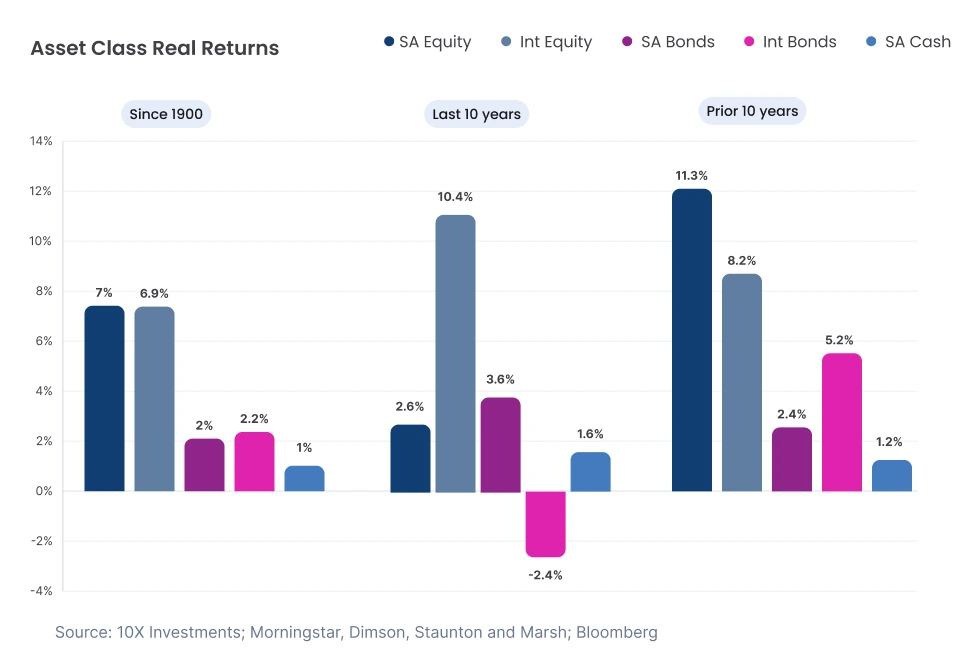
Asset allocation plays the biggest role in the performance of your preservation fund, accounting for over 90% of returns, as seminal research from Brinson, Singer and Beebower shows. You would look to carefully align your asset allocation with your risk tolerance, investment timelines and long term financial plan to find the asset allocation that best fits for you.
Our range of well-diversified funds suits a variety of different investors, helping you to ensure that you have the best fit for your situation and circumstances. Please visit our funds page for the most up-to-date fund information. Fund information is correct as of the 9th of December 2025.
Regulation 28 of The Pension Funds Act states that retirement products, such as preservation funds, must limit the percentage of their funds that they invest in both equities and offshore. This is to help ensure that investors avoid having poorly diversified portfolios. The current limit for equities is 75%, and the limit for offshore exposure is 45%.
These limits must be adhered to. You may wish to consider diversifying your portfolio offshore, as this may allow for further benefits on offer, as the international market is larger compared to the more limited local South African market. Including offshore exposure may also act as a hedge against local market instability and any potential depreciation of the Rand.
Fees: The hidden factor that can reduce retirement income
High fees can potentially reduce the returns available to reinvest and continue to potentially grow and accumulate over time. You would ideally look to minimise fees where possible by selecting a service provider who is cost-effective and transparent with regard to their fees.
Some of the fees that you may see charged on your preservation fund are as follows:
Administration fees: Administration fees will be charged for the administration tasks related to your fund. These will be for activities such as reporting, compliance and tax.
Management fees: These are the fees charged for the management of the fund.
Advisor fees: An advisor will charge fees for the advice and services that are provided. There might be both an initial and an annual fee charged.
The Effective Annual Cost (EAC) is a useful metric that can be used to evaluate the total fees and costs that are associated with owning an investment product over a one-year period of time. All factors being equal, a higher EAC would mean that less of your investment returns can be reinvested and potentially grow and compound over time, whilst a lower EAC may mean that more returns may be reinvested and allowed to potentially grow over the long term. Of course, the EAC of an investment is just one factor to consider when comparing different service providers.
10X offers an EAC calculator, part of our online suite of tools, which allows you to compare and evaluate the EAC of your current preservation fund with that which is charged by 10X.
Let’s have a look at an example which highlights the effect of fees on your preservation fund over the long-term. We will be comparing fees of 3% with fees of 1%.
Let’s assume the following factors for our example:
- Investment period of 30 years
- Investment of R100,000
- Return of 12% per annum
- An inflation rate of 6%
Example 1 (1% Fees): Real investment value is R398,578.
Example 2 (3% Fees): Real investment value is R231,004.
We can clearly see how a small difference in fees may lead to major differences in the real investment value over time. This example is for illustrative purposes, and real results may vary. You can learn more about the major impact of fees here.
At 10X, we like to keep our fees simple, transparent and easy to understand. Fees are usually less than 1% on our retirement products. Please explore our products for the most up-to-date fee information.
How to maximise your preservation fund benefits
Let’s have a look at some useful tips that can help you to maximise your preservation fund benefits:
- Monitor your fees regularly: Fees play a major role in determining how much of your investment is able to compound over time. Even slight differences in fees can have a huge impact on retirement outcomes. Make it a habit to review all fees and understand exactly what you’re paying for.
- Check your asset allocation annually: Your asset allocation is the biggest driver of long-term investment performance. Over time, your personal circumstances, risk tolerance and retirement timeline may change. By reviewing your asset allocation, you can make sure your investment strategy is still in line with your needs.
- Avoid early withdrawals: Aim to keep your savings invested by making use of a preservation fund when changing roles. Avoiding early withdrawals allows your capital to benefit from potential long-term growth and compounding. As such, withdrawals should only be reserved for emergencies. Remember, you can’t make more contributions to a preservation fund, so withdrawing capital may significantly impact retirement outcomes.
Our preservation fund at 10X is a transparent and cost-effective option which aims to focus on excellent long-term returns for our clients.
Final thoughts on preservation funds
A preservation fund can be the cornerstone of your long-term retirement plan, so keeping your savings invested instead of withdrawing can potentially help your retirement outcomes. This should be coupled with low fees, a strategic and well-diversified asset allocation that includes equities and a disciplined and consistent approach to investing that incorporates annual reviews.
10X’s preservation fund is cost-effective and transparent, while also offering a wide range of diversification across both local and offshore assets. If you would like to find out more about the 10X preservation fund, don’t hesitate to speak to the experienced and helpful investment consultants at 10X! We are more than happy to assist you with any questions or queries that you may have. Get in touch today!
Related articles



How can we 10X Your Future?
Begin your journey to a secure future with 10X Investments. Explore our range of retirement products designed to help you grow your wealth and achieve financial success.