How a retirement annuity turns into retirement income
19 May 2026
The Living Annuity Masterclass: How to maximise your retirement income


Your retirement annuity is a vehicle for saving money while you are working; at retirement, this changes. In South Africa, you can retire from your retirement annuity at age 55. Your retirement annuity can then be used to purchase an annuity, which provides you with an income for your retirement years. This can be a confusing concept for investors, particularly when it comes to understanding what happens to their retirement annuity at retirement.
In this article, we will delve deeper into your retirement annuity and the transition at retirement, as well as important areas to consider, such as fees and your asset allocation.
Build the retirement of your dreams with our
Retirement Annuity calculatorUnderstanding retirement annuities
Retirement annuities (RAs) are tax-efficient retirement savings vehicles that allow you to save money for your retirement years. Contributions to retirement annuities are tax-deductible, subject to annual limits, which are up to 27.5% of your income or R430,000. Investment returns within the RA are exempt from income tax, dividend tax, and capital gains tax while invested, thereby allowing more returns to be reinvested and potentially compounded over the long term.
You can contribute a lump sum or make regular contributions to your RA, depending on your financial situation. You will need to check the minimum requirements for both lump sum amounts and monthly contributions with your service provider. Retirement annuities are an incredibly useful vehicle for investors who don’t have a company pension or provident fund, allowing you to still save for your retirement years.
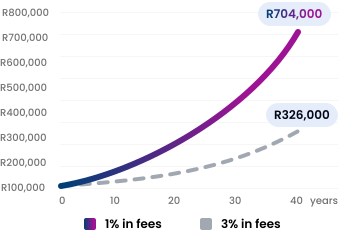
Higher fees very likely means lower returns (and here's the maths to prove it)
Paying high fees on your retirement investments (such as a retirement annuity or a living annuity) almost always means less money in your pocket, and less money for your retirement. Read more
Understanding the Two Pot Retirement System
The Two-Pot Retirement System was implemented in South Africa in September 2024. The system has changed how both contributions and withdrawals are handled for retirement products. All contributions you make to your RA will be split between the ‘retirement pot’ and the ‘savings pot’. Two-thirds of all contributions will be invested in the retirement pot, with one-third being allocated to the savings pot. There is a third pot, called the ‘vested pot’, for all contributions made prior to September 2024, and it remains governed by the old rules.
You can access your savings pot once per year for a minimum of R2,000. This withdrawal will be subject to both tax and an administration fee. If possible, it’s best to keep all savings invested and allow them to potentially grow and compound over the long term. Your retirement pot may only be accessed upon retirement, where it will be used for an annuity. Please consult the latest FSCA guidance for the most up-to-date information on the Two-Pot Retirement System.
Building blocks to a lasting Living Annuity
Our panel of experts discusses living annuities, sustainable drawdown rates, offshore investing, and everything else one might need to consider to ensure a comfortable retirement. Read more
![Building blocks to a lasting Living Annuity [webinar + transcript]](/_next/image?url=https%3A%2F%2Fimages.ctfassets.net%2Fyqvz0zwovkbq%2F4dZzwtwSkZ19hmRrVa6Zyb%2F770741ecc4b2ae3deda48fa06da42718%2FWebinar_recording_cover_1920X1080.webp&w=828&q=75)
What happens at retirement age
As mentioned, you are able to access your RA from age 55, although many South Africans will work a lot longer than this and continue to invest in their RA. Delaying retirement may allow your retirement savings more time to remain invested and potentially continue growing through compound returns.
Once you decide to retire from your retirement annuity, there are a few important decisions that need to be made regarding how your retirement savings will be used.
If the total value of your retirement annuity is less than R247,500, current regulations allow you to withdraw the full amount in cash. If your retirement annuity is worth more than R247,500, different rules apply. If your RA is more than R247 500, current regulations state that you may withdraw up to one-third of the vested portion of your RA in cash.
The remaining two-thirds of your RA must be used to fund an annuity. This annuity will then provide you with an income for your retirement years. In addition, any available savings pot money may also be withdrawn if needed.
Your retirement pot will also need to be used to fund your annuity and cannot be taken entirely in cash. Any cash withdrawals will be taxed according to the following retirement lump sum tax tables. Tax tables have been taken from the SARS website:
| Taxable income (R) | Rate of tax |
|---|---|
1 – 550 000 | 0% of taxable income |
550 001 – 770 000 | 18% of taxable income above 550,000 |
770 001 – 1 155 000 | 39 600 + 27% of taxable income above 770 000 |
1 155 001 and above | 143 550 + 36% of taxable income above 1 155 000 |
Where possible, it may be beneficial to minimise unnecessary cash withdrawals at retirement and instead keep more capital invested within your living annuity. Leaving more money invested may improve the long-term growth potential of your retirement capital and may support a more sustainable retirement income over time. H2: Turning the rest into an annuity
What is an annuity?
An annuity is a retirement product designed to provide you with an income during your retirement years. Once you retire from your retirement annuity, the portion of your retirement savings that is not taken as cash must generally be used to purchase an annuity. The annuity then becomes the vehicle that pays you an income throughout retirement. There are two types of annuities available in South Africa: a living annuity and a life (guaranteed) annuity. Each option comes with its own advantages, risks, and level of flexibility.
Living annuity vs life annuity
A living annuity is a flexible investment product that allows you to draw an income while keeping your savings invested. It offers flexibility in terms of the underlying investment portfolios and the drawdown rate selected. You are able to select your drawdown rate at policy anniversary each year, and this rate can be between 2.5% and 17.5%. The drawdown rate needs to be carefully managed as a living annuity does come with longevity risk. This is the risk of the capital running out too soon. A drawdown rate of 4% is generally considered to be sustainable by financial experts. You are able to pass on the remaining capital in your living annuity to your beneficiaries outside of your estate, and therefore, tax-free, which appeals to many investors.
A life annuity, which is also called a guaranteed annuity, is an insurance product that is purchased from an insurance company. It comes with less flexibility in terms of underlying investment portfolios and drawdown rate, but you will get a guaranteed income for life. Any risk lies with the insurance company, and the annuity will return to the insurance company on the passing of the annuitant.
How your retirement income is calculated
The amount of retirement income that you will receive during your retirement years depends on several important factors. Let’s have a look at some of these factors:
- The value of your retirement annuity: The total value of your retirement annuity is key. This capital will be transferred to your annuity upon retirement and funds your retirement income.
- The amount that you withdraw in cash: The amount you choose to take as a cash lump sum at retirement will also affect your future retirement income. The more you withdraw in cash, the less you will have available to fund your annuity.
- The type of annuity you select: You may select either a life annuity or a living annuity, and your choice will play a major role in how your income is structured.
- Your drawdown rate and investment strategy: If you select a living annuity, your drawdown rate will then play an important role in both the income you draw and the sustainability of your retirement capital. Higher drawdown rates may provide more income in the short term, but they increase the risk of your capital depleting too quickly. Other important factors include asset allocation, investment returns, fees and inflation.
The role of asset allocation after retirement
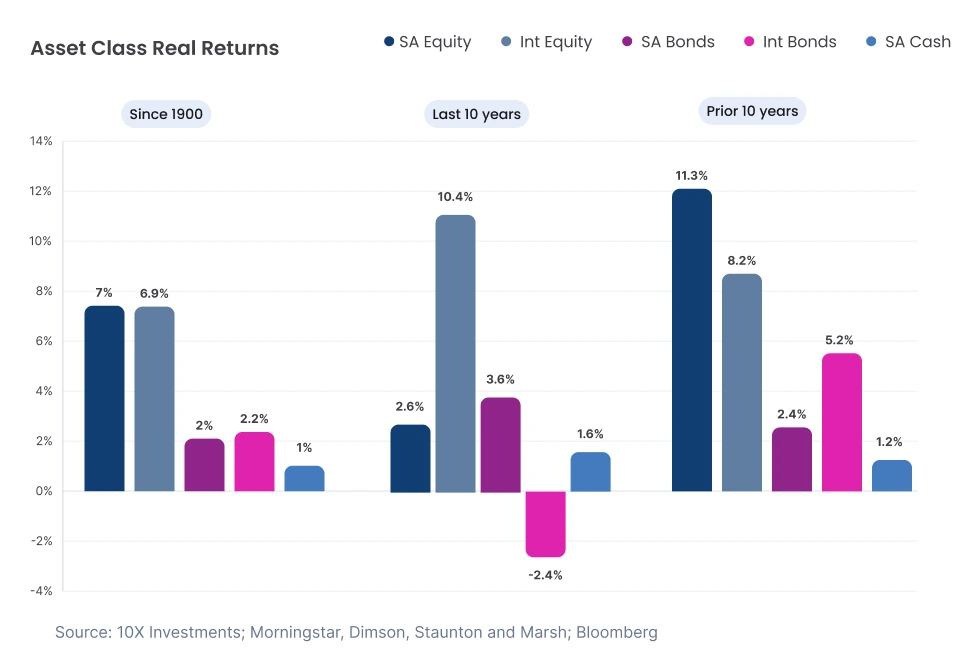
If you’ve used your retirement savings to fund a living annuity, choosing an asset allocation that aligns well with your investor profile and long-term investor timelines is important for its potential growth, much like the case with retirement annuities. Asset allocation plays the biggest role in the performance of your living annuity, accounting for over 90% of returns, as seminal research from Brinson, Singer and Beebower shows.
At 10X, you have the freedom to adjust your underlying portfolio by choosing from a selection of carefully curated investment funds, each geared towards different investor profiles. Your living annuity is a long-term investment which may span 25 to 30 years or longer. Therefore, you would ideally aim for growth in your portfolio by including growth assets such as equities and ensuring that your underlying portfolio is not too conservative with the goal of outperforming inflation.
As data suggests, equities have historically produced returns above inflation by around 7% annually - over the long term (based on JSE All Share Index performance versus CPI from 1960-2020), but past performance doesn’t guarantee future results. They are also the most volatile of the asset classes. You may also wish to include some real estate, bonds and cash in your portfolio. Real estate may generate some good returns and serve as a hedge against inflation. Bonds add stability to a portfolio, although the returns they generate may be lower. This doesn’t mean bonds will never outperform expectations, merely that it is seen as a more conservative option. Cash will generate the lowest returns among asset classes while also being the most stable.
You may also consider diversifying your portfolio offshore, as living annuities are not subject to Regulation 28, allowing you to invest 100% offshore if you wish. Whether it’s for your retirement annuity or your living annuity, 10X understands the importance of your asset allocation, especially when it comes to having a well-diversified portfolio. We offer a variety of different funds that are diversified across the asset classes and also local and offshore assets, allowing you the option to select the fund which best matches your investor profile and long-term financial goals. Please explore our funds for the most up-to-date information.
How fees affect your retirement income
While many investors fail to realise the impact of fees, their importance should never be understated. High fees may have the effect of reducing the returns that you have to reinvest, which may then impact the growth potential of your retirement annuity. There are some fees that you can expect to see deducted from your retirement annuity (or living annuity). Let’s have a look at some of these fees:
- Management fees: These are the fees charged for the management of the fund.
- Advisor fees: If you are making use of an advisor, they will offer you advice and possibly other services. They may charge both an initial and an ongoing fee for this.
- Administration fees: Administration tasks, such as those related to compliance, tax, reporting, and more, will incur an administration fee.
Let’s look at an example to compare higher fees (3%) with lower fees (1%) in order to see the impact that higher fees may have on your retirement annuity.
- Investment period of 30 years
- Initial lump sum investment of R50,000
- Monthly contributions of R2,000
- Return of 12% per annum
- An inflation rate of 6%
Example 1 (1% Fees): Real investment value is approximately R1.8 million
Example 2 (3% Fees): Real investment value is approximately R1.3 million
We can see how a difference of 2% in fees, which may seem small, can impact your final investment value. Please note that this example is for illustrative purposes only, and real results may vary. You can find out more about the impact of fees here.
The Effective Annual Cost (EAC) is a useful metric for you to use in order to determine the total fees and costs associated with owning a product over a one-year period. All factors being equal, a higher EAC would mean that less of your investment returns can be reinvested and potentially grow and compound over time, while a lower EAC may mean that more of your returns may be reinvested and potentially grow over the long term.
The EAC of an investment is just one factor to consider when comparing service providers. At 10X, we keep our fee structure cost-effective, simple, and transparent, so it is easy for all investors to see the fees they are charged. There are no hidden costs and fees on retirement products, which are usually 1% or less. Please explore our products for the most up-to-date fee information.
Final thoughts: Your RA’s final job is to pay you
Your retirement annuity plays a vital part in your retirement. It starts with saving, then moves the capital into an annuity that ultimately provides you with an income during the retirement years. Asset allocation and fees matter when it comes to accumulating capital while investing in your retirement annuity.
Your choice of annuity will also play a role in determining the income that you are able to receive from it. Taking a disciplined and consistent approach to saving for retirement while making use of your RA can set you on the right path for your retirement years!
10X offers a low-fee, transparent RA option that aims for superior returns. Speak to our experienced investment consultants to find out more!
Related articles



How can we 10X Your Future?
Begin your journey to a secure future with 10X Investments. Explore our range of retirement products designed to help you grow your wealth and achieve financial success.