How retirement annuities fit into a broader retirement plan
22 June 2026
The Living Annuity Masterclass: How to maximise your retirement income


Many investors view their retirement annuity as their primary retirement savings vehicle. Your retirement annuity plays an important role in your retirement plan, but it should not be your sole source of retirement savings. When it comes to your retirement planning, you should consider using a range of products to take advantage of the benefits each offers.
In this article, we will look at the importance of using a variety of products alongside your retirement annuity to access the benefits of each and potentially improve long-term retirement outcomes. We’ll also cover how 10X supports retirement planning and how we can assist you.
Build the retirement of your dreams with our
Retirement Annuity calculatorUnderstanding retirement annuities
A retirement annuity (RA) is an important long-term retirement savings vehicle which allows you to save for your retirement years while taking advantage of the valuable tax benefits offered. Updated regulations state that you are entitled to tax-deductible contributions of up to R430,000 and a maximum of 27.5% of your salary per annum.
You will notice that all growth within your retirement annuity is tax-free, allowing for more potential growth over time, as more returns are available to be reinvested and potentially compounded over time. From age 55, you are able to access your retirement annuity savings, and these can be used for either a life or living annuity. This annuity will then provide you with an income for your retirement years.
The role of a retirement annuity in a retirement plan
A retirement annuity is a vehicle that is designed for the long term. You may see your retirement annuity spanning many decades, allowing you to accumulate capital before it eventually provides for your retirement years. It will benefit from consistent and disciplined investing over the years.
You may wish to invest in a regular debit order, which will help with a disciplined and consistent approach. If you prefer, you may contribute lump sum amounts as and when you have the money available. A retirement annuity is a strong option for self-employed individuals who may not have an employer pension or provident fund and would benefit from the flexibility it offers regarding their contributions. You will need to check the minimum contributions as stipulated by your service provider.
The earlier that you start contributing to a retirement annuity, the more you stand to benefit from compound growth. Being disciplined enough to make regular contributions can also make a major difference to retirement outcomes. Let’s look at an example to illustrate the power of compound growth.
Scenario 1: You invest a R100,000 lump sum and generate 6% real return over 30 years.
Scenario 2: You invest a R100,000 lump sum, and also include a debit order of R1,000 per month for 30 years, generating a 6% real return.
Scenario 1: You end up with approximately R482,000.
Scenario 2: You end up with approximately R1.5 million.
Even a modest, regular debit can grow meaningfully when compounded over 30 years, which could make a major difference to the amount you have available for retirement. Increasing your monthly contributions over time can also accelerate compound growth. This example is for illustrative purposes only, and actual results may vary.
Each of the different investment products available can serve different purposes, depending on their flexibility, accessibility and tax efficiency. It is generally advised that investors use a range of different products, allowing you to take advantage of what each vehicle is able to offer.
Understanding The Two-Pot Retirement System
The Two-Pot Retirement System was implemented in South Africa in September 2024. This new system has changed the way that retirement products are dealt with. All contributions to retirement products are now split between two pots: a ‘retirement pot’ and a ‘savings pot’. There is also a third pot which is called the ‘vested pot’, which is for all savings that have accumulated prior to September 2024 and remains governed by the old rules.
Withdrawals from the savings pot are allowed, as long as you adhere to the stipulated rules. You are allowed one withdrawal per year, for a minimum amount of R2,000. These withdrawals are taxed at your marginal tax rate, and an administration fee will also apply. The savings pot capital should ideally remain invested, and withdrawals should be avoided unless absolutely necessary. This is to ensure you take full advantage of compound growth.
All contributions to your retirement annuity will be allocated to the retirement pot and the savings pot. One-third of contributions will be invested in the savings pot, and two-thirds in the retirement pot. The retirement pot can only be accessed from age 55, when it will then be used to purchase an annuity. Please consult the latest FSCA guidance for the most up-to-date information on the Two-Pot Retirement System.
How a tax-free savings account can complement a retirement annuity
A tax-free savings account (TFSA) is an investment product that allows for tax-free growth and tax-free withdrawals. The growth in your TFSA is tax-free, allowing more of your returns to be reinvested and potentially compounded over the long term. However, there are contribution limits you must adhere to. As of the 1st of March 2026, the current contribution limits are as follows: R46,000 per annum and R500,000 per lifetime.
If you exceed these limits, a 40% penalty will be applied to the excess contribution amount. There are also no restrictions on withdrawals, allowing flexibility if you need to access the capital in a hurry. This can be useful in times of emergency, as your retirement annuity does not allow for withdrawals, apart from your savings account, as mentioned above. If possible, your savings should remain invested in a TFSA to continue growing and compounding over time.
The role of preservation funds when changing jobs
A preservation fund is a long-term investment vehicle that allows you to continue to preserve your savings from your employer-sponsored pension or provident fund when changing roles or moving jobs. This transfer of capital can be made without triggering a tax event, meaning it will not require any tax to be paid.
The growth within your preservation fund “wrapper” is tax-free. This will allow more of your returns to be reinvested and continue to grow and compound over time, potentially resulting in greater capital accumulation for your retirement years. A preservation fund does not allow for further contributions, so factors such as fees and asset allocation will be extremely important when it comes to the growth of your capital.
How these investments work together at retirement
One of the major benefits of using multiple investment vehicles throughout your working years is that they can continue to serve different purposes during retirement. Rather than relying on a single source of retirement capital, investors may benefit from access to a combination of retirement products and discretionary investments, each offering different levels of flexibility, accessibility, and tax efficiency.
From age 55, which is currently the earliest retirement age in South Africa, you will be able to move your retirement products, such as retirement annuities and preservation funds, across to an annuity of your choice. You will select either a life annuity or a living annuity, which will provide you with income during retirement.
If you decide to go with a living annuity, you will select your drawdown rate each year, and you are also able to select the underlying funds that your capital is invested in and adjust these to meet changing needs over time. Your drawdown rate is the percentage of your capital that you withdraw as income each year.
At the same time, your TFSA and any discretionary investments, such as unit trusts, can remain invested and continue growing. These investments can provide additional flexibility in retirement and may be used to supplement your annuity income, cover unexpected expenses, or help fund larger one-off purchases without affecting your existing retirement income strategy.
When used together, retirement annuities, preservation funds, living annuities, tax-free savings accounts and discretionary investments can form a more reliable and comprehensive retirement plan, with each vehicle playing a different but complementary role.
The role of asset allocation in your retirement annuity
Your asset allocation should be carefully considered, as this can play an important role in the potential growth of your retirement annuity capital over time. Asset allocation plays the biggest role in the performance of your retirement annuity, accounting for over 90% of returns, as seminal research from Brinson, Singer and Beebower shows.
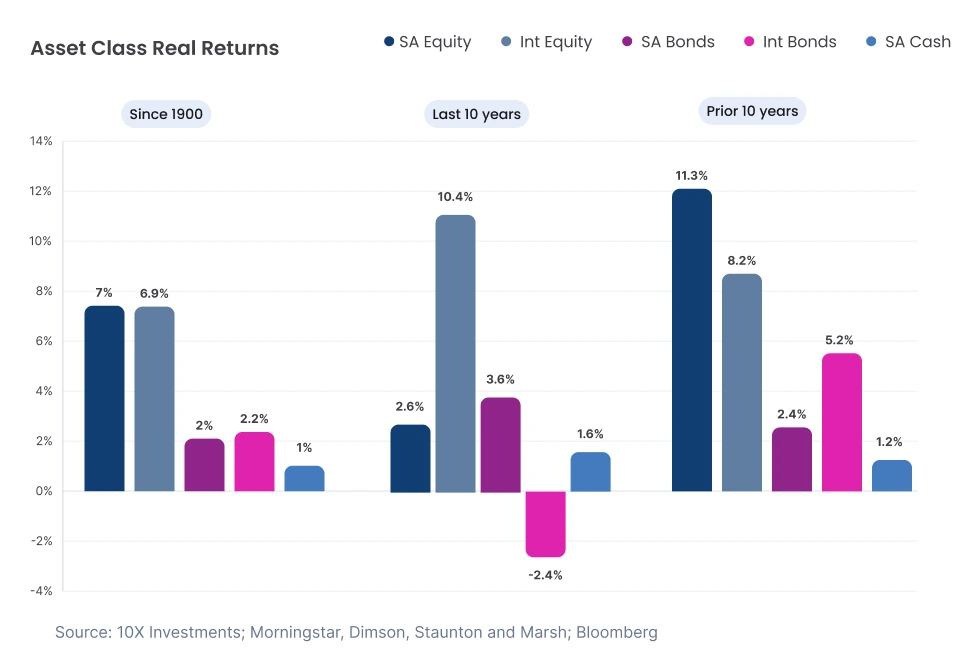
You would consider including a mix of equities, real estate, bonds and cash in your portfolio. At 10X, you can adjust your underlying portfolio by choosing from a selection of carefully curated investment funds, each geared towards different investor profiles via a different mix of assets.
Equities are the most volatile of the different asset classes, but they are likely to generate the best returns over time. Equities have historically produced returns above inflation, by around 7% annually over the long term (based on JSE All Share Index performance versus CPI from 1960-2020); however, past performance does not guarantee future results. Real estate may provide you with strong returns while serving as a hedge against inflation. Bonds may add stability to your portfolio, but they are likely to produce lower returns over time. Bonds may outperform expectations, but they are generally seen as a more conservative option. Cash is the most stable of the asset classes, but you are also likely to see the lowest returns generated here.
Generally, it’s important to diversify across assets, as this could be an effective way to balance both risk and returns in your portfolio.
You can also further diversify your portfolio offshore, provided your portfolio is Regulation 28-compliant. Regulation 28 of the Pension Funds Act sets limits on the amounts of equities and offshore investments you may include in your portfolio. Current regulations allow a maximum of 75% in equities and 45% offshore. At 10X, our funds are well-diversified across the different asset classes. As such, you are able to select a fund that suits your specific needs. Please explore our funds page for the most up-to-date fund information.
The impact of fees
The fees that you are paying on your retirement annuity should be reviewed annually to ensure that these are not too high. Higher fees may mean that you have fewer returns available to reinvest in your retirement annuity and potentially grow and compound over time. Lower fees may mean that you have more returns available to compound and grow over time. There are a number of fees that you may typically expect to see deducted from your RA. These are the following fee types:
- Administration fees: There will be administration fees charged for tasks that are related to admin. These will be for tasks like compliance, reporting, tax and similar.
- Advisor fees: If you have an advisor, they will charge an initial fee and ongoing fees for the services and advice that they offer you.
- Management fees: These are the fees that are charged for the running and management of the fund.
Let’s look at an example to illustrate the effect of fees of 3% versus fees of 1%. We will assume the following information:
- Investment period of 30 years
- Initial lump sum investment of R50,000
- Monthly contributions of R2,000
- Return of 12% per annum
- An inflation rate of 6%
Example 1 (1% Fees): Real investment value is approximately R1.8 million
Example 2 (3% Fees): Real investment value is approximately R1.3 million
As this example shows, a small difference in fees may impact the growth of your funds, especially when compounded over the long term. This example is for illustrative purposes only and real results may vary. You can find out more about how fees impact long-term retirement outcomes here.
Your Effective Annual Cost (EAC) shows your total costs and fees of owning an investment over a one-year time period. It is a standardised metric which was introduced by ASISA in 2015. All else being equal, you may see that a higher EAC would result in fewer returns available for reinvestment than a lower EAC, which may mean there are more returns available to be reinvested and potentially compound over time. The EAC should be just one factor to consider when comparing service providers.
Our fees at 10X are low-cost, transparent and simple - allowing you to easily see what you are being charged on your investment. Fees charged on retirement products are usually 1% or less, depending on the product chosen and the amount invested. Please explore our products for the most up-to-date fee information.
How 10X supports retirement planning
Building a successful retirement plan often requires more than one investment product. At 10X, we help investors create a comprehensive retirement strategy by offering access to a range of retirement and investment solutions that can work together through the different stages of their financial journey. Our offerings include retirement annuities, preservation funds, tax-free savings accounts, and living annuities.
We focus on low-cost investing, transparent fees and diversified portfolios, which help investors keep more of their returns over time. Our investment approach combines index-tracking alongside a more active approach to asset allocation, with access to a wide range of local and offshore investment opportunities. For those looking to maximise diversification, our tax-free savings account can be invested up to 100% offshore. Our living annuity also allows for 100% offshore investment. At 10X, our focus is on helping investors build and maintain a long-term retirement plan through disciplined investing, diversification, low fees and a consistent investment strategy.
Final thoughts: Seeing your retirement annuity as part of a bigger picture
Your retirement annuity plays a vital role in your retirement plan, but it shouldn’t be the only product you use within your broader retirement plan. Different vehicles offer varying levels of flexibility, tax savings, and accessibility, so these factors should be considered in your decision-making to help you meet your objectives.
As an investor, you should review your retirement plan and investments each year to ensure they meet your needs and any changes to your personal circumstances. Speak to the knowledgeable and helpful investment consultants at 10X, who are here to assist with any area of your retirement and investment planning.
Related articles



How can we 10X Your Future?
Begin your journey to a secure future with 10X Investments. Explore our range of retirement products designed to help you grow your wealth and achieve financial success.