Living annuity planning: The three decisions that matter most in a living annuity
20 May 2026
The Living Annuity Masterclass: How to maximise your retirement income


A living annuity offers you, as the investor, a great level of flexibility, but with this comes responsibility. There are a few key areas that can have an impact on your living annuity in the long term and require careful consideration. These factors are: your drawdown rate, your asset allocation and your fees.
By focusing on these three areas and being strategic in your decision-making, you can improve the longevity and sustainability of your living annuity. In this article, we will take a closer look at managing your drawdown rate, asset allocation and fees in order to achieve the best possible outcomes in the long term.
Plan for a comfortable retirement with our
Living Annuity calculatorWhat is a living annuity?
A living annuity is a flexible post-retirement income product that is funded by your retirement savings from your retirement annuity, preservation fund or similar. Your savings remain invested, and you are able to draw an income from your capital while keeping it invested in the market and allowing for potential growth over the long term.
You are able to select your drawdown rate and the underlying funds that your capital is invested in. Your drawdown rate can be adjusted each year at the policy anniversary date in order to cater to changing needs over time. It will, however, need to be within the stipulated drawdown rate bracket. You may also select the frequency of your payments; annually, biannually, quarterly or monthly, depending on your preferences.
One of the major appeals of living annuities is the ability to pass the remaining capital of your living annuity to your beneficiaries outside of your estate, which means it will be tax-free.
Building blocks to a lasting Living Annuity
Our panel of experts discusses living annuities, sustainable drawdown rates, offshore investing, and everything else one might need to consider to ensure a comfortable retirement. Read more
![Building blocks to a lasting Living Annuity [webinar + transcript]](/_next/image?url=https%3A%2F%2Fimages.ctfassets.net%2Fyqvz0zwovkbq%2F4dZzwtwSkZ19hmRrVa6Zyb%2F770741ecc4b2ae3deda48fa06da42718%2FWebinar_recording_cover_1920X1080.webp&w=828&q=75)
The importance of making the right decisions
The decisions you make regarding your living annuity during retirement are incredibly important, as it is a long-term investment product that needs to provide an income throughout your retirement years.
A long-term investment means that it may need to provide for you for 25 to 30 years - or even longer. You are also no longer contributing and accumulating savings in a retirement annuity or similar, but instead, you are now drawing from your hard-earned capital.
The decisions that you make now regarding your living annuity - no matter how small they may seem - can have a major impact on the potential long-term outcomes. Each decision you make should be carefully considered while always keeping your long-term plans and goals in mind.
Decision 1 — Your drawdown rate
Your drawdown rate is the percentage of the total value of your living annuity that you draw as an income. This drawdown rate may be amended each year at the policy anniversary date. This is the date at which your annuity was implemented. Current regulations state that your drawdown rate needs to be between 2.5% and 17.5% per annum.
A higher drawdown rate may mean that your capital depletes too quickly. Therefore, it is important to choose a lower drawdown rate, if at all possible. A lower drawdown rate ensures that more capital stays invested in order to potentially grow and compound over time.
A drawdown rate of 4% is generally thought to be sustainable by financial experts, allowing your capital to provide for you for the retirement years. Longevity risk is the risk that you outlive your capital, so this needs to be considered when managing your drawdown rate.
Decision 2 — Your asset allocation
As an investor, you’ll need to make a decision regarding the mix of assets in which you wish to invest. These are, namely, equities, real estate, bonds and cash. 10X gives you the freedom to adjust your underlying portfolio by choosing from a selection of carefully curated funds, each with a different mix of assets and geared towards different investor profiles.
Each of these asset classes presents different characteristics. Equities are considered the most volatile of the asset classes, but they are also likely to generate the highest returns in the long term. Equities have historically produced returns above inflation, by around 7% annually, over the long term (based on JSE All Share Index performance versus CPI from 1960-2020). Of course, past performance does not guarantee future results. Real estate will also provide some good returns, as well as a good hedge against inflation. Bonds are likely to generate some lower returns while also adding stability to your portfolio. While bonds are generally seen as a more conservative option, they may still outperform expectations. Cash is the most stable of the asset classes, but it is also likely to generate the lowest returns of all.
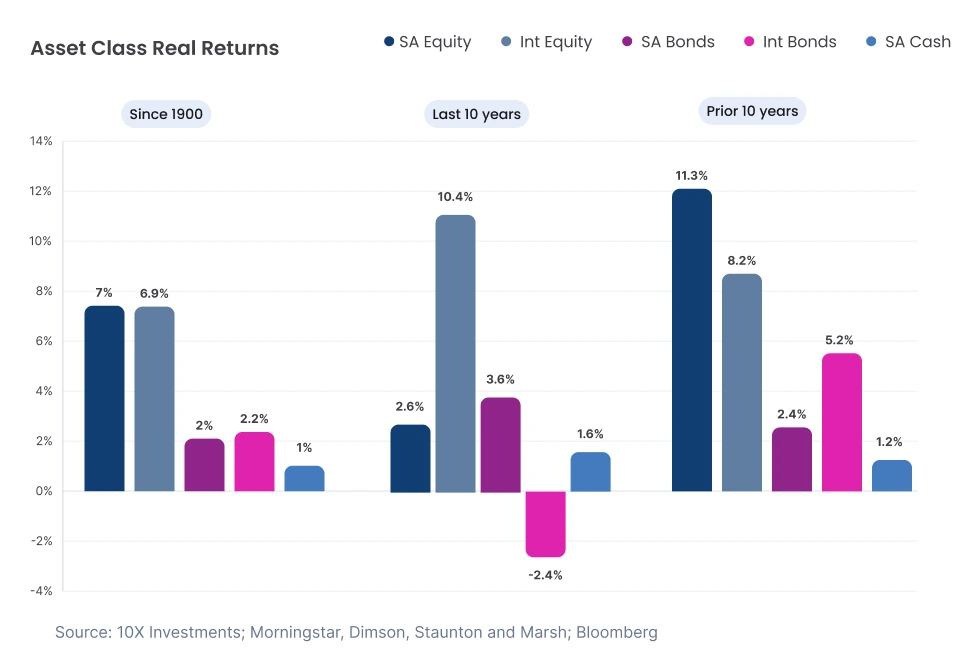
Your asset allocation is an important factor in your portfolio's returns and growth. In fact, asset allocation plays the biggest role in the performance of your living annuity, accounting for over 90% of returns, as seminal research from Brinson, Singer and Beebower shows.
You would want to balance return and risk in your portfolio and include a well-diversified portfolio that may allow you to take advantage of different economic cycles. Generally, you should avoid investing too conservatively, i.e. investing heavily in cash, as this may mean less growth on your capital. Including some growth assets such as equities in your portfolio may mean you are able to grow your living annuity capital over time. Keep in mind that investment decisions should depend on personal circumstances and your investor profile, and nothing can be guaranteed.
You may also want to further diversify your portfolio offshore. This can be a good hedge against local market instability in South Africa and any depreciation of the Rand. A living annuity is not governed by Regulation 28 of the Pension Funds Act. This means that, should you wish, you may invest your annuity 100% offshore, as long as this is offered by your service provider.
Aligning your asset allocation with your investor profile, which focuses on both your investment timelines and your risk profile, and your long-term financial goals, is considered a good way to structure your asset allocation, ensuring that it is well-aligned with your needs and situation.
As mentioned, at 10X, we make things easy for you by offering a range of carefully selected funds that are well diversified across asset classes. Please explore our funds page for our most up-to-date information. Fund information is up-to-date as of 19 May 2026.
Higher fees very likely means lower returns (and here's the maths to prove it)
Paying high fees on your retirement investments (such as a retirement annuity or a living annuity) almost always means less money in your pocket, and less money for your retirement. Read more
Decision 3 — Your fees
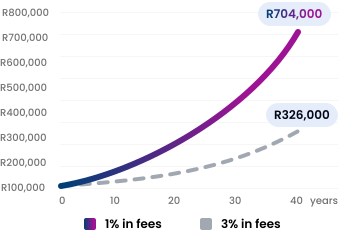
As an investor, it’s smart to keep fees as low as possible to ensure that they don’t impact your living annuity capital over the long term. As you are not contributing during your retirement years, there are no returns to offset fees. Higher fees may mean that there are fewer returns available to reinvest, while lower fees may mean there are more returns to reinvest and potentially grow over the long term.
There are some fees that you may expect to see deducted. These are as follows:
- Management fees: Fees charged for the operation of the fund.
- Advisor fees: If you decide to make use of an advisor, they will charge fees for the advice and any other services that they offer. There may be both an initial and an ongoing fee charged.
- Administration fees: Fees will be charged for administrative tasks. These will be for tasks such as compliance, tax and reporting.
Let’s look at an example which can help compare the difference between low fees of 0.86% and higher fees of 3% per annum. We will assume the following information in this example:
- Investment amount: R4 million
- Investment period of 25 years
- Drawdown rate: 4% (annual payments)
- Return of 12% per annum
- An inflation rate of 6%
Example 1 (0.86% Fees): Real investment value is approximately R4.7 million.
Example 2 (3% Fees): Real investment value is approximately R2.9 million.
A seemingly small difference in fees can have an impact on the potential growth of your living annuity over the long term. This example is for illustrative purposes only, and actual results may vary. You can learn more about how fees affect retirement outcomes here.
It’s also important to check your Effective Annual Cost (EAC). This is a standardised metric that was introduced in 2015 by ASISA. It allows you to see the total fees and costs involved in owning an investment product over one year. All things being equal, you may see that a higher EAC would result in fewer returns available for reinvestment than a lower EAC, which may mean there are more returns available to reinvest and potentially compound over time.
9 out of 10 people do better with 10X
The EAC would be one factor to consider when comparing different providers. At 10X, we offer an EAC calculator as part of our free online suite of tools for investors. This allows you to compare and analyse the fees charged by 10X with those charged by other providers. Your EAC should be displayed as a percentage on your investment statement - or if it is not visible there, it can be requested from your service provider. Our fees at 10X are low, simple and transparent - ensuring that all investors are clear on what they are being charged. Please explore our products for the most up-to-date fee information.
How these three factors work together
Your drawdown rate, asset allocation and fees do not operate independently of one another. Instead, these three factors work together and collectively influence the sustainability and longevity of your annuity over time. For example, if you decide on a high drawdown rate, high fees and a conservative asset allocation that is heavily invested in cash, you’re increasing the risk of outliving your living annuity capital. As mentioned, this is known as longevity risk. While cash offers stability, it may struggle to generate sufficient growth to keep pace with inflation and ongoing income withdrawals over a long retirement.
On the other hand, if you instead decide on a low drawdown rate, low fees, and a well-diversified portfolio with the appropriate exposure to growth assets in your underlying portfolio, your annuity is likely to be more sustainable in the long term. Keeping more capital invested may allow for greater long-term growth potential and may help your portfolio better withstand inflation over time. The goal is to ensure that these three factors stay aligned with your investor profile, retirement timelines, income needs, and long-term financial goals. A balanced and disciplined approach may place you in a stronger position to manage your retirement income more sustainably over 25 to 30 years or longer.
Common mistakes retirees make
There are common mistakes retirees may make when managing a living annuity. Let’s have a look at some of these mistakes:
- Drawing too much income: Having a high drawdown rate adds unnecessary pressure on your annuity capital and may increase the risk of your savings depleting too quickly.
- Being too conservative with your asset allocation: Some retirees become overly invested in cash because they are worried about market volatility. While cash provides stability, it may not generate enough growth to keep pace with inflation.
- Not paying attention to fees: High fees can gradually reduce the returns available for reinvestment and compounding over time. Even seemingly small differences can have a major impact on long-term outcomes.
- Reacting emotionally to short-term market volatility: Getting distracted by short-term volatility and not keeping focused on long-term plans can negatively impact your living annuity’s sustainability. Market volatility is a natural part of investing, and making knee-jerk decisions should be avoided.
- Failing to review your living annuity annually: While it’s important not to over-monitor your investments, your living annuity should still be reviewed annually to ensure that your drawdown rate, asset allocation, fees, and retirement objectives remain aligned with your long-term goals.
Final thoughts on living annuity decisions
Managing a living annuity can feel overwhelming, even though the flexibility and freedom it offers are great advantages. It’s important not to overcomplicate the process; instead, focus on the three key factors that can shape your retirement outcomes in the long term. By keeping your attention on your drawdown rate, asset allocation and fees, you can be assured that you are on the right track to building a sustainable retirement. At 10X, we help you retire your way. We aim for superior returns while offering exceptional service at low fees and 100% offshore exposure. Get in touch today to learn more!
Related articles


How can we 10X Your Future?
Begin your journey to a secure future with 10X Investments. Explore our range of retirement products designed to help you grow your wealth and achieve financial success.