How to transfer your pension or provident fund to a preservation fund
4 December 2025
The uncomfortable truth about retirement in South Africa - Rands and Sense by 10X [video]
We sit down with 10X Investment Consultant lead Andre Tuck and discuss the retirement savings crisis in South Africa. We also delve into living annuities, retirement annuities, TFSAs and everything in between. Read more
![The uncomfortable truth about retirement in South Africa - Rands and Sense by 10X [video]](/_next/image?url=https%3A%2F%2Fimages.ctfassets.net%2Fyqvz0zwovkbq%2F5ipSTnRq5Dp25fyghm5kGQ%2F02c801c78d5e1ca9280bfd34d7602368%2FAndre_Tuck_podcast_cover_image__1_.webp&w=828&q=75)
A job change may trigger the need for financial decision-making when it comes to your investment savings, and, in particular, whether to use a preservation fund. Transferring money from your pension or provident fund to a preservation fund allows you to make use of the potential compound growth that may come from ‘preserving’ your savings.
Withdrawing capital from your pension or provident fund may result in a loss in the potential growth that may otherwise have occurred if your savings had remained invested in a preservation fund. Investors may feel put off by the administration processes involved with transferring capital from a pension or provident fund to a preservation fund.
Many investors delay the decision to transfer purely because they’re unsure of the process or worry about making the wrong choice. By taking the time to understand how these funds work, you can make a significant difference to your long-term retirement outcomes. Approaching the transfer with clarity and accurate information allows you to give your money the best chance of continuing to compound uninterrupted.
In this article, we will take a closer look at the administration involved with such a transfer in order to help simplify the process and reduce some of the anxiety that investors may experience. We’ll also offer some tips to get the most out of your preservation fund.
See your pension savings grow with our
Preservation Fund calculatorA recap of preservation funds
A preservation fund is a long-term retirement savings product that allows you to continue to accumulate savings that have previously been in a pension or provident fund upon a job change. You can then select the funds that you wish to invest your savings in, according to your investor profile and financial goals.
Preservation funds also help prevent unnecessary withdrawals when changing jobs. Plenty of South Africans end up reducing their retirement prospects by cashing out at a career move. A preservation fund helps keep your long-term strategy intact by keeping your savings invested for your future.
Transferring your savings to a preservation fund will not trigger a tax event. The growth within the fund is also tax-free. Therefore, this potentially allows for more of your money to be reinvested and compounded over the long term. Upon the transfer, you will need to ensure that your pension fund is transferred to a pension preservation fund and your provident fund is transferred to a provident preservation fund.
Why preservation matters when leaving your job
The high cost of cashing out
Cashing out instead of preserving your savings will mean there is a loss of the potential compound growth of your capital over time. It also means you may need to pay more in tax. Please see below tax tables which have been taken from the SARS website:
| Taxable income (R) | Rate of tax |
|---|---|
1 – 27 500 | 0% of taxable income |
27 501 – 726 000 | 18% of taxable income above 27,500 |
726 001 – 1 089 000 | 125 730 + 27% of taxable income above 726 000 |
1 089 001 and above | 223 740 + 36% of taxable income above 1 089 000 |
Why a preservation fund is the best option
As mentioned, transferring your savings to a preservation fund does not trigger a tax event. Your savings that have been transferred can continue to potentially compound and grow, as has likely been the case previously, while they were invested in either the employer-sponsored pension or provident fund. Staying invested through market cycles means you can benefit from both the strong years and the weaker ones. This has historically produced better long-term results than trying to time the market. A preservation fund can ensure continuity in your strategy, so your investments remain aligned with your retirement plan.
Step-by-step guide to transferring your pension/provident fund
Let’s have a look at the different steps involved with transferring your pension or provident fund:
- Step 1: Request any necessary quotes from your current pension or provident fund service provider.
- Step 2: Complete the required withdrawal form from your current pension or provident fund service provider.
- Step 3: Complete the required application form, as requested by the new service provider.
- Step 4: Submit your FICA documentation, which includes a copy of your ID, proof of bank account and proof of address (FICA documentation may need to be certified), along with your completed and signed forms and quote to both sets of service providers.
- Step 5: This Section 14 Transfer may take up to 6 months to complete. You may need to check in with both providers along the process to ensure that the process is ticking along smoothly.
Delays tend to occur when documents are incomplete or certification requirements aren’t met, so, making sure everything is accurate from the beginning can shorten the timeline. It can also help to keep clear records of all correspondence and to respond quickly to any follow-up requests from either provider.
Understanding asset allocation
Asset allocation plays the biggest role in the performance of your preservation fund, accounting for over 90% of returns, as seminal research from Brinson, Singer and Beebower shows.
Your asset allocation can be a selection of the various asset classes, such as equities, real estate (property), bonds and cash. At 10X, you have the freedom to customise your underlying portfolio by choosing from a selection of carefully curated funds, each with a different asset allocation.
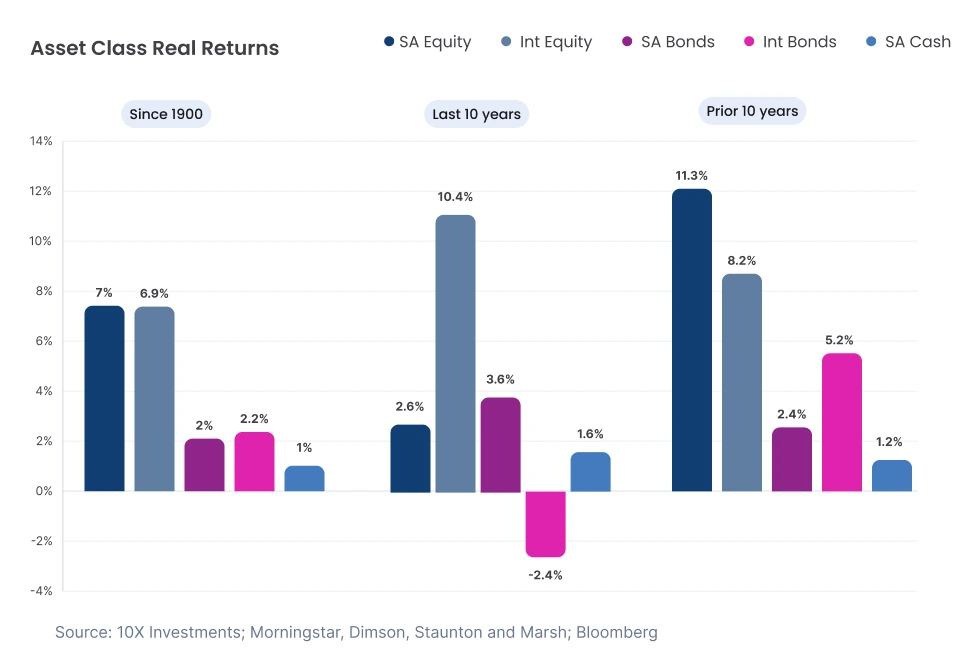
Bonds and cash will add stability to your portfolio. Cash is likely to generate the lowest returns of the asset classes, while also being the most stable. Bonds tend to produce better returns than cash, but are still considered a more conservative investment option. Keep in mind that this does not mean that bonds will never perform better than expected. Real estate, on the other hand, may be a good hedge against inflation.
Equities are the most volatile of the asset classes, but may produce the best returns in the long run. As data suggests, equities have historically produced returns above inflation by around 7% annually - over the long term (based on JSE All Share Index performance versus CPI from 1960-2020), but past performance does not guarantee future results.
What a good asset allocation should look like
The key thing is to make sure you align your asset allocation with your investor profile - which includes your risk tolerance levels, your investment timelines, and your long-term financial plan. This is of paramount importance.
Diversifying across the various asset classes helps to balance both capital preservation and growth. You may like to diversify offshore too, in accordance with the current Regulation 28 rules. Regulation 28 of The Pension Funds Act states that retirement products, such as preservation funds, must limit the percentage of their capital that they invest in both equities and offshore. The cap for equities is 75% and the cap for offshore is 45%. Diversifying offshore may provide a hedge against local market volatility and any depreciation of the Rand.
Why many people get asset allocation wrong
Some investors may invest too heavily in cash due to the fear of market volatility and experiencing a loss in capital. However, investing too heavily in cash may result in lower returns. These returns may then struggle to outperform inflation.
Aligning your investor profile and financial goals with your asset allocation is important. Your investor profile looks at both your risk tolerance levels and your investment timelines. A risk-averse investor with shorter timelines may not be comfortable investing too heavily in equities, compared to a younger investor with longer timelines. The younger investor who has a more risk-tolerant profile may look to avoid investing in cash and instead include a higher percentage of equities.
How 10X builds asset allocation
10X offers a wide range of Regulation 28-compliant funds that are well diversified across the asset classes. These funds align well with a variety of different investor profiles. We use an index tracking investment strategy, which includes a more active approach to asset allocation.
We've built the 'happy retirement' machine
Understanding the most effective strategy for investing your retirement savings is fundamental to experiencing a happy retirement. We've built an investment machine that gives you a great chance of really golden years. Read more

Our cost-effective funds also help to optimise growth within the fund. Please visit our funds page for the most up-to-date fund information. Fund information is correct as of the 27th of November 2025.
Rules and access: What you can and cannot withdraw
Two-Pot retirement system
The Two-Pot Retirement System is a system that was introduced by the National Treasury in September 2024. This changes the way preservation fund (and other retirement products) withdrawals are governed. Under the new system, all contributions are split between the ‘savings pot’ and ‘retirement pot’. One-third to the savings pot and two-thirds to the retirement pot.
There is also a third pot, known as the “vested pot”. All savings and contributions made before September 2024 will form part of the ‘vested pot’, and this pot is still governed by the old rules. This means that you are allowed one withdrawal from your vested portion of your fund before retirement.
Withdrawals are allowed from the savings pot once per year for a minimum amount of R2000. Withdrawals from the savings pot should be kept for emergencies only, if possible. All withdrawals will be taxed at your marginal tax rate and also subject to an administration fee. The retirement pot capital will remain invested until retirement age, which is from age 55 in South Africa.
Contributions to a preservation fund are not permitted. The savings component of the preservation fund, however, will grow at the same rate as the total fund. If the total fund grows by double the size, then both the savings pot and the vested pot will also grow by double the size. Please consult the latest FSCA guidance on the Two-Pot Retirement System.
Access at retirement (55+)
From the age of 55, you will have access to your preservation fund. This allows for a maximum of one-third to be taken as cash. Your preservation fund will then be used to purchase an annuity, either a life or a living annuity. This annuity will provide you with an income for your retirement years.
Why transfer to a low-fee provider like 10X
10X offers a transparent and cost-effective preservation fund with access to a wide range of well-diversified, Regulation 28 funds. The cost effectiveness of our fund may then result in more returns available to be reinvested and compounded over time. Higher fees may mean that you have fewer returns to reinvest and potentially grow over time, therefore impacting the potential growth of your fund.
Let’s look at an example to help illustrate the effect of high fees:
We will be comparing fees of 3% with fees of 1%.
Let’s assume the following factors for our example:
- Investment period of 30 years
- Investment of R100,000
- Return of 12% per annum
- An inflation rate of 6%
Example 1 (1% Fees): Real investment value is R398,578.
Example 2 (3% Fees): Real investment value is R231,004.
We can see how just a small difference in fees makes a major difference in retirement outcomes. This example is for illustrative purposes, and real results may vary. You can learn more about fees here.
There are typical fees that you may expect to see:
Administration fees: Administration fees are charged for admin tasks related to the fund. Examples of these kinds of tasks would be tax, compliance and reporting.
Advisor fees: Advisors will usually charge for their advice and services. There may be both an initial and an ongoing fee charged.
Management fees: These are the fees charged for the management of the fund.
The Effective Annual Cost (EAC) is a standardised metric which was introduced in 2015 by ASISA. This metric can be used to evaluate and compare the total costs of owning an investment over a one-year period. The EAC would include fees such as administration fees, advisor fees and management fees, as well as any other applicable costs. All factors being equal, a higher EAC would mean that less of your investment returns can be reinvested and potentially grow and compound over time, while a lower EAC means that more of your returns may be reinvested and potentially grow over the long term. The EAC of an investment is just one factor to consider when comparing service providers.
At 10X, our fees are simple and transparent, allowing investors to easily see what they are being charged. We charge fees of 1% or less on our retirement products, depending on the product selected and the amount invested. Please explore our product page for the most up-to-date fee information.
Final thoughts on transferring to a preservation fund
Transferring your pension or provident fund across need not be a complicated process. As you have seen, there are just a few key steps involved that need to be followed. A preservation fund is a great way to continue to grow your previously saved capital from a pension or provident fund when changing jobs.
Focusing on low fees, an appropriate asset allocation and offshore exposure can help contribute to the long-term growth of your fund. At 10X, our funds are cost-effective, transparent and well-diversified.
You can expect excellent customer service from our investment consultants with respect to all queries and administration, and a focus on superior returns for your preservation fund in the long term. Get in touch and speak to one of our consultants to find out more.
Related articles


How can we 10X Your Future?
Begin your journey to a secure future with 10X Investments. Explore our range of retirement products designed to help you grow your wealth and achieve financial success.