Living annuity planning: Balancing freedom and responsibility outside Regulation 28
15 May 2026
Often, investors do not realise that living annuities are not bound by Regulation 28 of the Pension Funds Act. Regulation 28 applies only to retirement products such as retirement annuities and preservation funds. Not needing to adhere to Regulation 28 will give you more freedom and flexibility when it comes to the underlying funds that you choose to invest in within the living annuity wrapper.
However, this will also come with the responsibility to manage your fund selection appropriately over time. In this article, we will look at the importance of managing your living annuity in order to achieve sustainability throughout your retirement years.
Plan for a comfortable retirement with our
Living Annuity calculatorWhat is a living annuity?
A living annuity is a post-retirement income product that will provide you with an income for your retirement years. It is funded by retirement savings from products such as retirement annuities, preservation funds, and similar. A living annuity offers you great flexibility; you are able to select both your drawdown rate and the underlying funds in which you invest.
Your drawdown rate is the percentage of the total value of your annuity that you draw as income. This may be a rate of between 2.5% and 17.5% per annum. Your annuity payments may be received annually, biannually, quarterly or monthly. This drawdown rate can be adjusted each year at the policy anniversary date.
With living annuities, you also have the ability to pass the remaining capital of your living annuity to your beneficiaries outside of your estate, which means it will be tax-free.
What is Regulation 28 of the Pension Funds Act?
Regulation 28 of the Pension Funds Act puts a limit on how much you should invest in certain asset classes. Current regulations state that you may invest up to 75% in equities and 45% offshore. As mentioned, these regulations apply to retirement products such as retirement annuities and pension and provident funds. It does not apply to living annuities.
Regulation 28 was implemented to help investors avoid poorly diversified portfolios that may also entail excessive risk. Regulation 28 may help you reduce risk in your retirement products whilst also helping you ensure that your portfolio is well diversified across different asset classes.
The benefits of investment freedom
There are a number of benefits that come with the greater investment freedom that is offered by living annuities. Let’s have a look at some of these:
- Greater exposure to offshore: Your living annuity allows you to invest up to 100% of your annuity offshore. This can be a good hedge against any local market instability. It can also mean more access to greater opportunities that may be offered by the international market.
- More flexibility when it comes to asset allocation: There are no restrictions, and you are able to select the asset allocation that aligns best with your investor profile, needs and financial goals.
- More flexibility to adjust to changing needs over time: You will have the freedom to adjust your drawdown rate and asset allocation to ensure that these both stay in line with your changing needs and situation over time.
The role of asset allocation in a living annuity
As there are no restrictions when it comes to your living annuity asset allocation, you will have a lot of freedom and flexibility to explore the different options available to you. Your asset allocation is the variety of different asset classes that you select to invest your money in. You will choose from equities, real estate, bonds and cash. At 10x, you’ll have the freedom to adjust your underlying portfolio by choosing from a range of different investment funds, each with a different mix of assets and geared towards different investor profiles.
Equities are the most volatile of the different asset classes, but are likely to see the best returns in the long-term. Equities have historically produced returns above inflation, by around 7% annually over the long term (based on JSE All Share Index performance versus CPI from 1960-2020), however, past performance does not guarantee future results. Real estate (property) will also provide some good returns over time, while serving as a good hedge against inflation. Bonds may produce some lower returns, but they will add stability to your portfolio. This doesn’t mean bonds will never outperform expectations, merely that they are seen as a more conservative option. Cash is the most stable and liquid of the asset classes but it is also likely to generate the lowest returns of all.
Asset allocation plays the biggest role in the performance of your living annuity, accounting for over 90% of returns, as seminal research from Brinson, Singer and Beebower shows.
You may even wish to invest your living annuity 100% offshore. We offer a number of well-diversified funds, allowing you to balance both risk and return in your portfolio. Please visit our funds page for the most up-to-date fund information.
Investment strategy: Why simplicity still matters
It can be tempting to overcomplicate the investment process, but sometimes simplicity can support better long-term investing discipline. An index-tracking investment strategy looks to simplify the investment process and focuses on consistent, long-term results for clients. Index-tracking is where a benchmark index, such as the S&P 500, is tracked, with the aim of getting the same returns as this index. This approach necessitates fewer activities, which may mean lower costs overall.
An active management investment strategy is when a manager aims to outperform the market by responding to current and projected market conditions. This approach involves research, analysis and trading activities, which may then mean higher costs passed on to the investor in the form of fees. This approach doesn’t always achieve the desired outcome of better performance, as data from the SPIVA scorecards suggests.
The S&P Indices Versus Active (SPIVA) Scorecards track the performance of actively managed funds against their benchmarks globally. According to the latest SPIVA South Africa Scorecard (as of June 2025), 67.61% of South African actively managed equity funds underperformed the S&P South Africa DSW Capped Index over the ten-year period ending June 30, 2025.
9 out of 10 people do better with 10X
Why fees matter even more without constraints
You will need to keep a close eye on the fees you are paying. Many investors fail to realise the importance of fees, despite the fact that they can make a major difference to their retirement outcomes.
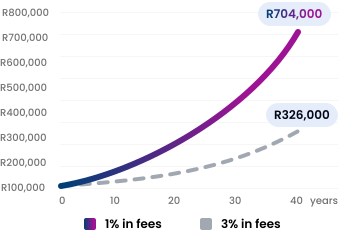
Higher fees may reduce the returns that you have available to reinvest in your annuity. Lower fees may mean more returns to reinvest, potentially growing and compounding your annuity capital over the long term. What may seem like just a small difference in fees can compound over time and have a major impact on your retirement outcomes.
Let’s have a look at some of the typical fees that you may see deducted from your living annuity:
- Management fees: These are the fees that are charged for the management of the fund.
- Administration fees: These fees are for tasks such as compliance, reporting and tax.
- Advisor fees: If you are using an advisor, they will charge fees for their services. You may see both an initial and an ongoing fee levied.
Let’s look at an example which can help compare the difference between low fees of 0.86% and higher fees of 3% per annum. We will assume the following information for this example:
- Investment amount: R4 million
- Investment period of 25 years
- Drawdown rate: 4% (frequency of payment: annually)
- Return of 12% per annum
- An inflation rate of 6%
Example 1 (0.86% Fees): Real investment value is approximately R4.7 million.
Example 2 (3% Fees): Real investment value is approximately R2.9 million.
It may seem like a small difference in fees, but this can have a major impact on the potential growth of your living annuity over the long term. This example is for illustrative purposes only, and actual results may vary. You can learn more about the impact of fees here.
Compare your retirement investments
Effective annual cost calculatorThe Effective Annual Cost (EAC) is an important metric to check. This standardised metric was introduced by ASISA in 2015. It allows you to view the total fees and costs associated with owning an investment product over one year. All things being equal, you may see that a higher EAC would result in fewer returns being available for reinvestment compared to a lower EAC, which may mean there are more returns available to be reinvested and potentially compound over time.
The EAC would be one factor to consider when comparing service providers. At 10X, we offer a useful EAC calculator as part of our online suite of tools. This allows you to compare and analyse the fees charged by 10X with those fees charged by your service provider. Your EAC should be displayed on your investment statement, or if not, it can be requested from your service provider. Our fees at 10X are low, transparent and simple, allowing you to easily see and understand what you are being charged. Fees on retirement products are usually 1% or less, but this does depend on the product chosen and the amount invested. Please explore our products for the most up-to-date fee information.
Drawdown strategy and fund selection freedom
It is important to carefully consider your drawdown strategy as well as your fund selection. Your drawdown rate needs to be sustainable in order to help ensure the longevity of your living annuity. Longevity risk is the risk that you may outlive your annuity capital.
A drawdown rate of 4% is thought to be sustainable by financial experts, but nothing can be guaranteed. If you are able to draw less, then this is suggested. This will then allow for more of your capital to remain invested, and potentially grow and compound over time.
Your asset allocation should align with both your investor profile and your long-term financial plan. Your investor profile takes into account both your risk profile, referring to your tolerance for risk, and your investment timelines. It’s also important to remember that your drawdown strategy does not operate in isolation. Factors like inflation, market returns, fees and life expectancy will influence how long your living annuity capital lasts. Retirement may span 25 to 30 years or even longer, which means your drawdown strategy should be reviewed regularly to ensure that it stays sustainable over time. A drawdown rate that appears manageable in the early years of retirement may become more difficult to sustain if market returns are weaker or inflation remains elevated for a prolonged period of time.
Common mistakes investors make
Let’s review a few common mistakes that investors can make when it comes to their living annuity:
- Not aligning asset allocation: Your asset allocation should be aligned with your investor profile and long-term financial plans and goals.
- Ignoring fees: Fees should be reviewed annually, and you should be aware of all of the charges. Remember to check your EAC.
- Not diversifying: You would want to diversify across the asset classes to ideally balance both risk and return.
- Being distracted by short-term market noise: It’s important to stay focused on your long-term retirement plan and avoid being distracted by any short-term market noise that may occur.
Final thoughts: freedom requires discipline
The freedom and flexibility that your living annuity offers need to be balanced with discipline and responsibility. Without this, you may find that your living annuity may not support your long-term retirement goals effectively. Your main focus should always remain on your long-term financial goals and strategy, without being distracted by short-term market noise. At 10X, we’re experts at everything to do with investments and retirement, and we’re here to help you secure your future. For more information on living annuities or to get started with a 10X Living Annuity today, reach out to one of our investment consultants now!
Related articles


How can we 10X Your Future?
Begin your journey to a secure future with 10X Investments. Explore our range of retirement products designed to help you grow your wealth and achieve financial success.