Living annuity pros, cons and risks that South Africans should understand
12 November 2026
Building blocks to a lasting Living Annuity
Our panel of experts discusses living annuities, sustainable drawdown rates, offshore investing, and everything else one might need to consider to ensure a comfortable retirement. Read more

- A living annuity offers flexible retirement income, control over investment choices and the potential for continued investment growth, with any remaining capital available to beneficiaries.
- Living annuities carry risks such as market volatility, inflation, high drawdown rates and the possibility of outliving your retirement savings, as income is not guaranteed for life.
- Managing your annuity requires regular reviews of your drawdown rate, investment performance, asset allocation and fees to help your retirement savings last.
A living annuity is a flexible retirement income product that allows you to draw an income while your capital remains invested in the market. Living annuities allow you to adjust your income draw each year, and they also allow you to amend your fund selection as needs and requirements change over time. Along with this flexibility comes responsibility for managing your annuity capital and the associated risks.
Unlike a guaranteed (life) annuity, which provides income for life, a living annuity does not guarantee income and carries longevity risk. Factors such as fees, asset allocation, fund selection, drawdown rate and investment performance all influence your retirement outcomes. It’s important to carefully consider both the advantages and disadvantages before making any decisions about your retirement.
In this article, we’ll take a closer look at the pros, cons and risks of living annuities. By reading through this piece, you’ll have a greater understanding of how living annuities work.
Plan for a comfortable retirement with our
Living Annuity calculatorWhat is a living annuity and how does it work?
A living annuity is a post-retirement investment product funded by your retirement savings from retirement annuities, preservation funds and similar products at retirement age. The earliest retirement age in South Africa is currently 55, but many people continue to work much longer.
Your capital may be invested in a range of funds within the annuity structure, and these funds can be switched as your needs and requirements change over time. You will also select your drawdown rate. This is the total percentage of your annuity that you draw as income annually. This can be amended each year, prior to the policy anniversary date. This is the date at which your annuity was implemented.
Current legal regulations allow you to select a drawdown rate of between 2.5% and 17.5% per annum. You are also able to select the frequency of your income payments. This may be annually, bi-annually, monthly or quarterly, depending on your individual circumstances and preferences. The remaining capital will be invested in the market and will be subject to any market fluctuations. H2: What are the pros? Let’s look at some of the pros:
Flexible retirement income
You have flexibility when it comes to the percentage of your annuity that you draw as income each year. This can be amended each year to cater for any changing needs. For example, perhaps you find you need less income from your annuity due to rental income, and therefore you may wish to reduce your drawdown rate.
Control over investment choices
You can choose the underlying funds your capital will be invested in. This will be selected after considering factors such as your risk tolerance levels, investment timelines and long-term financial goals and plans.
You can also review and adjust your fund selection as your circumstances change during retirement. For example, you may wish to reconsider your asset allocation as you get older or your income requirements change. This kind of flexibility allows you to maintain an investment strategy that reflects your individual circumstances rather than remaining in the same funds throughout retirement.
Potential for continued investment growth
As your funds are invested in the market, they carry the potential for growth. Investment growth is not guaranteed, but you would ideally want to see growth of your annuity capital over time. Your annuity will need to cover fees, the drawdown rate, and inflation.
Unlike a product that provides a guaranteed income in exchange for your retirement capital, a living annuity allows your remaining savings to benefit from potential investment growth even after you start drawing an income. Positive investment returns can help offset the effect of withdrawals and inflation, potentially allowing your capital to support your retirement income for longer.
Beneficiary details
Any residual capital in your living annuity can be passed on to your beneficiaries upon your passing. They may choose to take over the annuity, receive a cash lump sum, or make use of both options. It is important that your beneficiary information is up to date and accurately reflects your wishes.
What are the cons?
The cons usually stem from the fact that you are responsible for managing it, and there is no guaranteed income for life. Let’s take a look:
No guaranteed retirement income for life
A living annuity does not guarantee a fixed income for life. Your capital is invested in the market, which means it will experience market fluctuations and there may be dips in investment performance. If your withdrawals are too high, they may also affect the longevity of your capital.
Greater responsibility for managing retirement savings
The responsibility for managing your annuity lies with you, as the investor. You will need to ensure that your drawdown rate is sustainable. Ideally, this means that more capital remains invested to potentially grow over time. A sustainable drawdown rate is estimated at around 4%, as suggested by industry experts like William Bengen, but this is not a guarantee, and real results may vary.
Limited access to retirement capital
Your annuity is designed to provide you with a regular income for your retirement years. You generally cannot make additional lump-sum withdrawals from the annuity and must instead adhere to the applicable drawdown rules, apart from certain limited exceptions.
The 4% retirement rule isn't dead (but your investment fees might kill it)
4% has historically been a good rule of thumb when it comes to income drawn down from retirement investments such as a living annuity. But is it still relevant, and when might it be too much? Read more

What are the biggest risks of living annuities?
Longevity risk: Outliving your retirement savings
This is the risk of outliving your retirement savings. An annuity may need to provide for you for 20 or 30 years, making it a long-term investment product. If your withdrawals are too high, this may mean less capital to reinvest and potentially grow and compound over time. It’s important to plan for the long term.
You also need to consider the possibility of living longer than you originally expected. If your capital is depleted too quickly during the earlier years of retirement, you may struggle to maintain your income later in life. Regularly reviewing your drawdown rate and remaining capital can help you assess whether your savings are likely to last.
Investment and market risk
As your annuity capital is invested in the market, it is subject to market volatility. If there is a market downturn, this may affect the value of your annuity. It’s important to balance both growth and capital preservation in your portfolio.
Sequence-of-returns risk
This is the risk of earning poor returns in the early years of retirement while drawing an income from this capital, which could affect your annuity capital and make it difficult to recover. For example, if financial markets experience a major decline shortly after you retire, your regular income withdrawals will continue reducing your remaining investment capital. This means that you may have less money invested when markets eventually recover. Even if investment returns improve in subsequent years, the capital lost through withdrawals during the downturn could have a lasting effect on your retirement savings.
Inflation risk
Inflation risk is the risk that increasing prices may decrease the purchasing power of your money over time. A certain level of income that is suitable now may not be sufficient in the future as the price of goods and services increases over time.
This may put pressure on you to increase your annuity withdrawals to cover rising living expenses. But increasing your drawdown rate could reduce the capital available for future investment growth. Your investment strategy, therefore, needs to consider both your current income requirements and the potential impact of inflation over the years ahead.
High drawdown and fee risk
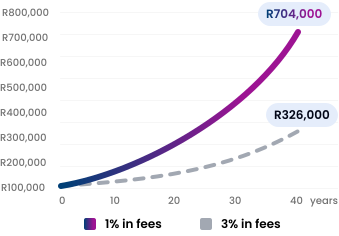
A high drawdown rate may impact your capital as fewer funds are available to grow and compound over time. High fees may also reduce the returns that you have available to reinvest and grow over the long term.
These two factors can have a considerable combined effect on the sustainability of your annuity. If a large portion of your investment returns is being used to cover withdrawals and fees, your remaining capital may struggle to keep pace with inflation or maintain its value over time. This is why it’s important to review both your drawdown rate and the total costs of your annuity regularly.
Living annuity vs life annuity: Understanding the trade-offs
A living annuity is a flexible investment product that lets you draw an income while your funds remain invested in the market, with the potential to grow over time. You can choose the underlying portfolio in which your funds are invested and the income you wish to receive. When you pass away, any remaining value can be passed on to your nominated beneficiaries.
Living annuities carry longevity risk because they are exposed to market fluctuations, so they need to be managed carefully. As a retiree, you are responsible for this. The ‘golden equation’ is one planning framework you may wish to use when managing your annuity: Drawdown rate + fees + inflation ≤ investment returns. This planning guideline assumes your investment returns exceed your drawdown rate, fees, and inflation combined, so your capital doesn’t decline.
A guaranteed annuity is purchased from an insurance company and provides an income for life. Life annuities can be structured to provide level income, income that increases by a predetermined percentage, or inflation-linked income. Upon your passing, the guaranteed annuity returns to the insurance company. A life annuity provides a fixed, predictable income, reducing the stress of market volatility and its potential impact on your income. It also eliminates longevity risk by providing income for life. Unlike a living annuity, you generally can’t change your underlying investment choices or income structure after purchasing a life annuity.
Understanding asset allocation
Asset allocation is an important consideration. It can be an important factor in determining the returns in your portfolio. This can be seen in the research by Brinson, Singer and Beebower. You will select your asset allocation according to your investor profile, investment timelines and long-term investment goals and plans.
Equities may offer long-term capital growth in your portfolio and potentially deliver returns that outpace inflation. They provide exposure to economic growth and companies, but can also fall in value. Their value may fluctuate in the short term, making them more suitable for investors who can tolerate volatility and have longer investment horizons.
Bonds can offer income, diversification and stability in a portfolio. They usually come with less volatility than equities, but this does not mean they are risk-free. You may see values being affected by changes in interest rates, inflation expectations and the ability of the issuer to repay its debt. They are considered more conservative, but they may still outperform expectations.
Real estate provides exposure to real assets and economic activity. It may also generate income through rent and distribution, supporting long-term portfolio growth. However, listed property can be volatile and affected by interest rates, economic conditions, and changes in the property market. Real estate may also help hedge against inflation.
Cash is usually the most liquid and stable of the asset classes. It is less likely to experience the same levels of volatility that you may see with equities or real estate. However, cash returns may not be able to keep pace with inflation over the long term. This may have an impact on purchasing power.
At 10X, you are able to select your funds from our carefully selected list of funds, each offering you access to a wide range of funds. Please visit our funds page to learn more.
The importance of fees
As previously mentioned, high fees may reduce the funds available to be reinvested and allow them to potentially grow and compound over time. Let’s look at an example to illustrate the effect that high fees may have on your investment over the long term.
We will assume the following information:
- Starting capital: R4 million
- Investment period: 25 years
- Gross annual return: 10%
- Inflation: 5%
- Annual drawdown rate: 4% of the opening value each year
Scenario 1 - 0.86% Fees: After 25 years, the annuity would have an estimated inflation-adjusted value of around R4.14 million.
Scenario 2 - 3% Fees: After 25 years, the annuity would have an estimated inflation-adjusted value of around R2.47 million.
This example is for illustrative purposes only and real results may vary. You can learn more about fees here. Here are some cost terms which you may come across:
- Total Expense Ratio (TER): The ongoing expenses within an investment fund.
- Total Investment Charge (TIC): The total investment charge. This combines the TER with the fund's transaction costs.
- Effective Annual Cost (EAC): An annualised estimation of the impact of product, investment management advice, administration fees, and all other relevant charges.
The Effective Annual Cost (EAC) provides a standardised way to understand the full cost of holding an investment over a one-year period of time. The EAC combines various charges linked to an investment into a single annual percentage. This may include advice fees, admin fees, investment fees, penalties, guarantees and more. It allows investors to compare costs between different service providers more easily and consistently.
Assuming all other factors are equal, a higher EAC may mean less available returns to reinvest, potentially limiting growth and compounding over time. A lower EAC may mean that there are more returns available to reinvest and potentially grow over time. Costs shouldn’t be considered in isolation, as factors like investment strategy, risk, service and product features also matter. Fees may play a significant role in supporting long-term retirement outcomes. You may see the following when reviewing costs:
- Administration fees: There will be fees for tasks such as compliance, reporting, tax and more.
- Advisor fees: If you are using an advisor, you may be charged an initial and an ongoing fee for the services provided.
- Management fees: These are the fees charged for the running of the fund.
We focus on keeping our fees low, transparent and clear for all investors to understand. Please visit our information page to see the product-specific information.
How 10X can help you manage your annuity
10X offers a living annuity with access to a diverse range of underlying funds, helping you balance potential growth with capital preservation. You can choose flexible drawdown rates within the legally stipulated limits and select your preferred payment frequency. Our investment strategy is primarily an index-tracking one, with a more active approach to asset allocation.
Fees are kept both low and transparent so you can be sure of no hidden surprises. You are also able to access a range of useful and free online tools to assist with managing your annuity. The Living Annuity Calculator lets you do some scenario planning with different drawdown rates. The EAC Calculator is an excellent tool which you may like to make use of when comparing fees. The 10X Investment Consultants are also available to chat through your options at no additional cost.
Final thoughts on living annuity pros, cons and risks
Living annuities offer several benefits, including flexible drawdown rates, fund selection, beneficiary options and the potential for investment growth. However, they also come with greater responsibility for managing your annuity, along with risks such as inflation, investment losses, longevity and limited access to your capital. Regular reviews are important. Focus on maintaining a sustainable drawdown rate, keeping fees low and choosing a diversified asset allocation that suits your investor profile, income needs and long-term financial goals.
If you need help exploring your options, get in touch with the experienced and knowledgeable investment consultants at 10X.
Related articles


How can we 10X Your Future?
Begin your journey to a secure future with 10X Investments. Explore our range of retirement products designed to help you grow your wealth and achieve financial success.