My cholesterol scare got me thinking about my future… and the health of my investments
17 November 2026
The views and opinions expressed in this article are those of the author and do not necessarily reflect the official policy or position of 10X Investments.
The uncomfortable truth about retirement in South Africa - Rands and Sense by 10X [video]
We sit down with 10X Investment Consultant lead Andre Tuck and discuss the retirement savings crisis in South Africa. We also delve into living annuities, retirement annuities, TFSAs and everything in between. Read more

For most of this year I have eaten pretty healthily, while tracking calories in an app, and hitting the gym early every weekday with a run or a cycle fitted in most weeks. The figures on my phone told a flattering story about someone with his life and health in good order. On paper I was doing everything right, and by the evidence in the mirror it looked that way too.
Then a routine check-up recently looked under the hood in a way that the mirror and the bathroom scale never could, and it showed that my cholesterol was higher than it should be. I felt perfectly well, and nothing about a body that feels and looks healthy gives you any reason to go looking, so I would never have found out without the test.
It was a bit scary, finding out I wasn’t as healthy as I thought. And it got me thinking about the other areas of my life that I don’t usually look too closely at. Particularly, it made me think about my retirement savings, which I tend to think about with the same confidence as my workouts. The debit order leaves my account every month, it feels responsible, and I tell myself I’m someone who saves, which is usually where the thinking stops. Saving is the financial equivalent of running and calorie tracking, a record of effort that is easy to mistake for a result. A fund can look every bit as healthy as I did, while fees and other small flaws work away at it from the inside, without a single symptom, for as long as the deposits keep arriving.
9 out of 10 people do better with 10X
Nobody sends a reminder to check on the health of your money
With your health, somebody eventually suggests that you go and get checked. With your retirement fund there is no nurse with a clipboard and no reminder in your inbox (and while they’ll tell you that you’re looking good, friends usually stay politely away from the topic of finances). The statement you receive shows a balance that is hopefully climbing without showing what it cost to get there or whether the fund is doing what you need it to do over the long term.
A proper check-up covers three things. The first is the total you pay each year, which is usually expressed as your effective annual cost, or EAC. It rolls investment management, administration, advice and other charges into one percentage so that you can compare one product with another, and the 10X EAC calculator will give you yours in a few minutes. This matters because fees rarely announce themselves, and National Treasury observed in a that most people cannot judge what small recurring charges will do over many years, and few feel the future is close enough to act on them today.
Why I'm saving for my kids' university with a Unit Trust and not a Tax-Free Savings Account
A unit trust is more flexible than a tax-free savings account, and the tax burden might not be as bad as you think. Don't make the wrong choice when it comes to medium vs long term savings for your kids. Read more

The second is what you are actually invested in, which means the fund underneath the brand name on the statement and the mix of assets inside it. The mix that suited you at 35 is more than likely not the one you want at 55.
And the third is whether it will pay what you need when you hit retirement age. A balance that keeps growing is encouraging, but what matters more is the monthly income it realistically produces once you stop working, and the 10X is a reasonable place to set real numbers against the hope.
Fees, and what a small number does to a big one
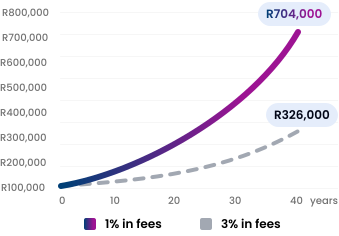
Consider someone who puts R4,000 a month into a retirement annuity for 25 years, in a fund that grows 9% a year before fees. If the total annual fee is 1%, the fund grows 8% after fees and ends up at roughly R3.8 million. At a fee of 1.75% it ends up at roughly R3.4 million, and at 2.5% it ends up at roughly R3 million.
In every case the person puts in R1.2 million, so the difference between the cheapest and the most expensive version is roughly R800,000, which is more than a fifth of what the cheaper version delivers. The contributions, the markets and the discipline are identical, and the only thing that differs is a number that most of us have never bothered to look at.
National Treasury’s own modelling in that 2013 paper found that a regular saver who reduced annual charges from 2.5% to 0.5% of assets would receive a benefit 60% bigger after 40 years. More recently, an analysis on how retirement annuities charge found that two products that look almost identical on a marketing page, each starting with R500,000, can finish roughly R1.8 million apart after 30 years.
None of this means that the cheapest option is automatically the right one. If you are paying for advice that stops you from selling in a panic during a crash, that can be worth a great deal of money, but it is a decision you can only make properly once you know what the number is.
Higher fees very likely means lower returns (and here's the maths to prove it)
Paying high fees on your retirement investments (such as a retirement annuity or a living annuity) almost always means less money in your pocket, and less money for your retirement. Read more
Book the test and repeat it yearly
Nothing about retirement savings comes with a warning light, and that is exactly the problem, so the sensible approach is to look under the hood once a year, in the same way that you would service the car or run your bloods for a health check-up, while there is still time to fix whatever you find. Whether I am saving was never really in doubt, and what I had not checked is whether the fund I am saving into is doing its job. You can get a health check on your investments free of charge from the experts at 10X, and it could save you a whole heap of trouble down the road.
Related articles


How can we 10X Your Future?
Begin your journey to a secure future with 10X Investments. Explore our range of retirement products designed to help you grow your wealth and achieve financial success.