My retirement plan looked good in my head, but the numbers on the page disagreed
10 September 2026
The Living Annuity Masterclass: How to maximise your retirement income


The views and opinions expressed in this article are those of the author and do not necessarily reflect the official policy or position of 10X Investments.
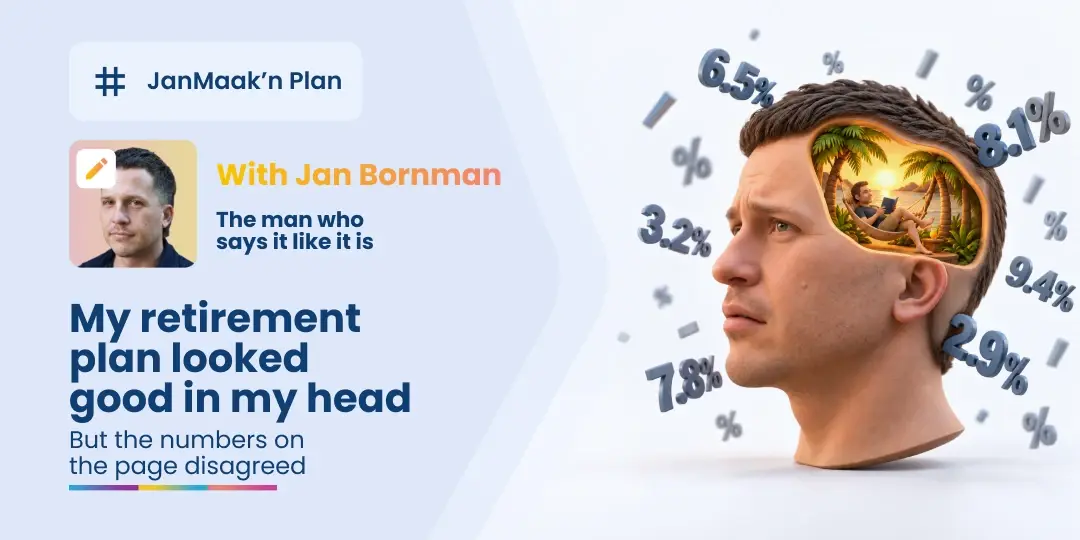
For a long time, my retirement plan existed mainly in my head. I knew I was saving, understood that compound growth would hopefully do some of the work over the next few decades, and assumed that as I earned more I would be able to put more away. There was no detailed spreadsheet behind this confidence, just the reassuring sense that because I was thinking about retirement and doing something about it, I was probably broadly on track.
For those of us who like believing we will figure things out as we go, committing that plan to actual numbers can be uncomfortable. There is a big difference between knowing you are saving and knowing whether what you are saving will actually fund the retirement you have in mind.
Perhaps you’re similar, and the problem only really became obvious when you put some numbers against that confidence, and saw the gap was surprisingly large.
There is a well-established body of behavioural research showing that confidence and good financial decision-making do not necessarily go hand in hand. Humans are particularly good at filling in gaps when we do not have all the information, and retirement planning gives us plenty of room to do exactly that. Rough mental maths, assumptions about what we will earn in future and the knowledge that we are at least saving something can all create a reassuring picture without telling us whether the numbers actually work.
Build the retirement of your dreams with our
Retirement Annuity calculatorWhen confidence meets the numbers
For South Africans, there is good reason to test that confidence. 10X’s has repeatedly shown how few South Africans are on track for a comfortable retirement, while many have no retirement plan or savings at all. Even among people who are putting money away, knowing that contributions are being made is very different from knowing whether they are actually enough to fund the retirement you imagine.
This is where the retirement plan in my head starts running into the one on paper. As a rough rule of thumb, someone wanting to maintain their lifestyle may need retirement savings of around 15 times their final annual income. Another way of thinking about the target is through a replacement ratio, with this guide to explaining the idea in more detail. Neither measure can predict exactly what any individual will need, but both force you to translate “I think I’m doing okay” into an actual number.
The uncomfortable truth about retirement in South Africa - Rands and Sense by 10X [video]
We sit down with 10X Investment Consultant lead Andre Tuck and discuss the retirement savings crisis in South Africa. We also delve into living annuities, retirement annuities, TFSAs and everything in between. Read more
![The uncomfortable truth about retirement in South Africa - Rands and Sense by 10X [video]](/_next/image?url=https%3A%2F%2Fimages.ctfassets.net%2Fyqvz0zwovkbq%2F5ipSTnRq5Dp25fyghm5kGQ%2F02c801c78d5e1ca9280bfd34d7602368%2FAndre_Tuck_podcast_cover_image__1_.webp&w=828&q=75)
Say, for example, you earn R850,000 a year and you are putting R5,000 a month into retirement. That is R60,000 a year going towards your future, and it is easy to feel reasonably good about that. You are saving consistently, after all.
Then put it against the rough 15-times-income rule. On an annual income of R850,000, that points to a retirement target of about R12.75 million in today’s money. Suddenly, knowing that you are saving R5,000 a month tells you much less than you thought it did.
Assume, purely for illustration, that you have 30 years until retirement and your contributions achieve an average return of 5% a year above inflation after fees. R5,000 a month would grow to roughly R4.2 million. At R10,000 a month, the figure would be around R8.3 million. At R15,000, it would be about R12.5 million.
That is not a forecast of what anyone will actually retire with. It ignores money already saved, future salary increases and changes in contributions, while actual investment returns will vary. What it does show is how a contribution that feels substantial in isolation can look very different once it is measured against the retirement you are trying to fund.
Retirement Annuity vs Tax-free Savings Account vs Bond: Where Should Your Extra Money Go?
Got extra money to invest? Compare three powerful options: Retirement Annuity, Tax-Free Savings Account (TFSA), or paying off your bond faster. Learn the pros and cons of each to make an informed choice for your financial future. Read more

For many men in particular, the difficulty is that retirement is competing with everything we feel responsible for now: a bond, children, school fees, ageing parents and the ordinary cost of keeping a household running. Putting another R1,000 or R2,000 into retirement can feel less urgent than something your family needs today, yet the reason for saving is closely connected to that same instinct to provide. Eventually the salary stops, but you may still want to support a partner, help your children or grandchildren and have enough financial breathing room that you do not become dependent on them.
The small decisions that shape the outcome
Once you put the plan on paper, smaller details also become harder to dismiss, with fees being one of them. A percentage point here or a fraction of one there can look insignificant on an annual statement, but those costs are being deducted from money that could otherwise remain invested and compound. The shows how the effect builds over time, while an gives investors a way to compare what they are actually paying.
Warren Buffett once put two important investing lessons into one sentence: “Investors should remember that excitement and expenses are their enemies.” The expenses part is obvious in a retirement context, but the excitement matters too. Retirement investing is generally a decades-long exercise, not a competition to identify the next hot investment. That same thinking sits behind approach, which makes the case for long-term investment discipline rather than chasing whichever investment has recently performed best.
The same long-term thinking applies when changing jobs. Retirement money can suddenly look very useful when there are immediate expenses to cover, but withdrawing it also means losing years of potential compounding.
Savvy RA investors let SARS fund their Tax-Free Savings Account (or their kid's one)
Being responsible with your retirement annuity (RA) could mean you get a maxed out tax-free savings account for free. Here's how. Read more

That, for me, is the useful difference between the retirement plan in my head and the one on paper. The first is built largely on good intentions and confidence, while the second tells me whether those intentions are translating into enough money, whether I am losing too much to fees and whether the decisions I make along the way are helping or hurting the outcome.
For anyone who wants to check that more closely, a free can show how the fees and historical performance of an existing retirement investment compare with 10X. Investment consultants are also available at no cost to explain product options and an investor’s situation.
Putting the plan on paper will not make retirement perfectly predictable. There are too many variables for that. What it can do is replace a vague sense that things will probably work out with a much clearer idea of where you stand and what may need to change.
When the eventual goal is not only our own financial security, but the ability to keep looking after the people who matter to us, retirement is probably too important to leave to approximate mental maths and hope.
A fixed deposit? No thanks!
Moneyweb regular Jimmy Moyaha discusses the problems with that old bank favourite, a fixed deposit, and what else you can do with your money. Read more
Related articles



How can we 10X Your Future?
Begin your journey to a secure future with 10X Investments. Explore our range of retirement products designed to help you grow your wealth and achieve financial success.