Preservation fund investment choices: How to choose the right fund for your timeline
14 September 2026
Opting for a preservation fund involves more than just deciding to invest in it when switching jobs. It also requires selecting the appropriate underlying funds for your capital. The ideal fund for you may vary greatly in your 30s, 40s, 50s, or 60s, so it’s important to review and adjust your choices as your circumstances and factors evolve over time.
In this article, we will spend some time looking at 10X fund options, asset allocation, risk tolerance and investment timelines, Regulation 28, how 10X is able to support you as an investor and the importance of fees.
See your pension savings grow with our
Preservation Fund calculatorWhat is a preservation fund?
A preservation fund lets you keep saving for retirement instead of withdrawing your savings when you change jobs. Your money would have previously been in an employer-sponsored provident or pension fund.
Moving to a preservation fund usually doesn't trigger a tax event, but it’s crucial to ensure your pension fund moves to a pension preservation fund and your provident fund to a provident preservation fund. Since these funds don't allow further contributions, the fund choice and associated fees become even more significant for the growth of your retirement savings over time.
Switching jobs? The maths shows that preserving your pension is much smarter
Thinking about cashing out your pension when you move jobs? The maths shows that preserving your retirement savings is much smarter. Read more
Why your timeline matters
The first factor to consider is your investment timeline. You should think about how long you have until your anticipated retirement. If you have a longer time horizon until retirement, say 20 to 30 years, you may be more comfortable with market volatility, as you have more time for your capital to recover from a market downturn.
If you have a shorter time horizon until retirement, say 5 years, you may be more comfortable with a more balanced fund selection as you have less available time to recover from a market downturn. You would also not want to go too conservative with your fund selection too early on, as this may impact the growth potential of your capital.
Understand your asset allocation before choosing a fund
Asset allocation refers to the way an investment portfolio is divided between the different asset classes, such as equities, bonds, property and cash. Along with your investment timelines, you would also look to align your asset allocation with your risk profile and your long-term financial goals and plans. If you are an investor with a longer investment horizon and a stronger tolerance for short-term volatility, you may be comfortable with a higher allocation to growth assets. On the other hand, if you are an investor who needs greater stability or if you are closer to retirement, you may prefer a portfolio with a larger allocation to bonds and cash. Asset allocation can be vital in the performance of your portfolio, as the research shows us.
Equities are usually included in a portfolio for long-term capital growth and potentially inflation-beating returns. Equities give investors exposure to companies and economic growth, but this may also come with sizable market declines. They are generally more appropriate for investors with longer time horizons and the ability to tolerate volatility due to the potential for fluctuating values. Equities have historically delivered returns above inflation by approximately 7% annually over long periods (based on JSE All Share Index performance versus CPI from 1960-2020).
The Hare and the Tortoise: The perfect parable for your investments in 2026
When it comes to your retirement investments, should you be chasing fast returns or steady growth over the long term? And do you know a bubble when you see one? Read more

Bonds can provide your portfolio with income, diversification, and some stability. They are usually less volatile than equities, but this does not mean that they are completely risk-free. Bond values could be affected by changes in interest rates, inflation expectations and the ability of the issuer to repay its debt. They are seen as more conservative, but they still may outperform expectations.
Real estate may be a good hedge against inflation. Real estate can also offer exposure to real assets and economic activity, while generating income through rentals and distributions. It may also contribute to long-term growth in your portfolio. Listed property can be volatile and may be affected by factors such as interest rates, economic conditions, occupancy levels and changes in the property market.
Cash is less likely to experience the same levels of volatility as equities or real estate. It is usually the most stable of the various asset classes. However, cash returns struggle to keep pace with inflation over the long term, which can affect purchasing power.
These funds are governed by Regulation 28 of the Pension Funds Act. Regulation 28 limits exposure to certain asset classes, including a maximum of 75% in equities and 45% offshore. These limits have been implemented to encourage diversification in your portfolio.
As an investor with 10X, you do not need to choose individual shares, bonds, or properties. Instead, investors may select from a range of diversified 10X investment funds. Each fund has a predetermined combination of asset classes and is designed for a specific type of investor, risk profile and investment horizon. You may choose the fund which most closely aligns with your financial goals, time horizon and investment risk. Our funds are carefully selected and include exposure to a wide range of asset classes, allowing you to choose a fund that aligns best with your timelines, goals and investor profile.
Fund choices in your 30s and 40s
As an investor in your 30s or 40s, you will have a longer investment time horizon with more years ahead of you before retirement. Therefore, you may like to focus on growth in your portfolio. You may also want to avoid being too conservative with your fund selection.
This may provide stability, but it may also mean that your returns struggle to outperform inflation, which may then impact the potential growth of your fund. Patience and discipline are key factors when it comes to long-term investing. You would also want to avoid any emotional decision-making or reacting to short-term market noise.
Fund choices in your 50s
In your 50s, you still have time to invest, but you are getting closer to your retirement years. This may mean that you have less time for your capital to recover if there is a major market downturn. You would still ideally want to aim for growth in your portfolio, so you would therefore want to carefully manage growth and risk in your portfolio.
When you are reviewing your fund, you may like to focus on your fund selection and asset allocation, fees, as well as keep an eye on the future by considering your potential retirement age, other retirement savings and your annuity options. Your fund selection is likely to change as your investment timelines change.
Fund choices close to retirement
As you start to near the retirement years, your thinking will start to switch more to the retirement years ahead. You may want to consider avoiding being too aggressive with your fund selection as your investment timeline is short, leaving not much time for recovery.
At the same time, being too conservative with your fund selection may result in inflation risk. You would look to ensure that your fund selection still matches your investor profile and long-term retirement plan and goals whilst also considering your annuity options for the retirement years. When you review your fund each year, you would want to take an informed and rational approach whilst avoiding any emotional decision-making.
The 10X fund options
Investors with 10X have a range of well-diversified, Regulation 28 compliant funds to choose from. Let’s have a look at some of these funds:
10X Your Future Fund
The 10X Your Future Fund, one of our flagship funds, is a multi-asset, high-equity fund with a higher allocation to growth assets. The fund also provides exposure to local and international markets. The fund is well-suited to investors with a higher tolerance for short-term market volatility and who have an investment timeline of 5 years or more. The aim is for long-term capital growth, which may include fluctuations in the short term.
Fund returns (all returns greater than 12 months are annualised)
| 1 month | -0,2% |
|---|---|
3 months | -1,2% |
1 year | 8,0% |
3 years | 10,9% |
5 years | 10,5% |
Source: Fund Fact Sheet
10X Moderate Fund
The 10X Moderate Fund is a multi-asset, medium-equity fund. The fund includes a greater allocation to growth assets than defensive assets, but with less exposure to equities than a high-equity fund.
The option is best suited to investors who are looking for capital growth with less volatility than you may find in a high-equity portfolio. The fund has both local and offshore investments and is well-suited to an investment time horizon of 3 years or more.
Fund returns (all returns greater than 12 months are annualised)
| 1 month | -0,1% |
|---|---|
3 months | -0,7% |
1 year | 8,0% |
3 years | 10,9% |
5 years | 10,1% |
10X Defensive Fund
The 10X Defensive Fund is a multi-asset, low-equity fund that holds a larger percentage of defensive assets compared to growth assets.
The fund is best suited to cautious investors who are looking for stability and also some growth. The ideal investment period is usually between one and three years or longer.
Fund returns (all returns greater than 12 months are annualised)
| 1 month | -0,1% |
|---|---|
3 months | 0,0% |
1 year | 8,1% |
3 years | 10,4% |
5 years | 9,3% |
10X Income Fund
The 10X Income Fund invests mainly in a diversified range of local and international interest-bearing assets. The aim is to provide investors with a high level of income, whilst also focusing on the stability of the capital over the long term.
The fund is generally best suited for investors with an investment horizon of at least three years. It is positioned as an income-focused option, but its value and returns may still fluctuate.
Fund returns (all returns greater than 12 months are annualised)
| 1 month | 0,4% |
|---|---|
3 months | 2,0% |
1 year | 7,3% |
3 years | 9,5% |
Since inception | 9,3% |
10X Money Market Fund
The Money Market Fund is the most conservative of the fund options. It invests in a diversified mix of short-term money market instruments and short-term bonds, with the aim of generating interest income, preserving capital and providing liquidity. The fund is best suited to investors who require short-term stability or who would like to minimise risk.
Fund returns (all returns greater than 12 months are annualised)
| 1 month | 0,6% |
|---|---|
3 months | 1,7% |
1 year | 7,0% |
3 years | 8,0% |
Since inception | 7,1% |
Why fees matter
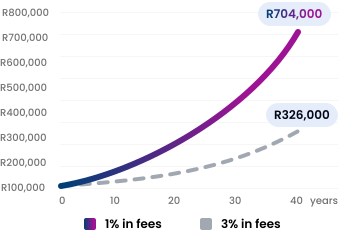
Fees are incredibly important. As this kind of fund does not allow further contributions, higher fees may reduce the returns available for reinvestment. Some important terms that you may see on your investment statement are the following:
- Total Expense Ratio (TER): This is the ongoing expenses within an investment fund, calculated according to the applicable standard.
- Total Investment Charge (TIC): This combines the TER with the fund's transaction costs.
- Effective Annual Cost (EAC): An annualised estimate of the impact of product, investment management advice, administration fees, and all other applicable charges.
Your EAC is a useful metric introduced by ASISA in 2015, providing investors with a standardised way to understand the full cost of holding an investment over time. The EAC combines various charges linked to an investment into a single annual percentage. EAC can be helpful for investors, enabling them to compare the cost structures of different products and providers more consistently. Assuming all other factors are equal, a lower EAC generally means that a larger portion of your money remains invested to potentially earn returns. A higher EAC may place greater pressure on net returns as fees accumulate over time. The EAC should be just one factor to consider when comparing different service providers. There are also a few different kinds of fees that you may see charged:
- Administration fees: These will be for tasks such as compliance, reporting and similar.
- Advisor fees: If you have an advisor, there will be fees charged for the advisory services and any other services offered.
- Management fees: The fees charged for the running of the fund.
Let’s have a look at an example which shows the effect of fees. We will assume the following information for our example.
- Starting capital: R4 million
- Investment period: 20 years
- Gross annual return: 10%
- Inflation: 5% per annum
- No withdrawals
Scenario 1 - 1% fees: The fund would grow to approximately R8.6 million after 20 years.
Scenario 2 - 3% fees: The fund would grow to approximately R5.8 million after 20 years.
Just a small difference in fees can lead to major differences in retirement outcomes. This example is for illustrative purposes only and real results may vary. Learn more about fees here. The fees at 10X are kept low, transparent and simple so it is easy for all investors to see what they are being charged. Please visit our fund page to find out more about the applicable fees. Our investment consultants are also more than happy to answer any questions you may have.
How 10X can support investors
At 10X, we offer our investors a variety of tools and support to help you make an informed decision about your retirement savings choices. You may like to make use of our EAC calculator and PF calculator. Both are part of our online suite of tools, available to you on our website for free, to help you compare costs and scenarios. Our efficient and experienced 10X investment consultants are also on call if you need any assistance or guidance around your preservation fund options or related questions. They will be able to assist you at no additional cost.
Final thoughts on preservation fund investments
These funds allows you to continue to save for your retirement years. Along with your preservation fund comes the need to decide how it will be invested in the underlying funds over the years leading up to your retirement. These underlying funds may change as you move from your 30s through the decades up to retirement. Factors such as your investment timelines, risk profile, financial goals, fund selection and fees all play an important role in your fund’s potential growth and investment journey.
Get in touch with 10X Investments today to learn more about our retirement investment options.
Related articles


How can we 10X Your Future?
Begin your journey to a secure future with 10X Investments. Explore our range of retirement products designed to help you grow your wealth and achieve financial success.