Retirement annuity fund choices: How to match your RA to your timeline
18 September 2026
The Living Annuity Masterclass: How to maximise your retirement income


- Your retirement annuity fund choice should match your age, investment timeline, risk tolerance and long-term retirement goals, as different life stages may require different levels of growth and stability.
- Asset allocation plays an important role in your RA, as your exposure to equities, real estate, bonds, cash, offshore assets and Regulation 28 limits can influence growth, volatility and diversification.
- Fees, fund performance and personal circumstances should be reviewed regularly to ensure your RA fund choice remains aligned with your retirement plan over time.
The initial step is choosing to start a retirement annuity, but the process doesn’t stop there. You will also need to select the funds in which you invest your capital within your RA wrapper. These choices can vary greatly from person to person. Fund selections may change based on factors such as age, whether you're in your 30s, 40s, 50s, or approaching retirement. In this article, we will explore in more detail topics such as asset allocation, time horizons, risk tolerance, Regulation 28, fees, 10X fund options, annual reviews, and how 10X can support you as a retirement annuity investor.
Build the retirement of your dreams with our
Retirement Annuity calculatorWhy your retirement annuity fund choice matters
A retirement annuity is a long-term retirement savings vehicle that allows you to save for retirement in a tax-efficient manner. All growth in your RA is tax-free, and you will not need to pay income tax, dividend tax, or capital gains tax. Contributions to your RA are also tax-deductible. The current applicable limit for the 2026/2027 year is 27.5% of your taxable income. This is capped at an annual amount of R430,000. There is limited access to your RA as it is designed to allow you to save for retirement and ideally not withdraw capital from it.
Your RA capital will be invested in a range of underlying funds. This fund choice affects your exposure to local and offshore assets as well as growth and defensive assets. It can also have an impact on the volatility, long-term growth of your portfolio and how you feel about being invested in the market in times of volatility. H2: Understand your investor profile You would want to consider your investor profile. This looks at your risk tolerance, or risk profile, as well as your investment timelines. Your risk tolerance level reflects how comfortable you are with short-term market volatility. Investment timeline refers to how long you have until retirement and how long you anticipate keeping your RA invested.
If you are an investor with 25 or 30 years until retirement, you may be more comfortable taking a bit more risk in your portfolio, as you have more years to recover from any short-term market declines. If you are an investor closer to retirement age, you may be more cautious about market volatility while still seeking growth in your portfolio.
You would also look to consider your long-term retirement goals and financial plan. Two investors may be of similar age, but they may choose very different funds due to different risk profiles and long-term retirement goals. Your investor profile and long-term goals should be well aligned with your asset allocation.
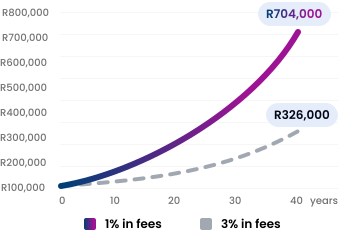
Higher fees very likely means lower returns (and here's the maths to prove it)
Paying high fees on your retirement investments (such as a retirement annuity or a living annuity) almost always means less money in your pocket, and less money for your retirement. Read more
Understand asset allocation before choosing a fund
Asset allocation is the mix of different asset classes. Each of the assets may play a different role in your portfolio. The usual mix of asset classes is: equities, real estate, bonds and cash. Your asset allocation should be carefully considered, as research shows the important role it can play in your portfolio performance.
Equities may provide long-term capital growth and the potential to earn returns above inflation. Equities offer exposure to economic growth and companies, but they may also experience notable market declines. There may be fluctuations in value over shorter periods, making them generally more suited to investors with longer time periods.
Real estate may provide exposure to real assets and economic activity, while also generating income through rentals and distributions. It may result in long-term growth in your portfolio. Listed property may be volatile and could be affected by interest rates, economic conditions, occupancy levels, and changes in the property market. Real estate can be a good hedge against inflation.
Bonds can provide some stability, income, and diversification in your portfolio. Bonds are usually less volatile than equities, but they may still come with some risk. Bond values may be affected by factors such as inflation expectations, changes in interest rates, and the issuer's ability to repay its debt. They are more conservative, but they still may outperform expectations.
Cash is usually the most stable of the asset classes. It is unlikely to experience the same volatility as you might experience with equities or real estate. Cash returns may not keep up with inflation over long periods, which can erode purchasing power.
A vampire wouldn’t drain you as much as some investment managers
This Halloween, Nicola Mawson is finally burying those unnecessary investment fees for good. Read more
Regulation 28 of The Pension Funds Act applies to retirement annuities. This limits your exposure to both equities and offshore investments. Current regulations state that a 75% limit applies to equities and a 45% limit to offshore.
At 10X, you don’t need to choose individual assets; instead, you can select from a range of carefully selected funds with different mixes of asset classes, tailored to your investor profile and long-term financial goals and plans. Please visit our fund page to view more information on our funds.
RA fund choices in your 20s, 30s and 40s
If you are in your 20s or 30s, you may have a longer investment time horizon and a longer time until retirement age. This may mean more time for your RA to recover from any short-term market volatility that may happen.
Growth assets, such as equities and real estate, may be volatile, but they also aim to deliver long-term growth and potentially produce inflation-beating returns over time, so you may consider including them in your portfolio. Of course, you will also need to consider your investor profile and long-term retirement goals.
If you are in your 40s, you will still have time before your retirement, so growth assets will still remain important. You would also want to ensure that your fund selection remains aligned with your investor profile and long-term retirement plan.
RA fund choices in your 50s and early 60s
In your 50s and 60s, you are closer to retirement age; you will still want growth in your portfolio, but it’s important to remember that you may have less time to recover from a market decline. You would still look to avoid any emotional decision-making when it comes to your fund choices. It’s important to avoid going too conservative with your fund selection to ensure you are still targeting growth in your portfolio, while also avoiding being too aggressive, which can be problematic in a market downturn.
You should always review fees, fund selection, anticipated retirement age, retirement savings and goals, as well as possible annuity options for the retirement years. In South Africa, the retirement age is 55. However, it is often the case that South Africans prefer to stay invested and save for retirement well past this age.
The 10X retirement annuity funds
At 10X, you can find a variety of different fund options to invest in with your RA wrapper. Note that past performance does not guarantee future results. Let’s have a look at some of these in more detail:
10X Your Future Fund
The 10X Your Future Fund is a multi-asset, high-equity fund which includes a higher allocation to growth assets. It is also one of the 10X flagship funds. The fund will provide exposure to local and international markets.
The fund is suited to investors with a 5-year or longer investment horizon. The aim is long-term capital growth, which may involve short-term volatility.
Fund returns (all returns greater than 12 months are annualised)
| 1 month | -0,2% |
|---|---|
3 months | -1,2% |
1 year | 8,0% |
3 years | 10,9% |
5 years | 10,5% |
Source: Fund Fact Sheet
10X Moderate Fund
The 10X Moderate Fund is a multi-asset, medium-equity fund. The fund has fewer equities than a high-equity fund but also includes a higher allocation to growth assets than defensive assets.
This fund is best suited to investors with a 3-year or longer time horizon and seeking capital growth with lower volatility than a high-equity portfolio. The fund has both local and offshore investments.
Fund returns (all returns greater than 12 months are annualised)
| 1 month | -0,1% |
|---|---|
3 months | -0,7% |
1 year | 8,0% |
3 years | 10,9% |
5 years | 10,1% |
10X Defensive Fund
This fund is a multi-asset, low-equity fund with a higher allocation to defensive assets than to growth assets.
The fund is suited to investors seeking growth and stability in their portfolios. The preferred investment period is between one and three years or more.
Fund returns (all returns greater than 12 months are annualised)
| 1 month | -0,1% |
|---|---|
3 months | 0,0% |
1 year | 8,1% |
3 years | 10,4% |
5 years | 9,3% |
10X Income Fund
The 10X Income Fund invests in a diversified range of local and international interest-bearing assets with the goal of generating a high level of income along with preserving capital over the long term.
The fund is well-suited for investors with an investment horizon of three years or more. Its value and returns may still vary even though the fund is income-focused.
Fund returns (all returns greater than 12 months are annualised)
| 1 month | 0,4% |
|---|---|
3 months | 2,0% |
1 year | 7,3% |
3 years | 9,5% |
Since inception | 9,3% |
10X Money Market Fund
This fund is the most conservative of the fund choices. It includes a diversified mix of short-term money market instruments and short-term bonds. The aim is to generate interest income, preserve capital and offer liquidity. The fund is best suited to investors who require short-term stability or who would like to minimise risk.
Fund returns (all returns greater than 12 months are annualised)
| 1 month | 0,6% |
|---|---|
3 months | 1,7% |
1 year | 7,0% |
3 years | 8,0% |
Since inception | 7,1% |
Why fees should influence your fund decision
Fees should also be an important consideration when selecting your fund. As an investor, you will keep the net returns after fees have been deducted. The effect of higher fees can compound over the long term and may have an impact on the growth of your capital. Here are some of the typical fees that you may see:
- Management fees: These are the fees charged for the running of the fund.
- Administration fees: There will be fees charged for the admin-related tasks like compliance, tax and more.
- Advisor fees: An advisor will charge for their advice as well as any other services that they offer.
Let’s have a look at an example to illustrate the effect of fees over time. We will assume the following information:
- Starting capital: R0
- Monthly contributions: R3,000 at the end of each month
- Investment period: 30 years
- Gross annual return: 10%
- Inflation annual rate: 5%
- No withdrawals are made during the investment period, and contributions remain fixed
Scenario 1 - 1% fees: After 30 years, your RA will grow to an estimated inflation-adjusted value of R2 million.
Scenario 2 - 3% fees: After 30 years, your RA will grow to an estimated inflation-adjusted value of R1.5 million.
We can see how small differences in fees can lead to major differences in retirement outcomes. This example is for illustrative purposes only and real results may vary. You can learn more about fees here. Here are a few of the key terms you see on your investment statement:
- Total Investment Charge (TIC): The total investment charge, which combines the TER with transaction costs within the fund.
- Total Expense Ratio (TER): Ongoing expenses of an investment fund, calculated in accordance with the applicable standard.
- Effective Annual Cost (EAC): An annualised estimate of the impact of product, investment management advice, administration fees, and all other applicable charges.
The EAC is a standardised metric which was introduced by ASISA in 2015. It is shown as a percentage value on your investment statement and allows you to see the total costs of owning an investment product over a one-year period of time. Depending on the product, this may include investment management fees, administration costs, advice fees, penalties and more. Assuming all other factors are equal, a lower EAC may mean that a larger portion of your money remains available to potentially grow over time. A higher EAC may place greater pressure on net returns as fees start to compound over time. Costs should be only one factor among others when evaluating service providers, since additional aspects, like risk, investment strategy, and service, are also important. At 10X, our focus is on low-cost, transparent and simple fees. Please explore our products if you would like to find out more about our fees.
Review your RA fund choice once a year
After choosing your fund, it's important to review it annually to make sure it aligns with your evolving needs and long-term financial objectives. You should also review your fund selection each year when checking your RA. This helps determine whether your fund still fits your investment timeline, risk level, long-term aspirations, and contribution plans.
Let’s have a look at some of the questions that you may like to ask upon review:
- Are the fees you are paying appropriate?
- Has there been any change in your retirement date?
- Does your fund selection still align with your investment timelines?
- Has there been a change in your risk tolerance levels?
- Have you changed your contribution amount?
How 10X can support retirement annuity investors
10X offers retirement annuity investors an index-based investment strategy that includes an active approach to asset allocation. You can expect fees that are transparent, low-cost and simple to understand. You may also like to make use of our range of free tools available on our website. For example, you can compare fees with our EAC calculator or do some scenario planning with our retirement annuity calculator. Our experienced and knowledgeable investment consultants are just a quick call away, should you have any questions or would like to discuss your retirement annuity fund options.
Final thoughts on RA fund selection
Choosing the right fund for your RA involves considering more than just your age. You should evaluate your risk profile, investment timeline, and long-term financial objectives. Additionally, review fees, asset allocation, and Regulation 28 regulations. Take a look at the carefully selected 10X funds, as one of them is likely to fit your profile and long-term goals well. To learn more about our retirement investment options, get in touch with one of our investment consultants today.
Related articles

How can we 10X Your Future?
Begin your journey to a secure future with 10X Investments. Explore our range of retirement products designed to help you grow your wealth and achieve financial success.