Retirement annuity planning: When should you actually access your RA?
5 May 2026
The Living Annuity Masterclass: How to maximise your retirement income


Many South Africans see age 55 as the ideal age to retire from their retirement annuity. This is the earliest age at which you may do it, but it shouldn’t necessarily be your target retirement age. It’s important to assess whether you are retirement-ready before retiring from your retirement annuity.
This decision should not be based solely on reaching the eligible age; a range of different factors should be considered. The timing of your retirement from your retirement annuity can significantly affect your retirement outcomes, so it should be carefully considered and planned.
In this article, we will take a closer look at when you should consider accessing your retirement annuity, the implications of retiring too early, and the benefits of staying invested for longer.
Build the retirement of your dreams with our
Retirement Annuity calculatorUnderstanding what a retirement annuity is and when you can access it
A retirement annuity (RA) is a long-term retirement savings vehicle that offers tax benefits to investors. Contributions to retirement annuities are tax-deductible, subject to annual limits; these are up to 27.5% of your income or R430,000, as per the new limits in place as of the 1st of March 2026.
All investment returns within the retirement annuity are exempt from income tax, dividends tax and capital gains tax while invested. This means that more of your returns are available to be reinvested and can potentially grow over the long term. A retirement annuity will be used to fund an annuity from the time that you retire, and this annuity will then provide you with an income for your retirement years.
It’s important to discern when the best time is to access your retirement annuity, whether this will be at age 55 or later. If your savings remain invested, this may allow for more potential growth over time and may also impact your potential retirement outcomes. As such, sometimes it makes more sense to let your savings continue to grow.
Why 55 isn’t always the right time to retire
It’s important to consider longevity risk when it comes to your retirement savings. Longevity risk is the risk that you might outlive your retirement savings. Your retirement years may last longer than 30 years, so this needs to be taken into account when planning for this period of your life. The earlier that you retire, the more money you will need to sustain you for your retirement years.
While age 55 is the earliest point at which you can access your retirement annuity, it does not necessarily mean that this is the right time to retire. If you retire too early, there is greater pressure placed on your retirement capital, especially if you still have many years of living expenses, healthcare costs, and inflation to account for. For example, if your retirement savings need to provide an income for three decades or more, withdrawing too early can increase the risk of running out of money later in life.
Delaying retirement, even by a few years, may potentially allow your capital more time to remain invested and continue compounding over time. This can also reduce the pressure on your future drawdown rate, especially if you move into a living annuity.
Retirement Annuity vs Tax-free Savings Account vs Bond: Where Should Your Extra Money Go?
Got extra money to invest? Compare three powerful options: Retirement Annuity, Tax-Free Savings Account (TFSA), or paying off your bond faster. Learn the pros and cons of each to make an informed choice for your financial future. Read more

Key factors to consider before accessing your RA
Let’s have a look at some of the factors that you would need to consider before deciding to retire from your RA. Accessing your retirement annuity is a major long-term financial decision, so it’s important to look beyond just reaching age 55 and assess whether you are actually financially prepared for retirement.
Financial readiness
You’ll need to assess whether you have enough capital saved to support your retirement years. This means looking carefully at your expected monthly expenses, such as housing, medical costs, groceries and lifestyle spending, and comparing these to the income your retirement savings will be able to provide.
Life expectancy
The longer your life span is, the more capital you will need saved in order to provide for yourself for your retirement years. Many retirees may need their retirement savings to last 25 to 30 years or even longer. Planning for a longer life expectancy reduces the potential risk of running out of money later in life.
Other income sources
You should also consider other sources of income that you have coming in. This could be rental income, discretionary investments, a tax-free savings account, and other savings and investments. Multiple income streams can help reduce the pressure on your retirement annuity and improve overall retirement security.
Lifestyle expectations
Another important consideration would be your lifestyle expectations and what this includes. Are you planning to travel regularly, assist family members financially, or maintain a certain standard of living? Your desired lifestyle will directly affect how much income you need and how long your retirement capital must last.
Inflation
Inflation has the impact of reducing the purchasing power of your money over time. In other words, this means that your money may not stretch as far as it has in previous years. When planning for retirement, it’s important to ensure that your savings and investment strategy are able to keep pace with inflation so that your standard of living can be maintained over time.
The introduction of the Two-Pot Retirement System
The Two Pot Retirement System was implemented in September 2024, and this has changed the way that contributions to and withdrawals from retirement products are managed in South Africa. With the new system, all contributions to retirement products are now split between a ‘retirement pot’ and a ‘savings pot’. There is also a third pot, which is called the ‘vested pot’. This pot is for all savings accumulated prior to September 2024, and remains governed by the old rules. Withdrawals from the savings pot are allowed as long as you adhere to the stipulated rules. Withdrawals may be done once per year, for a minimum amount of R2,000. Withdrawals are taxed at your marginal tax rate, and there is also an administration fee included. The savings pot should only be accessed in an emergency, if at all.
Contributions will be split between the retirement pot and the savings pot, with one-third allocated to the savings pot and two-thirds to the retirement pot. The retirement pot can only be accessed upon retirement, when it will be used to purchase an annuity. Please consult the latest FSCA guidance for the most up-to-date information on the Two-Pot Retirement System.
The impact of accessing your RA too early
If you retire from your retirement annuity too early, there may be some consequences as a result. Even a short extra investment period, such as one or two years, may affect your potential retirement outcomes. Accessing your RA too soon means less time for your capital to remain invested and continue compounding, while also increasing the number of years that your savings will need to support you.
- Less retirement capital available: You may have less capital available for your retirement years due to a shorter time with your retirement annuity invested in the market. This may lead to a smaller capital amount being available in your retirement years, which can place more pressure on your long-term financial plan.
- Greater pressure on your retirement income: A smaller retirement capital base means that your income may need to stretch much further. There may be more pressure or worry placed on you during your retirement, especially if you are invested in a living annuity where your drawdown rate needs to be managed. Longevity risk is the risk that you outlive your retirement capital, and it becomes much greater when retiring too early.
- Higher sequence of returns risk: You may have a greater exposure to sequence of returns risk if you are using a living annuity. This is the risk of poorer returns early on in your retirement years, which may then impact your living annuity retirement capital. Negative returns combined with withdrawals can reduce your capital quickly and make it harder for your investment to recover over time.
The potential benefits of delaying access
Allowing your savings to remain invested for longer gives your capital more time to grow and can improve the sustainability of your retirement income. Let’s have a look at some of the potential benefits that you may experience by delaying retirement from your retirement annuity:
- Your capital will stay invested, which will then allow for more time to compound, and this will lead to potentially more growth of your capital.
- You will have potentially more capital to transfer to your life or living annuity.
- You may have less longevity risk, as you are retiring with more capital and later in life.
- There may also be less pressure on your selected drawdown rate with living annuities, as you’ll have greater capital available for your retirement years.
Why fees matter when planning your retirement timing
Investors often underestimate the impact of fees, but they can have a major impact on retirement outcomes. This is especially evident when you see high fees compounded over a long time. Your Effective Annual Cost (EAC) is a standardised metric that shows the total fees and costs associated with owning an investment product over a one-year period. This standardised metric was introduced by ASISA in 2015. All things being equal, you may see that a higher EAC would result in fewer returns available for reinvestment than a lower EAC, which may mean more returns are available to reinvest and potentially compound over time.
The EAC would be one factor to consider when comparing service providers. 10X offers a useful, free EAC calculator as part of our online suite of tools on our website. This allows you to compare and analyse the fees charged by 10X with those fees charged by your service provider. Your EAC should be displayed on your investment statement.
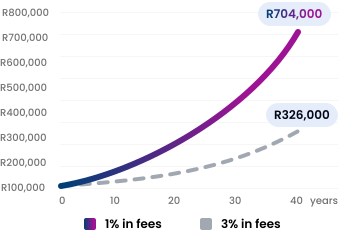
Let’s look at an example to illustrate the effect of fees of 3% versus fees of 1%: We will assume the following information for our example:
- Investment period of 30 years
- Initial lump sum investment of R50,000
- Monthly contributions of R2,000
- Return of 12% per annum
- An inflation rate of 6%
Example 1 (1% Fees): Real investment value is approximately R1.8 million
Example 2 (3% Fees): Real investment value is approximately R1.3 million
A small difference in fees can have a substantial impact on the money that you may have available to you for your retirement years. This example is for illustrative purposes only, and actual results may vary. You can learn more about fees here. When you view your fee breakdown, there are some typical categories of fees that you may expect to see. Let’s have a look at some of these fees:
- Advisor fees: If you are using an advisor, they will offer you advice and other services. There may be both an initial and an annual fee charged for this.
- Administration fees: There will be administration tasks such as reporting, compliance and tax. These will come with administration fees.
- Management fees: These are the fees that are charged for running and managing the fund.
At 10X, we aim to keep fees low. This may allow for more of your returns to be reinvested and allowed to potentially grow and compound over time. Fees charged on our retirement products are usually 1% or less, depending on the product selected and the amount invested. Please explore our products for the most up-to-date fee information.
Transitioning from a retirement annuity to a life or living annuity
From the age of 55, once you have decided to retire from your RA, if your RA is less than R360,000 (as per the updated figures effective from the 1st of March 2026), you will be able to withdraw the full amount as cash without the need to purchase a living annuity.
Current regulations state that you may withdraw up to one-third of the vested portion of your RA in cash. The remaining two-thirds of your RA will need to be used to purchase an annuity of your choice. You are able to select either a life or a living annuity, and this will provide you with an income for your retirement years. Your retirement pot will also need to be used for an annuity.
A living annuity is a flexible retirement product that keeps your money invested while you draw an income from the capital. You are able to select both your underlying funds and also your drawdown rate, both of which can be amended to cater to your changing needs, situation or financial plan over time.
A life annuity is a product which is purchased from an insurance company. You will select your income payout structure when you purchase the product. There is less flexibility than with a living annuity, but also less concern for you as the investor when it comes to the longevity of your savings, as you are guaranteed an income for life. Any risk will lie with the service provider.
The age at which you decide to retire from your RA can affect the decisions that you make regarding your retirement.
Asset allocation and your retirement annuity
Your asset allocation should align with your risk profile, investment timelines, and long-term financial plan and goals. Your asset allocation is usually a mix of equities, real estate, bonds and cash. Including a variety of asset classes provides diversification in your portfolio, allowing you to potentially balance risk and reward as you move through different economic cycles. At 10X, you can adjust your underlying portfolio by choosing from a selection of carefully curated funds, each with a different mix of assets and geared towards different investor profiles.
Equities are the most volatile of the asset classes, but they are also likely to generate the best long-term returns. Equities have historically produced returns above inflation, by around 7% annually over the long term (based on JSE All Share Index performance versus CPI from 1960-2020); however, past performance does not guarantee future results. Real estate may produce some good returns while serving as a hedge against inflation. Bonds will likely produce some lower returns while also adding stability to your portfolio. While bonds are typically seen as more conservative, they may still outperform expectations. Cash is the most liquid and stable of all the asset classes, but it is also likely to produce the lowest returns of all the asset classes.
Retirement annuities are subject to Regulation 28 of the Pension Funds Act, so these limits must be adhered to. This regulation limits the amount of your retirement annuity that you may invest in both equities and offshore investments. Under current regulations, the cap is 45% for offshore investments and a maximum allocation of 75% to equities. This regulation was introduced to help protect investors against poorly diversified portfolios.
At 10X, you can expect a range of well-diversified and Regulation 28-compliant funds. Please visit our funds page for the most up-to-date fund information.
Retirement annuity planning: Retirement is a decision, not a date
Age 55 is the earliest age at which you can retire from your RA. However, this age shouldn’t be your target. The decision to retire from your RA should be made with careful consideration and should be based primarily on your financial readiness. The timing of your RA retirement can have a significant impact on your potential retirement outcomes, so it should be given careful thought and planning.
If you need support with planning your RA or your retirement, don’t hesitate to contact the knowledgeable and experienced investment consultants at 10X! Get in touch today!
Related articles

How can we 10X Your Future?
Begin your journey to a secure future with 10X Investments. Explore our range of retirement products designed to help you grow your wealth and achieve financial success.