Why consistency matters more than timing in your tax-free savings account
28 April 2026
Some investors may try to ‘time’ the market when it comes to investing in their tax-free savings account. This can be very difficult to get right, even for experienced professionals in the industry.
A better approach is to aim for a more consistent and disciplined strategy over the long term. A tax-free savings account is a long-term investment vehicle that allows you to potentially compound your growth, tax-free. Staying invested over the long term, while focusing on consistency, discipline, and growth, are key priorities, rather than looking to time the market.
In this article, we’ll take a closer look at why consistency matters more than timing in your TFSA, as well as discuss the 10X investment strategy and why it works.
9 out of 10 people do better with 10X
Understanding your tax-free savings account
A tax-free savings account (TFSA) is a long-term savings vehicle that was introduced by the National Treasury as a way to encourage South Africans to save more money. Growth within the Tax-Free Savings Account is tax-free. This means there is no capital gains tax, interest or dividends tax, allowing for more available returns to potentially grow and compound over time.
You shouldn’t look at TFSAs as regular savings accounts, but rather long-term investment vehicles with the potential to compound and grow significantly over time.
There are contribution limits in place, so it is important that, as an investor, you are aware of these to avoid any penalties. As of the 1st of March 2026, contribution limits are R46,000 per annum and R500,000 per lifetime.
There are no penalties or restrictions on withdrawals. A TFSA is a long-term investment that benefits from the capital remaining invested and growing over time. Once you have withdrawn capital, you can’t add these contributions back in, as this contribution room has now been used. If possible, it is advisable to avoid withdrawals and keep your money invested to build and grow over time.
What does “timing the market” really mean, and why is it difficult?
‘Timing the market’ is when you try to enter the market and leave the market at exactly the right points in time, in order to take advantage of short-term market changes. In other words, you are trying to enter the market when stock prices are low and then trying to sell when stock prices are high. In the context of a TFSA, this means changing the underlying funds you are invested in through the TFSA 'wrapper' at exactly the right time (NOT withdrawing the funds from the TFSA itself - this would seriously impact your investment allowance and is not a good idea).
Markets can be highly unpredictable, and it is a difficult task to try to time them in this manner. Trying to time the market can also bring in emotions such as greed, fear and others into the equation, which may result in emotional decision-making and even knee-jerk decisions.
A better approach is ‘time in the market’ and investing for the long term in a consistent manner, while focusing on your long-term goals and also taking advantage of the power of compound growth.
The power of consistency in a tax-free savings account
It is powerful to take a consistent and disciplined approach to investing in your tax-free savings account over time. You should also ensure that you focus on the long term and your long-term financial goals and plans, while moving through the different economic cycles and market fluctuations.
This can help remove some of the emotional aspects of investing and help you avoid any knee-jerk or emotional decision-making. It can be helpful to set up a regular debit order, which can also help you remain consistent when it comes to adding contributions to your tax-free savings account. The more consistent you are with your TFSA, the sooner you will reach the lifetime cap, and the more you stand to benefit from potential compound growth.
We offer investors a free TFSA calculator at 10X, which you can use to calculate your savings. This calculator is part of our free online suite of tools on offer to investors. If you have any additional questions, don’t hesitate to reach out to our investment consultants.
The role of asset allocation in consistent investing
Your asset allocation can be an important driver of the returns you achieve. You would aim to be strategic in selecting your asset allocation. It will usually be a mix of equities, real estate, bonds and cash. You would ideally want to align your asset allocation with your risk tolerance, expected investment timelines, and your long-term investment plan and goals. At 10X, you can choose from a selection of carefully curated investment funds, each with a different mix of assets and geared towards different investor profiles.
Cash is the most liquid and stable of the asset classes, but you can expect low returns. Bonds may also generate low returns while adding stability to your portfolio (bonds are seen as a more conservative option, but they may outperform what’s expected). Real estate may produce good returns and also provide a good hedge against inflation. Equities are the most volatile of the asset classes, but you can expect the best returns from them in the long term. Equities have historically produced returns above inflation, by around 7% annually over the long term (based on JSE All Share Index performance versus CPI from 1960-2020); however, past performance does not guarantee future results.
A well-diversified portfolio, which includes a variety of asset classes, as well as exposure to local and offshore assets, allows you to potentially balance both risk and return. A TFSA is not subject to Regulation 28 of The Pension Funds Act, so you would be able to invest it 100% offshore, should your service provider offer this.
At 10X, we offer you a range of different funds that you can invest in within the TFSA “wrapper”. These funds are well-diversified across various asset classes, allowing you to choose a fund that suits you best and sets you up for disciplined investing over the long term. Please visit our funds page for the most up-to-date fund information.
Our 10X TFSA offers a simple, transparent, low-cost option. It can also be invested 100% offshore, if this is your preference.
The 10X investment strategy: Why simplicity wins
An index-tracking investment strategy focuses on keeping things simple while targeting consistent returns and long-term growth. With this kind of strategy, a benchmark index such as the S&P 500 will be mimicked in order to try to get the same returns as this index. This kind of strategy involves fewer activities, so this may mean lower costs and ultimately lower fees passed onto you as the investor.
Suppose we compare this to an active management strategy, where a fund manager spends time and effort looking for the stocks which he thinks will perform the best and produce the best returns. This kind of strategy involves research, analysis and also trading costs. This may result in higher overall costs, which may then be passed on to you as higher fees. This approach isn’t always the most effective strategy, as data from the SPIVA scorecards suggest.
The S&P Indices Versus Active (SPIVA) Scorecards track the performance of actively managed funds against their benchmarks globally. According to the latest SPIVA South Africa Scorecard (as of June 2025), 67.61% of South African actively managed equity funds underperformed the S&P South Africa DSW Capped Index over the ten-year period ending June 30, 2025.
An index-tracking investment strategy looks to focus on consistency, long-term returns and growth for investors. This strategy encourages discipline and may potentially lead to strong retirement outcomes. At 10X, we use an index-tracking investment strategy alongside a more active approach to asset allocation.
Why fees matter in long-term TFSA investing
While some investors still underestimate the importance of fees, it can lead to major differences in retirement outcomes and the potential growth of your long-term savings. Fees have the effect of reducing the returns that you have available to reinvest and to potentially grow and compound over the long term. There are some fees that you can expect to see charged on your TFSA. Let’s have a look at these fees:
- Management fees: These are the fees that are charged for the running and management of the fund.
- Administration fees: There will also be administration fees charged. These fees are charged for tasks such as reporting, compliance, tax and related activities.
- Advisor fees: An advisor will charge fees for the advice and services that they offer you. There may be both an initial and an ongoing fee charged.
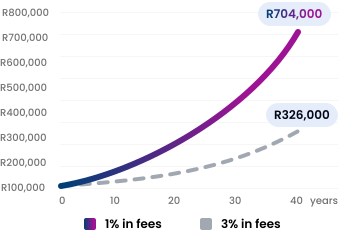
Effective Annual Cost (EAC) is a standardised metric that allows you to see the total costs and fees of owning an investment over a one-year period. The EAC is expressed as a percentage value and can be found on your statement. If not, you will be able to request your EAC from your service provider. All factors being equal, a higher EAC may mean that there are fewer returns to be reinvested and allowed to potentially grow over time. A lower EAC may mean that there are more returns to be reinvested and allowed to compound over the long term.
Of course, the EAC would be just one factor to consider when comparing service providers. Let’s look at an example of 1% in fees vs 3% in fees while making use of a TFSA and assume the following information:
- Monthly contribution: R3,000
- TFSA lifetime limit: R500,000
- Investment term: 30 years
- Annual return: 12%
- Annual inflation: 6%
Contributions will stop once the limit is reached, but the money will remain invested for the full 30 years. The returns are compounded monthly and adjusted for inflation to determine the final investment values.
Example 1 (1% in fees): After 30 years, the final investment value is approximately R1,438,627
Example 2 (3% in fees): After 30 years, the final investment value is approximately R901,248
As this example shows, a small difference in fees can have a significant impact on your TFSA’s final investment value. This example is for illustrative purposes only, and actual results may vary. If you’d like to learn more about how fees impact retirement outcomes, head over to our blog that gets into the maths.
At 10X, we prioritise minimising fees, as we understand the importance of keeping them low, thereby allowing more of your returns to be reinvested and potentially allowing your capital to grow over the long term. You can expect low, simple and transparent fees when investing with 10X, as well as no hidden costs. Please explore our products for the most up-to-date fee information.
Common mistakes investors make
Let’s look at some common mistakes that investors may make when it comes to investing in their TFSA:
- Trying to wait for the ‘right time’ before investing in your TFSA: It’s incredibly hard to time the market, and a disciplined and consistent approach may make more sense
- Using your TFSA as a short-term savings account instead of seeing it as a long-term savings investment vehicle: TFSAs are not like regular savings accounts, they should be seen as long-term investment vehicles.
- Stopping your contributions during a market downturn or recession: Consistent contributions should generally continue, even when there is a market downturn.
- Making withdrawals from your TFSA instead of keeping savings invested: This may result in you failing to get the most out of potential compound growth in your TFSA, and you will not get that allowance back again.
- Moving your funds to cash during a market downturn: This may have the effect of locking in losses when the market does recover, and again, you will not get that allowance back again.
These kinds of actions or behaviour may all work against consistent investing, so it’s important to stay aware of them.
How to build a consistent tax-free savings account investment habit
There are some strategies that you may like to consider putting in place in order to help you build a consistent TFSA investing approach. Let’s have a look at some practical tips for managing your TFSA:
- Setting up a monthly debit order can help you to be consistent when it comes to contributing to your TFSA.
- You would want to always focus on your long-term investment plan and goals and avoid being distracted by any short-term market noise that may occur.
- Generally, you should try to keep your investment strategy approach simple and avoid overcomplicating it.
- It’s wise to review your TFSA annually and avoid checking its performance too regularly.
Tax-free savings account strategy: Consistency is your biggest advantage
Trying to time the market can be a tricky task. Even the experts may find it hard to do. A TFSA is a long-term investment vehicle, so the best approach is to focus on the long term and take a consistent approach to investing, which includes regular contributions and always keeping your savings invested. Keeping your money invested allows more of your returns to grow and compound over the long term.
The helpful and skilled 10X investment consultants are just a phone call away to assist you with setting up and managing your tax-free savings account. Get in touch and secure your future today!
Related articles


How can we 10X Your Future?
Begin your journey to a secure future with 10X Investments. Explore our range of retirement products designed to help you grow your wealth and achieve financial success.