Retirement annuity planning: Why restricted access can be a good thing
14 August 2026
The Living Annuity Masterclass: How to maximise your retirement income


The uncomfortable truth about retirement in South Africa - Rands and Sense by 10X [video]
We sit down with 10X Investment Consultant lead Andre Tuck and discuss the retirement savings crisis in South Africa. We also delve into living annuities, retirement annuities, TFSAs and everything in between. Read more
![The uncomfortable truth about retirement in South Africa - Rands and Sense by 10X [video]](/_next/image?url=https%3A%2F%2Fimages.ctfassets.net%2Fyqvz0zwovkbq%2F5ipSTnRq5Dp25fyghm5kGQ%2F02c801c78d5e1ca9280bfd34d7602368%2FAndre_Tuck_podcast_cover_image__1_.webp&w=828&q=75)
Many investors see the 'locked-in' feature of a retirement annuity until retirement age as a downside, but this restriction can actually be beneficial. Some may even avoid purchasing a retirement annuity because they cannot withdraw funds at will. While this might seem inconvenient, prioritising long-term savings for retirement over short-term access to funds is crucial, as early withdrawals can hinder the growth of your retirement capital.
This article will examine the structure and lock-in of retirement annuities, how they promote a disciplined long-term savings approach, the potential tax advantages they offer, and the importance of maintaining accessible capital outside your retirement account.
Build the retirement of your dreams with our
Retirement Annuity calculatorUnderstanding retirement annuities
A retirement annuity (RA) is a long-term retirement savings vehicle designed to help you save for your retirement years whilst also offering attractive tax benefits. Under the current 2026 tax rules, up to 27.5% of the greater of remuneration or taxable income is tax-deductible, subject to the annual cap of R430,000. However, a tax refund should not be viewed as “free money”. It results from tax deductions and your circumstances as a taxpayer.
All growth within your RA will not be subject to income tax, dividend tax or capital gains tax. This may mean that there are more returns available to grow and compound over time. At retirement age, your capital will be used to fund an annuity of your choice. This will be either a life annuity or a living annuity. The annuity will provide you with an income for your retirement years.
What retirement annuity lock-in means and why it matters
A retirement annuity (RA) is designed for long-term retirement savings and should not be accessed for short-term needs. It can stay invested for many years to benefit from potential compounding. This kind of long-term structure is one of the main reasons an RA can be useful for retirement planning, as it keeps the focus on building capital for your future income needs rather than short-term spending.
The 'lock-in' feature protects against premature withdrawals that might be necessary due to short-term financial pressures. Essentially, a retirement annuity trades liquidity for tax advantages and encourages disciplined, long-term investing. Therefore, it’s advisable to maintain an accessible savings account alongside the RA for emergencies. This way, your short-term needs can be covered separately, while your retirement annuity remains dedicated to its main purpose: helping you save for retirement.
Withdrawals from your RA are governed by the retirement fund rules. This means that withdrawals are generally linked to the retirement fund rules, the Two-Pot Retirement System, and permitted withdrawals. Limited access is allowed via the Two-Pot system, which we discuss below. It’s important to remember that access does not change the overall purpose of the product; your RA is designed to preserve and grow retirement capital over time, and unnecessary withdrawals may reduce the amount available to support you in retirement.
The Hare and the Tortoise: The perfect parable for your investments in 2026
When it comes to your retirement investments, should you be chasing fast returns or steady growth over the long term? And do you know a bubble when you see one? Read more

How the Two-Pot Retirement System changes access, but not the purpose
The Two-Pot Retirement System was introduced in South Africa in September 2024. This new system now allows some access to the savings portion of your retirement annuity before you reach retirement age. These withdrawals are allowed once per tax year and will be taxed at your marginal tax rate. There is a minimum withdrawal amount of R2,000, and an administration fee will be charged. Any withdrawals that you make from your savings component may also reduce the capital that you have available for your retirement years.
New contributions to your RA are allocated one-third to your savings pot, and two-thirds to your retirement pot. The retirement component is to remain preserved until retirement and should be used to provide retirement income, in accordance with the applicable retirement rules. Any savings that you have made prior to September 2024 will remain in a vested component. This vested portion will be governed by the rules that were in place prior to the Two-Pot system.
Let’s have a look at two examples to help illustrate the Two-Pot Retirement System:
Example 1: If R12,000 is contributed to a retirement fund after the 1st of September 2024, approximately R4,000 is allocated to the savings component and R8,000 to the retirement component. If you make a withdrawal from your savings component, this will have the effect of reducing the capital available to potentially grow over time.
Example 2 (Including vested component): Let’s say an investor had R200,000 saved in a retirement fund before 1 September 2024. Upon the introduction of the Two-Pot Retirement System, the smaller of 10% of this amount and R30 000 was transferred to the savings component as seed capital. In this example, this would amount to 10% or R20 000. The remaining R180,000 would remain in the vested component and continue to be governed by the old rules. If the investor then contributes R12,000 after the Two-Pot System implementation, approximately R4,000 will be allocated to the savings component and R8,000 to the retirement component.
Please check the latest FSCA guidelines for the most up-to-date information on the Two-Pot Retirement System.
The behavioural benefit: protecting you from short-term decisions
An often overlooked threat to an investor’s retirement savings is not only market performance but also investor behaviour. It can be easy to make emotional or knee-jerk decisions in response to short-term pressures, and there can be a real temptation to withdraw from retirement savings. For example, it may be tempting to draw on long-term savings to ease short-term cash flow, or to use retirement savings to fund lifestyle expenses.
These decisions may feel helpful in the moment, but they can have a lasting effect on your retirement outcome. Once retirement capital is withdrawn, it is no longer invested and no longer has the same opportunity to potentially grow over time. Repeated withdrawals, even if they seem small, can weaken the long-term goal of your RA and reduce the capital you have available for your retirement years.
It can be advantageous to restrict easy access to your RA savings. This encourages you, as an investor, to keep the capital invested, allowing the capital to potentially grow and compound, and support your retirement. While this might not always appeal in the short term, it can help you remain committed to your retirement objectives over time, leading to better retirement results. This is why the lock-in feature should not only be viewed as a limitation. It can also be seen as a safeguard that helps protect your future retirement income from short-term financial decisions.
Why a retirement annuity should not be your only savings vehicle
As mentioned earlier, keeping your retirement annuity (RA) funds largely inaccessible can benefit your long-term savings. However, it might not meet all your financial needs. Investors often need liquid funds for short-term goals, emergencies, or unexpected expenses. It’s advisable to use your RA for your retirement savings and maintain a more flexible account for unforeseen costs. Since RAs are not designed for easy access, consider having another savings option that allows quick fund access when necessary.
Retirement Annuity vs Tax-free Savings Account vs Bond: Where Should Your Extra Money Go?
Got extra money to invest? Compare three powerful options: Retirement Annuity, Tax-Free Savings Account (TFSA), or paying off your bond faster. Learn the pros and cons of each to make an informed choice for your financial future. Read more

This separation can make your overall financial plan more practical. Your emergency savings can help you deal with short-term disruptions without disturbing your retirement capital, while your RA can remain focused on its long-term purpose. When you give each savings vehicle a clear role, you reduce the risk of needing to access retirement money too early and give your retirement annuity a better chance of supporting you in your retirement years.
Fees and your retirement annuity
Fees are one of the few factors that an investor has control over. It is important to review your fees and compare the fees charged by different service providers. The lower the fees are, the more returns can be reinvested and allowed to potentially compound and grow over time. As an investor, it’s important to understand the following terms:
- TER (Total Expense Ratio): Ongoing expenses within an investment fund, calculated according to the applicable standard. (A way to compare the operating costs of similar funds, but it is not the final cost)
- TIC (Total Investment Charge): The total investment charge, which combines the TER with transaction costs within the fund. (A way to compare the full cost of the investment portfolio itself)
- EAC (Effective Annual Cost): An annualised estimate of the impact of product, investment management advice, administration fees, and all other applicable charges.
Higher fees very likely means lower returns (and here's the maths to prove it)
Paying high fees on your retirement investments (such as a retirement annuity or a living annuity) almost always means less money in your pocket, and less money for your retirement. Read more
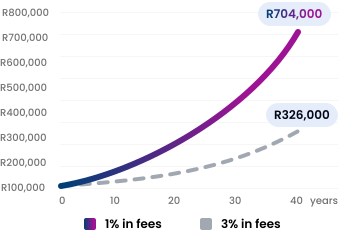
Effective Annual Cost (EAC) is a standardised metric which ASISA introduced in 2015. It allows you to understand the full cost of holding an investment over time. The EAC combines various charges linked to an investment into a single annual percentage, which can be seen on your investment statement. Depending on the product you have, this may include investment management fees, administration costs, advice fees, penalties and more. It is a useful comparison tool for you to use, as an investor. Assuming all other factors are equal, a lower EAC may mean that a larger portion of your money remains invested and available to potentially grow over time. A higher EAC may result in greater pressure on net returns, as fees accumulate over time, which may then have an impact on the growth of your RA. Let’s look at an example to show the effect of fees. We will assume the following information:
- Starting capital: R0
- Monthly contributions: R5,000 at the end of each month
- Investment period: 30 years
- Gross annual return: 10%
- Inflation: 5% p.a.
- No withdrawals are made during the investment period, and contributions are fixed.
Scenario 1 - 1% fees: After 30 years, your retirement annuity will grow to an estimated inflation-adjusted value of R3.37 million.
Scenario 2 - 3% fees: After 30 years, your retirement annuity will grow to an estimated inflation-adjusted value of R2.43 million
As this example shows, fees can impact your final investment values. This is especially evident when fees are compounded over time. This example is for illustrative purposes only, and real results may vary. You can look at this article covering the maths to learn more about the impact of fees.
At 10X, our fees are low, transparent and simple for you to understand. There is generally a single fee charged, which is usually less than 1% for most retirement products. Please explore our products to find out more.
Asset allocation
Another key factor you can control as an investor is asset allocation. This refers to the mix of different asset classes that you invest in within the RA wrapper. The usual mix of assets that you would select from is as follows: equities, real estate, bonds and cash. The right mix of asset classes for you will depend on your time horizon, income needs and risk profile. The research from Brinson, Singer and Beebower highlights the importance of asset allocation and the impact this can have on your returns.
Equities may be included in your asset allocation to provide long-term growth and potentially inflation-beating returns. Equities have historically delivered returns above inflation by approximately 7% annually over long periods (based on JSE All Share Index performance versus CPI from 1960-2020). Values may change considerably over shorter periods, which means they are usually better-suited if you are an investor with a longer time horizon and the ability to tolerate volatility in your portfolio.
Real estate allows for exposure to real assets and economic activity, while also generating income through rentals and distributions. It may contribute to long-term growth in your portfolio. However, listed property can be volatile and may be affected by interest rates, economic conditions, occupancy levels and changes in the property market.
Bonds can provide diversification, stability and income within your portfolio. They are generally less volatile than equities, but they may still come with some risk. They are considered some of the more conservative of the asset classes, but they may still exceed expectations.
Cash is usually understood to be the most stable of the asset classes. It is less likely to be as volatile as equities or real estate. However, cash returns may struggle to keep up with inflation over long periods of time.
As an investor with 10X, you do not need to choose individual assets themselves. Instead, you may select from a range of diversified 10X investment funds. Each fund has a predetermined combination of asset classes and is designed for a specific type of investor, risk profile and investment timeline. You may choose the fund which best fits with your financial goals, time horizon and investment risk. Please explore our funds page for the most up-to-date fund information.
How 10X supports disciplined retirement annuity investing
At 10X, our focus is on long term retirement outcomes. 10X takes a disciplined, rule-based middle road between rigid, passive index-tracking and a more active approach to asset allocation. We focus on simplicity and transparency, helping you to be clearer on fees, investment strategy and funds.
Our fees are also cost-effective, allowing more of your returns to potentially grow and compound over time. Not only do we offer a range of free online tools, such as this EAC calculator and this retirement annuity calculator, to help you with your retirement investing, but you are also able to speak to our helpful and experienced 10X investment consultants if you have any queries.
This support can be especially useful when you are trying to stay disciplined over many years. Retirement annuity investing is not only about choosing a product once, but it’s also about understanding your fund selection, reviewing your fees, using available tools and keeping your long-term retirement goals in focus.
Final thoughts on retirement annuity access
Regarding your retirement annuity, the limited access to your money might seem like a drawback, but it is actually a key feature that supports your RA's purpose and assists in achieving your long-term retirement objectives. Your focus should be on the future, backed by a disciplined approach to your retirement savings.
It's best to keep your retirement savings separate from short-term investments to ensure they're dedicated to their intended purpose. If you don’t have an RA yet, now is the perfect time to start saving for retirement. The 10X Retirement Annuity provides everything you need to help reach your retirement goals.
Get in touch with 10X to learn more about our products or to start investing today!
Related articles



How can we 10X Your Future?
Begin your journey to a secure future with 10X Investments. Explore our range of retirement products designed to help you grow your wealth and achieve financial success.