Should you switch retirement annuity providers?
4 December 2025
The uncomfortable truth about retirement in South Africa - Rands and Sense by 10X [video]
We sit down with 10X Investment Consultant lead Andre Tuck and discuss the retirement savings crisis in South Africa. We also delve into living annuities, retirement annuities, TFSAs and everything in between. Read more
![The uncomfortable truth about retirement in South Africa - Rands and Sense by 10X [video]](/_next/image?url=https%3A%2F%2Fimages.ctfassets.net%2Fyqvz0zwovkbq%2F5ipSTnRq5Dp25fyghm5kGQ%2F02c801c78d5e1ca9280bfd34d7602368%2FAndre_Tuck_podcast_cover_image__1_.webp&w=828&q=75)
It is fairly common for South Africans to be invested in old and expensive retirement annuities that are no longer providing for them or aligning appropriately with long-term objectives and goals. Along with this may come high fees and less-than-suitable asset allocation, which may result in poor retirement outcomes in the long term.
Using a modern, transparent and low-cost service provider may result in more positive long-term investment performance. Considering switching providers while carefully weighing up any pros and cons can be a fruitful move in the long run. In this article, we will delve deeper into switching service providers and how to decide if this would be a sensible move for you and your RA.
Build the retirement of your dreams with our
Retirement Annuity calculatorA recap: Retirement annuities
A retirement annuity (RA) is a long-term retirement investment savings vehicle that offers tax benefits to you, the investor. Contributions that you make to your RA are tax-deductible to certain limits. These limits are up to 27.5% of your income and up to R430 000 per annum. Investment returns within the retirement annuity wrapper are also exempt from income tax, dividends tax and capital gains tax while invested.
This means that you may potentially have more returns to compound and grow your retirement investment savings over the long term. At retirement age, which is currently from age 55 in South Africa, you will use your retirement annuity to purchase either a living annuity or a life annuity. This annuity will then provide you with an income for your retirement years.
A retirement annuity can be an incredibly useful retirement savings vehicle for investors who do not have a company-sponsored pension or provident fund. They offer flexibility in that you are able to contribute via a monthly debit or a lump sum amount or both; you decide according to your preferences. This can also be amended according to your changing needs. Of course, you will need to keep in mind any minimum contribution amounts as stipulated by your service provider.
Retirement Annuity vs Tax-free Savings Account vs Bond: Where Should Your Extra Money Go?
Got extra money to invest? Compare three powerful options: Retirement Annuity, Tax-Free Savings Account (TFSA), or paying off your bond faster. Learn the pros and cons of each to make an informed choice for your financial future. Read more

Why people consider switching retirement annuity providers
Outdated, high-fee contracts
Older style RAs may have a more expensive and complicated fee structure, which can make it more difficult for investors to understand. The Effective Annual Cost (EAC) of your investment shows the total costs and fees of owning a retirement annuity over a one-year period of time. This standardised metric is a good way to compare and evaluate with other service providers.
High fees may have an impact on the growth of your retirement annuity over the long term. This is because there may be fewer available returns to reinvest and potentially grow and compound over time. What might seem to be a small difference in fees may significantly impact the growth of your RA when this is compounded over many years. On the other hand, lower fees means there are more available returns to reinvest and potentially compound over time.
Let’s look at an example to illustrate the profound effect of compound growth working for you, alongside a conscientious approach to investing:
Scenario 1: In the first case, you start with a R100K lump sum and generate 6% real return over 30 years (real returns refers to returns minus inflation)
Scenario 2: In the second case, you start with a R100K lump sum, and add a R1,000 per month to it for 30 years at the same 6% real return.
Higher fees very likely means lower returns (and here's the maths to prove it)
Paying high fees on your retirement investments (such as a retirement annuity or a living annuity) almost always means less money in your pocket, and less money for your retirement. Read more
In the first scenario, you end up with around R482,000.
In the second scenario, you end up with approximately R1.5 million.
We can see how small contributions over time can make a major difference. Note that this example is for illustrative purposes only, and real results may vary.
Poor transparency
As an investor, choosing a service provider who is transparent with their fees and investor statements is important. You should ideally be able to navigate your provider’s online portal easily and be able to find documentation such as tax certificates and statements effortlessly. These statements should be clearly laid out and easy for investors to understand.
An easy-to-navigate online portal can make monitoring your retirement annuity simple and stress-free. No transparency equals no trust, and as an investor, you may struggle to identify hidden costs or make informed decisions about your portfolio. As such, choosing a provider that prioritises clarity helps you stay in control of your retirement plan and avoid unwanted surprises in the long term.
Poor or misaligned asset allocation
A provider should offer a well-diversified range of funds which allow investors to select an appropriate fund according to their investor profile and long-term financial goals and plans. This selection may include a range of both local and offshore assets, as this allows you to spread risk and capture global growth opportunities.
Poor or outdated asset allocation can limit returns or expose your portfolio to unnecessary risks. With the right provider, you should have flexible fund options to choose from that align with your profile as an investor and your long-term objectives.
We've built the 'happy retirement' machine
Understanding the most effective strategy for investing your retirement savings is fundamental to experiencing a happy retirement. We've built an investment machine that gives you a great chance of really golden years. Read more

Fees: The #1 reason most people switch retirement annuity providers
Fees are an often overlooked factor, but they can have a major impact on retirement outcomes. As an investor, you should always be aware of the fees that you’re paying, and you should understand the impact that they have. It’s important to understand your fees as a Rand value rather than a percentage. This can be a retiree’s biggest single cost and can help show the real cost of high fees.
Fees may play an important role in determining the growth of your RA over the long term. Lower fees may mean there are more returns available to compound and potentially grow your RA over the long term.
Quantifying the impact of high fees
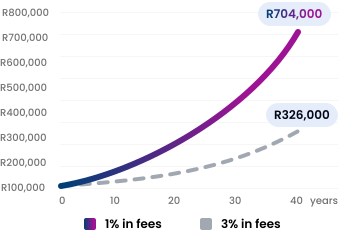
Let’s look at an example to compare higher fees (3%) with lower fees (1%) to help illustrate the effect that fees may have on your final investment value.
Investment period of 30 years
Initial lump sum investment of R50,000
Monthly contributions of R2,000
Return of 12% per annum
An inflation rate of 6%
Example 1 (1% Fees): Real investment value is approximately R1.8 million
Example 2 (3% Fees): Real investment value is approximately R1.3 million
As this example shows, a relatively small difference in fees can impact your final investment value by a notable amount. Please note that this example is for illustrative purposes only, and real results may vary. You can learn more about fees here.
Understanding and comparing fees
There are a few typical fees that you may see deducted from your retirement annuity:
Management fees: These are the fees charged for running and managing the fund.
Administration fees: Administration fees are the fees charged for admin-related tasks. These would be tasks such as compliance and tax.
Advisor fees: Your advisor may charge fees for their advice and services. Most advisors will charge both an initial and an ongoing fee.
Your EAC can be viewed on your statement, or you can request this from your service provider. All factors being equal, you may find that a higher EAC means that there are fewer returns to be reinvested and allowed to compound over time. A lower EAC may mean that there are more returns available to be reinvested and allowed to compound over the long term.
The EAC of your investment would be just one consideration when evaluating service providers. At 10X, we provide this useful EAC calculator, which allows you to check and compare your EAC with the EAC charged by 10X. This calculator is a part of our online suite of free tools that we offer to investors. We keep our fees simple and transparent at 10X with no hidden fees. Fees charged are usually less than 1% for retirement products such as retirement annuities. Please visit our product page for the most up-to-date fee information. Fee information is correct as of the 18th of November 2025.
The importance of asset allocation in retirement annuities
Asset allocation is a crucial factor when it comes to your RA. Asset allocation plays the biggest role in the performance of your retirement annuity, accounting for over 90% of returns, as seminal research from Brinson, Singer and Beebower shows.
10X offers a variety of carefully selected funds which allow investors to diversify across the various asset classes, including both local and offshore assets. This allows you to align your portfolio to match with your investor profile and financial goals. The typical asset mix will be a selection of the following asset classes: equities, real estate, bonds and cash.
Diversifying across the asset classes allows you to balance any potential risk or reward. Bonds and cash add stability to your portfolio. This is not to say that bonds may not outperform ever, merely that over the course of a lifetime of saving for retirement, they are typically a more conservative option. Bonds do tend to generate higher returns than cash, with cash being the most stable of the asset classes, while real estate may provide a good hedge against inflation. Equities may provide the best returns of the asset classes over the long term, while also being the most volatile of the asset classes.
As data suggests, equities have historically produced returns above inflation by around 7% annually - over the long term (based on JSE All Share Index performance versus CPI from 1960-2020) - but past performance does not guarantee future results. In order to aim to beat inflation, you would generally look to include equities in your portfolio. Retirement annuities are subject to Regulation 28 of the Pension Funds Act. This regulation was implemented in order to help investors structure a well-diversified portfolio which includes a variety of different asset classes. Current regulations put a cap on the percentage of your retirement annuity that you may invest in both equities and offshore funds. This limit is currently 45% for offshore and a limit of 75% for equities.
10X offers a variety of Regulation-28-compliant funds that will provide you with access to a range of different asset classes - both local and offshore. Diversifying offshore can provide a good hedge against any local market instability that may occur. It can also provide a hedge against any subsequent depreciation of the Rand.
How to know if switching makes sense for you
The self-assessment checklist Here is a practical checklist that you can use to assess whether or not you should be considering switching service providers:
- Fees: Is your service provider cost-effective and transparent when it comes to the fees that they charge
- Transparent reporting: Does your provider issue clear, easy-to-understand performance reports and statements? Are you able to easily view your RA’s performance at a variety of different time intervals
- Asset allocation and fund choice: Is your service provider offering a range of well-diversified funds that include both local and offshore exposure? This will allow you to structure your portfolio in order to meet your long-term financial goals and timelines.
- Online platform access: Does your provider offer a digital platform that enables you to easily access statements that you may require or make changes to your RA effortlessly?
- Customer service: Is your provider able to provide you with a high level of customer service? Are you able to access consultants easily and get feedback without too much effort?
This list is a useful tool in helping you to assess whether your current RA provider is still providing for you and helping you to meet your financial goals and strategy. H2: The retirement annuity transfer process explained (Section 14 Transfer) For those who make the decision to transfer your retirement annuity from one service provider to another, you will need to initiate a Section 14 process. This process will involve a number of steps:
- You will need to request a transfer-out quote from your current service provider. This will detail any additional costs.
- This signed quote, along with your signed application form for your new RA, will need to be submitted to both providers.
- There will then be further documentation drawn up - known as the Form J and Form H.
- Section 14 transfers usually take around 3 months to complete, but they may take up to 6 months to be finalised.
10X offers a cost-effective, transparent retirement annuity with access to a wide range of carefully selected funds, allowing you to strategically align your long-term objectives with your risk tolerance levels and investment time horizons.
Final thoughts on switching retirement annuity providers
If you find that transferring your RA to a different provider will result in the best long-term outcomes for you, then the earlier that you make the transfer, the better. Transferring earlier will allow you to take advantage of the power of potential compound growth. Factors such as high fees, shoddy customer service, and ambiguity when it comes to reporting may necessitate the need to transfer to a different provider.
Your retirement annuity can be a key part of your retirement investment savings plan, so leveraging this by making the most of a strategic asset allocation and low fees can pay off in the long term. Peace of mind is paramount when it comes to investing, hence the importance of choosing a trusted, transparent provider who resonates with you, focuses on excellent returns and prioritises minimising fees.
The 10X investment consultants are just a call or email away. They are more than happy to help with any questions that you may have regarding retirement annuities and making the switch to 10X. Get in touch today and secure your future!
Related articles



How can we 10X Your Future?
Begin your journey to a secure future with 10X Investments. Explore our range of retirement products designed to help you grow your wealth and achieve financial success.