The cost of delaying your retirement annuity contributions
28 April 2026
A common situation for investors is delaying the start of their retirement annuity contributions. It’s easy to want to put this off until a later date. Regardless of the reason, it’s important to remember that time is a powerful factor when it comes to investing. By not taking advantage of time and instead delaying your retirement contributions, you may end up affecting your retirement outcomes.
Starting your retirement investing early, regardless of the amount you are able to contribute, can mean that you are able to take advantage of the potential tax benefits, the benefits of potential compounding growth, as well as the potential long-term growth of your capital.
In this article, we will look in more detail at the costs of delaying starting your retirement contributions, as well as the immense benefits of starting your retirement contributions earlier.
Build the retirement of your dreams with our
Retirement Annuity calculatorWhat is a retirement annuity?
A retirement annuity (RA) is a long-term retirement savings vehicle that offers some attractive benefits to investors. They are tax-efficient savings vehicles that play a major role in retirement planning. Contributions to retirement annuities are tax-deductible, subject to annual limits; these are up to 27.5% of your income or R430,000, as from the 1st of March 2026.
Investment returns within the retirement annuity are exempt from income tax, dividends tax and capital gains tax while invested. This will allow for more returns to be reinvested and potentially compounded over time. You can contribute via a regular debit order to your retirement annuity or make a lump-sum deposit. Keep in mind that you will need to check the minimum amounts required with your particular service provider.
You can also adjust your debit order to cater to changing needs over time, which may suit self-employed individuals whose income changes from month to month. The key is to start investing in your retirement annuity early and be consistent, be it via a lump sum deposit or a regular debit order.
Why investors delay starting a retirement annuity
It can be easy to fall into the habit of putting off starting a retirement annuity until later in life. There can be a variety of reasons for this, depending on your individual circumstances. You may find that you have more ‘pressing’ expenses that you need to cover, or perhaps you are saving up for a specific item, such as a house, or maybe you are just waiting for that salary increase.
It could even be a situation where you aren’t aware of the importance of starting your retirement annuity earlier and the potential long-term benefits of doing so. It may seem innocuous to delay starting your retirement annuity contributions, but it can greatly affect your retirement outcomes in the long run.
The power of starting early and the tax cost of delaying your RA
When it comes to investing, time is a very powerful tool that you have at your disposal. The earlier that you start, the more time you have available to take advantage of the potential power of compound growth. This is the growth that is seen over time when returns generate more returns.
Let’s have a look at an example which can help to illustrate the power of starting early and being able to take advantage of potential compound growth:
Scenario 1: You invest a R100k lump sum and generate 6% real return over 30 years.
Scenario 2: You invest a R100k lump sum, and also contribute a debit order of
R1000 per month for 30 years. The investment generates a 6% real return over this time period.
In Scenario 1, you end up with approximately R482,000
In Scenario 2, you end up with approximately R1.5 million.
By including a regular debit order, even a relatively small debit order, when compounded over 30 years, it can add up and positively affect the total capital that you have available for your retirement. This example is for illustrative purposes only, and actual results may vary.
Retirement annuities can reduce your taxable income. This means you may move into a lower tax bracket and pay less tax on your earnings. If you delay starting your retirement annuity, you are not only missing out on the potential long-term growth but also on potential tax savings that may be available.
The role of asset allocation over time
Your asset allocation should be structured according to your investment timelines and time horizons. In addition, you should aim to align your asset allocation with your risk tolerance and your long-term investment plans and goals. Asset allocation plays the biggest role in the performance of your retirement annuity, accounting for over 90% of returns, as seminal research from Brinson, Singer and Beebower shows.
The usual asset allocation will include a mix of equities, real estate, bonds and cash. 10X gives you the option to adjust your underlying portfolio by choosing from a selection of carefully designed funds, each with a different mix of assets and geared towards different investor profiles.
Equities are considered the most volatile of the asset classes, while also historically producing the best long-term returns. If you start your RA earlier in life, you may wish to include a higher percentage of equities, as the longer timeline gives you more opportunity to recover over market cycles and periods of volatility. Equities may produce the best returns over the long run, but they are also the most volatile of the asset classes. Equities have historically produced returns above inflation, by around 7% annually over the long term (based on JSE All Share Index performance versus CPI from 1960-2020); however, past performance does not guarantee future results.
Real estate can also produce good returns while acting as a hedge against inflation. Bonds may produce some lower returns, but they will add some stability to your portfolio. Even though bonds are seen as a more conservative option, they may still outperform expectations. Cash is the most stable of the asset classes, but it is also likely to generate the lowest returns of all.
If you start your retirement annuity later in life, this may mean you will consider including a smaller percentage of growth assets in your portfolio, as you may have less time to recover from any potential market downturns. This is another major reason why starting early is important.
You will also want to ensure that your retirement annuity is Regulation 28 compliant. Regulation 28 of the Pension Funds Act is in place to help investors avoid poorly-diversified portfolios. This regulation will put a cap on the percentage of equities and offshore investments that you may invest in. Current regulations allow you to allocate up to 75% to equities and 45% offshore.
Our offerings at 10X are well diversified across asset classes, ensuring you can select a fund that matches your investment timelines, risk profile, and long-term financial plan and goals. Please visit our funds page for the most up-to-date information on funds.
Retirement annuities and the Two-Pot Retirement System
The implementation of the Two-Pot Retirement System in September 2024 has changed the way that contributions and withdrawals to and from retirement products are made in South Africa. All contributions that are made to retirement products are now split between a ‘retirement pot’ and a ‘savings pot’. There is also a third pot, which is called the ‘vested pot’. This vested pot includes all savings that were accumulated prior to the implementation of the Two Pot Retirement System in September 2024, and remains governed by the old rules.
You may withdraw from your savings pot once per year. This will need to be for a minimum amount of R2,000. Withdrawals are taxed at your marginal tax rate, and there will also be an administration fee charged. Withdrawals from your savings pot should generally be avoided, if possible, in order to take full advantage of compound growth.
The bulk of your savings will go to the retirement pot, with two-thirds of contributions being allocated to the retirement pot and one-third of contributions going to your savings pot. The retirement pot can only be accessed upon retirement. This is currently for people aged 55 (earliest access age) in South Africa. It may then be used for either a life or a living annuity. Please consult the latest FSCA guidance for the most up-to-date information on the Two-Pot Retirement System.
Why fees matter even more when you start late
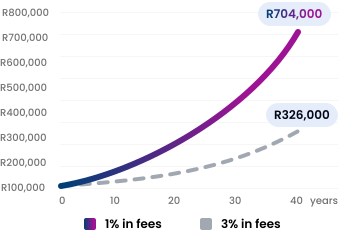
The importance of fees should never be understated when it comes to retirement annuities. If you are starting your RA later in life, you may want to pay even closer attention to the effect of fees. Higher fees may leave fewer returns available to reinvest. If you are trying to maximise growth in your portfolio, you would want to minimise fees to allow more returns to be available to reinvest. High fees, when compounded over time, may have a significant impact on your retirement outcomes.
There are some common fees that you may see charged on your RA. Let’s have a look at some of these fees:
- Administration fees: There will be fees charged for administration tasks. These will be tasks such as: tax, compliance and reporting.
- Management fees: These are the fees charged for the management of the fund.
- Advisor fees: If you are using an advisor, they will usually charge fees for their advice and any other services. They may charge both an initial and an ongoing fee.
Let’s look at an example to help illustrate the effect of fees. This could be a situation where you are starting your RA later in life and therefore aiming for higher monthly contributions over a 20-year period of time: We will assume the following factors:
- Investment period of 20 years
- Initial lump sum investment of R300,000
- Monthly contributions of R10,000
- Return of 12% per annum
- An inflation rate of 6%
Example 1 (0.86% Fees): Real investment value is approximately R3,442,000
Example 2 (3% Fees): Real investment value is approximately R2,775,000
Just a small difference in fees can have a major impact on the real investment value of your RA. This difference is even more evident when fees are compounded over time. You can learn more about the impact of fees here.
You should also check your Effective Annual Cost (EAC). This is a standardised metric which was introduced by ASISA in 2015. This metric allows you to see the total fees and costs associated with owning an investment product over a one-year period. All factors being equal, a higher EAC may mean that there are fewer returns to be reinvested and allowed to potentially grow over time. A lower EAC may mean that there are more returns to be reinvested and allowed to compound over the long term.
Of course, the EAC would be just one factor to consider when comparing service providers. We aim to keep fees low, simple and transparent at 10X. Please explore our products for the most up-to-date fee information.
Investment strategy: why index tracking supports long-term growth
An index-tracking strategy is an investment strategy in which a benchmark index, such as the S&P 500, is mirrored. The aim is to achieve returns that match the index. This approach therefore involves fewer activities, as there is far less research, analysis or trading. You may then find that costs are kept lower, which could result in lower fees for you, as the investor. This strategy focuses on long-term growth for investors as well as consistent returns over time. An active management strategy involves a fund manager tasked with the objective of picking winning stocks. This kind of task will involve extensive research, trading, buying, and selling, which may result in higher costs.
The S&P Indices Versus Active (SPIVA) Scorecards track the performance of actively managed funds against their benchmarks globally. According to the latest SPIVA South Africa Scorecard (as of June 2025), 67.61% of South African actively managed equity funds underperformed the S&P South Africa DSW Capped Index over the ten-year period ending June 30, 2025.
How to start (or restart) your RA today
Starting or restarting your retirement annuity doesn’t need to be complicated. The most important step is simply to begin. Even if you’re only able to contribute smaller amounts at first, consistency over time can make a meaningful difference.
- Start small, but start now: Even a small monthly contribution can benefit from potential long-term compound growth.
- Set up a regular debit order: Starting a debit order can help to keep your investing disciplined and consistent over time.
- Use bonuses and extra income strategically: If you do get any bonuses or extra income, this can be put into your RA to help boost growth.
- Stay focused on the long-term: Keep your focus on your long-term goals and don’t be distracted by short-term market noise that may occur.
Retirement annuity final thoughts: The best time to start is now
It can be easy to procrastinate and put off starting your retirement annuity, but RA contributions should be a priority. Consistent contributions are key, even if they are small, as every bit counts. You can always increase your contributions as your salary rises. If you have any extra income, add it to your RA, and reap the benefits of potential compound growth over time.
As always, keep focused on your long-term goals and your retirement plan. If you have any queries surrounding retirement annuities or would like to set up a 10X Retirement Annuity, feel free to get in touch with our investment consultants today, who are more than happy to assist!
Related articles


How can we 10X Your Future?
Begin your journey to a secure future with 10X Investments. Explore our range of retirement products designed to help you grow your wealth and achieve financial success.