The living annuity stress test: Will your money survive market crashes?
25 June 2026
Building blocks to a lasting Living Annuity
Our panel of experts discusses living annuities, sustainable drawdown rates, offshore investing, and everything else one might need to consider to ensure a comfortable retirement. Read more
![Building blocks to a lasting Living Annuity [webinar + transcript]](/_next/image?url=https%3A%2F%2Fimages.ctfassets.net%2Fyqvz0zwovkbq%2F4dZzwtwSkZ19hmRrVa6Zyb%2F770741ecc4b2ae3deda48fa06da42718%2FWebinar_recording_cover_1920X1080.webp&w=828&q=75)
A fear of a market crash is a very real worry that retirees may experience when considering their living annuity. This is understandable, as a market crash may affect their annuity and the income they can draw from it. Notable market crashes in recent years have been the 2008 financial crisis and the 2020 COVID-19 market crash.
A stress test is a way to gauge how your annuity will perform in times of market pressure and volatility. How market volatility is responded to is also very important. 10X’s adopted approach, which focuses on key elements such as low fees, well-diversified portfolios, index-tracking strategies, and long-term consistency, aims to manage volatility effectively.
In this article, we will guide you through how to stress test your annuity and ensure that you incorporate measures that will help build resilience into your portfolio.
Plan for a comfortable retirement with our
Living Annuity calculatorA living annuity recap
A living annuity is a flexible, long-term investment product. The retiree invests the savings and then also draws an income. This drawdown rate can be selected each year at the policy anniversary date. Your drawdown rate is a percentage of the total value of your annuity that you draw as income each year.
Current regulations state that you may draw an income of between 2.5% and 17.5% per annum. This drawdown rate can be adjusted as your needs change over time. Your choice of underlying funds can also be changed, allowing for flexibility as your preferences and/or financial situation change. A big part of a living annuity’s appeal is the ability to pass on the remaining capital to your beneficiaries outside of your estate, and this will therefore be tax-free.
Why market crashes matter more in a living annuity
High withdrawals can erode capital faster
As you are drawing down at a high rate, say greater than 6%, the combined effect of this and a market crash may has the potential to erode your capital base. If returns aren't compensating for the combined effect of inflation, a high draw down and high fees, you might start to see your capital base slowly eroded.
Emotional mistakes during downturns
During a market downturn, you may feel panicked, which can lead to emotional decision-making. This could prompt you to switch funds to a more conservative selection, perhaps with a higher cash allocation. This may affect the long-term growth of your annuity, as any losses may then be ‘locked in’.
Why timing matters during retirement
Retirees are especially vulnerable to market crashes early in retirement. If a significant market decline occurs as you start drawing income from your annuity, you may be forced to withdraw income from a portfolio that has fallen in value. As such, less capital is invested to participate in any future market recovery.
By contrast, an investor who is still accumulating savings and making contributions may actually benefit in future from lower market prices by purchasing investments at a discount now. A retiree drawing income does not have this advantage, which is why market declines can have a more significant impact on an annuity’s sustainability.
The risk is often referred to as sequence-of-returns risk and highlights the importance of a carefully considered drawdown rate, asset allocation, low fees, and long-term investment approach.
The 10X lens
10X takes a long-term view when it comes to investing. Knee-jerk decisions should be avoided, if possible, and your long-term financial plan should always be at the forefront of all decision-making. Low fees will help during a market recovery period, allowing more returns to be reinvested and potentially continuing to grow and compound, while diversifying across asset classes helps balance risk and return.
How to stress test a living annuity
There are three areas to focus on when it comes to your annuity and assessing its resilience:
1. Asset allocation
You would look to strategically select your asset allocation according to your investor profile and timelines. Your asset allocation is usually a mix of equities, real estate, bonds and cash. 10X allows investors to adjust their underlying portfolio by choosing from a range of carefully curated investment funds, each with a different mix of assets and geared towards different investor profiles.
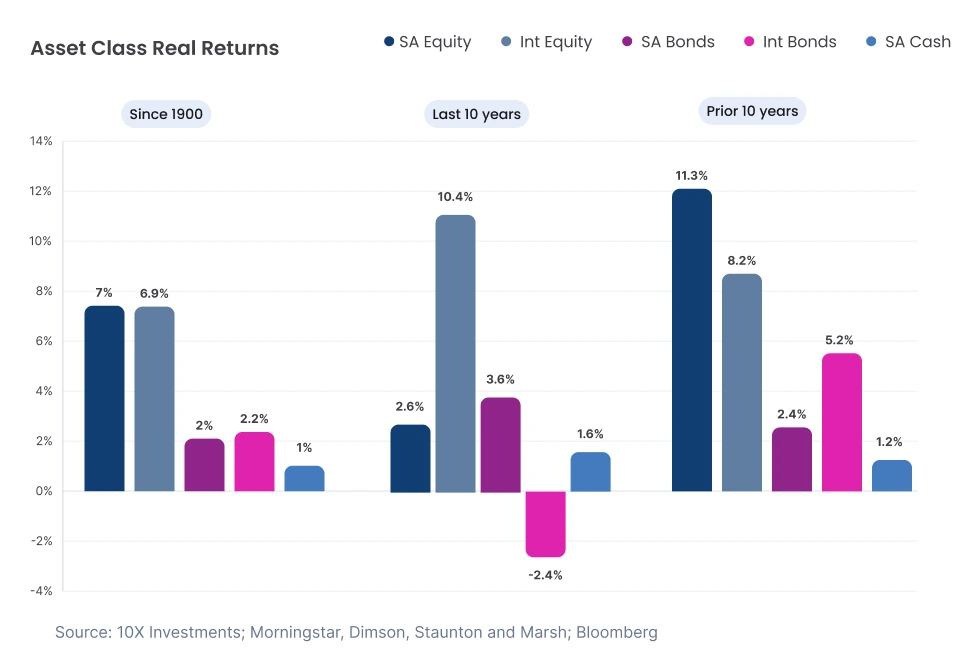
Equities may generate the best long-term returns but are also the most volatile among asset classes. Real estate may produce some strong returns while serving as a hedge against inflation. Bonds will add some stability to a portfolio, but may generate lower returns. This doesn’t mean bonds will never outperform expectations, merely that they are seen as a more conservative option. Cash will likely produce the lowest returns of all and is also the most stable asset class.
Diversifying across the asset classes allows you to spread your risk. You may also look to further diversify offshore. This can provide a hedge against local market instability and any depreciation of the Rand. As living annuities are not subject to Regulation 28 of the Pension Funds Act, they may be invested 100% offshore, provided your service provider offers this.
At 10X, we have a range of diversified funds that offer you access to both local and offshore assets. These funds have been carefully selected in order to suit a range of different investor profiles, so you can be sure there is a fund to suit you. Please explore our funds for the most up-to-date fund information. Fund information is correct as of 23 June 2026.
2. Drawdown rate
Your drawdown rate should be sustainable in order for your annuity to provide for your retirement years and to avoid it running out too soon. A sustainable drawdown rate is thought to be about 4% by financial experts, but nothing can be guaranteed. Of course, if you are able to draw less, then this would be advised as a method of potentially improving sustainability. Anything higher than 6% may mean that your savings run out too quickly. Ultimately, the responsibility lies with you as the investor, so it’s important that your drawdown rate is carefully managed.
3. Fees
Fees may impact the growth of your annuity, especially when these are compounded over the long term. Higher fees may result in there being fewer returns available to be reinvested and allowed to potentially grow over the years. Even a small difference in fees may have an impact on the potential growth of your capital.
The role of asset allocation in crash survival
Asset allocation plays the biggest role in the performance of your living annuity, accounting for over 90% of returns, as seminal research from Brinson, Singer and Beebower shows.
Equity exposure
As mentioned, equities may have the highest returns over time, along with being the most volatile of the asset classes. As data suggests, equities have historically produced returns above inflation - by around 7% annually - over the long term (based on JSE All Share Index performance versus CPI from 1960-2020), but past performance does not guarantee future results. They may fall the most during a market crash, but they may also recover the quickest.
Bonds and cash
Bonds and cash are both more stable than equities. During a market crash, they may not be as affected as equities. Growth may be slower with bonds and cash, with cash in particular struggling to beat inflation. Investing too heavily in cash may also result in a slow recovery after a market crash. That being said, bonds may still outperform expectations, despite being seen as a more conservative option.
Offshore exposure
Offshore exposure can provide a bit of a buffer against local market instability. With the global market being bigger than the South African market, this may provide opportunities that would not otherwise be available. There may be more access to different companies and industries in comparison to what you could find in the local market. As mentioned, living annuities are not governed by Regulation 28 of the Pension Funds Act, meaning that you are able to invest 100% offshore if you wish.
Ideal asset allocation for crash survival
While nothing can be guaranteed when it comes to investments, there are guidelines you can follow to help you get the most out of your annuity. You should ideally structure your asset allocation according to your risk profile and your investment timelines, while also considering your long-term financial goals.
Your risk profile looks at your risk tolerance levels and how comfortable you are with short-term market volatility. Generally speaking, the younger you are and the longer your timelines, the more growth assets, such as equities, you would look to include in your portfolio. An older retiree may be less risk-tolerant, and with shorter timelines on hand, they may prefer to be more conservative with their asset allocation.
As an investor, you want to ensure your asset allocation aligns with your risk tolerance levels, timelines and long-term financial goals.
The role of fees in stress test results
Effective Annual Cost
The Effective Annual Cost (EAC) is an important metric that can be used to compare service providers. It is a way for investors to see all the fees and costs that are being deducted over a one-year period of time. This standardised metric was introduced by ASISA in 2015. The EAC is the total fees and costs of owning an investment over a one-year period of time. The EAC can be viewed on your statement, or if not, you can request it from your service provider.
All else being equal, you may find that a higher EAC means that there are fewer returns to be reinvested and allowed to compound over time. A lower EAC may mean that there are more returns available to be reinvested and allowed to compound over the long term. The EAC of your investment would be just one consideration when evaluating service providers.
At 10X, we offer an EAC calculator to investors, which is a part of our free suite of online tools. This can be useful if you are looking to compare and evaluate the EAC charged by your service provider against that charged by 10X.
Let’s look at an example to illustrate the effects of fees, especially when they're compounded over time.
We will assume the following for this example:
- Investment amount: R2 million
- Investment period of 25 years
- Drawdown rate: 4% (assuming an annual payment)
- Return of 12% per annum
- An inflation rate of 6%
Example 1 (0.86% Fees): Real investment value is approximately R2.36 million.
Example 2 (3% Fees): Real investment value is approximately R1.45 million.
We can see how small differences in fees may lead to major differences in retirement outcomes. This example is for illustrative purposes only, and actual results may vary. You can find out more about the impact of fees here.
The 10X advantage
At 10X, we offer a transparent and cost-effective fee structure which is clear for all investors to understand. We understand the importance of minimising fees so that there are more potential returns to grow over time. Please explore our products for the most up-to-date fee information.
How to run your own living annuity stress test
A stress test is an effective way to assess how resilient your retirement income strategy is during periods of market volatility and uncertainty. By reviewing a few key areas, you can identify potential weaknesses in your retirement plan and make adjustments where needed.
Step 1 — Check your drawdown rate
Is your drawdown rate sustainable over the long term? Your drawdown rate has a direct impact on how much capital remains invested and available for potential future growth. While there is no guaranteed “safe” drawdown rate, many financial experts consider 4% to be the sweet spot.
Step 2 — Check your fees
Are you paying high fees? As discussed, even small differences in fees can lead to significant differences in retirement outcomes. As a general guideline, it’s important to understand your EAC and ensure your fees are transparent and competitive. The lower the fees, the more investment returns are available for reinvestment and growth.
Step 3 — Check your asset allocation
Is your portfolio well-diversified and aligned with your investor profile, retirement objectives, and investment time horizon? Think about whether your portfolio includes an appropriate mix of growth assets, defensive assets, and offshore exposure. A well-diversified portfolio may be better positioned to withstand market volatility while still targeting long-term growth.
Step 4 — Run different scenarios
Consider how your annuity may perform under different market conditions, drawdown rates, and investment returns. Make use of a tool such as this free living annuity calculator offered by 10X to model different scenarios and assess the potential impact of changes to your drawdown rate over time. This can provide you with valuable insights and help you make more informed decisions.
Final thoughts on living annuities
A market crash might be unavoidable, but steps can be taken to ensure that your living annuity is more resilient than what may otherwise be the case. Stress testing helps you see where you stand with your annuity. It also highlights the importance of low fees, an appropriate asset allocation and a sustainable drawdown rate.
At 10X, our low fees, well-diversified fund options, and index-tracking strategies, along with your consistent and disciplined investment approach, can help build resilience into your annuity. Please get in touch with our qualified and experienced investment consultants who are ready and willing to answer any questions you may have.
Related articles



How can we 10X Your Future?
Begin your journey to a secure future with 10X Investments. Explore our range of retirement products designed to help you grow your wealth and achieve financial success.