What makes a good preservation fund provider?
6 March 2026
The Living Annuity Masterclass: How to maximise your retirement income


The uncomfortable truth about retirement in South Africa - Rands and Sense by 10X [video]
We sit down with 10X Investment Consultant lead Andre Tuck and discuss the retirement savings crisis in South Africa. We also delve into living annuities, retirement annuities, TFSAs and everything in between. Read more
![The uncomfortable truth about retirement in South Africa - Rands and Sense by 10X [video]](/_next/image?url=https%3A%2F%2Fimages.ctfassets.net%2Fyqvz0zwovkbq%2F5ipSTnRq5Dp25fyghm5kGQ%2F02c801c78d5e1ca9280bfd34d7602368%2FAndre_Tuck_podcast_cover_image__1_.webp&w=828&q=75)
Often, investors make a hasty choice when choosing a preservation fund provider while changing roles. This is understandable. During a job transition, your focus is primarily on securing a new role, starting a new position or settling into a new workplace, not necessarily on carefully choosing a preservation fund provider who's going to give you the best chance at better returns and a more comfortable retirement.
As a result, sometimes investors choose a provider based on convenience or brand familiarity rather than taking the time to consider the bigger picture. In reality, providers can differ significantly when it comes to service delivery, fees, transparency and investment strategy.
The benefits of a preservation fund are considerable, and we will address each in turn. But by far the most important points are the following:
- You have much greater control of your savings. You choose the fund with the investment strategy that suits you. You're not locked in to the fund your previous employer chose, which would be the case if you left your pension or provident fund where it is when you move jobs;
- You could save on fees drastically. A small difference in fees can make a huge difference to your retirement - we'll address this more further down.
In this article, we will investigate what makes a good provider and how choosing the right provider may help improve your long-term retirement outcomes.
See your pension savings grow with our
Preservation Fund calculatorWhat is a preservation fund?
When you leave an employer where you were contributing to a pension or provident fund, you generally have several options for what to do with your accumulated retirement savings. One option is to transfer those savings into a preservation fund.
A preservation fund is a retirement savings vehicle used for employer-sponsored pension or provident fund savings when you are changing jobs. Capital that has been saved in your pension or provident fund can be transferred to the preservation fund without triggering a tax event.
You will need to transfer your provident fund to a provident preservation fund and your pension fund to a pension preservation fund. Growth within the preservation fund is also tax-free. Better growth and lower fees may mean that there are more returns available to be reinvested and potentially compound and grow over the long-term.
Switching jobs? The maths shows that preserving your pension is much smarter
Thinking about cashing out your pension when you move jobs? The maths shows that preserving your retirement savings is much smarter. Read more

What does a preservation fund provider actually do?
Your provider has an important role to play in terms of your retirement savings. Providers like 10X typically offer a range of investment funds from which you can choose, and your savings will be invested according to your selected fund or portfolio.
A provider is also responsible for the administration, reporting and compliance related to your funds. This includes record-keeping, regulatory compliance, reporting and issuing statements that allow you to track the performance of your investment. They will also need to service you, their client, and attend to any queries or transactions that are requested.
Unlike a retirement annuity, a preservation fund does not allow for any further contributions. This means that any growth of your investment depends largely on your investment returns. Therefore, you will need to pay close attention to factors like fees, asset allocation and the investment strategy used by your provider.
What is the Two-Pot Retirement System, and how does it affect preservation funds?
The Two-Pot Retirement System was introduced in South Africa by the National Treasury in September 2024. This system has amended the way that preservation funds are treated. All savings are now split between two pots, namely the ‘savings pot’ and ‘retirement pot’. One-third will be invested in the savings pot, and two-thirds will be allocated to the retirement pot. A third pot, the ‘vested pot’, is for all savings made before September 2024, and remains governed by the old rules.
Withdrawals are allowed from the savings pot once per year for a minimum amount of R2,000. Withdrawals will be taxed at your marginal tax rate, and you’ll also be charged an administration fee. If possible, you would want to avoid withdrawals. You would instead look to keep your savings invested, which allows for the potential growth of your capital over time. All of the capital in the retirement pot will remain invested until retirement age, which is from age 55 in South Africa.
Any further contributions to a preservation fund are not permitted. However, the savings component of the preservation fund will grow at the same rate as the total fund. For example, if your total fund grows by double the size, so will the savings pot and the vested pot. Please consult the latest FSCA guidance for more on the Two-Pot Retirement System.
The most important factor: Fees
While many investors overlook fees, higher fees may reduce the returns that you have available to reinvest. As mentioned, you would ideally look to nurture any growth that occurs within your portfolio, as you are not able to add any further contributions.
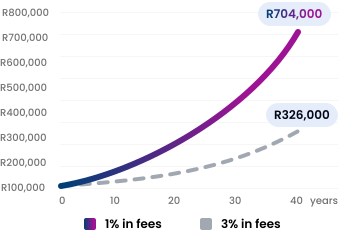
You do not want your returns to have to cover excessive fees. High fees can have a significant impact on your investment capital, and this is especially true when high fees are compounded over the long term. Low fees, on the other hand, may mean that you will have more returns available to be reinvested and allowed to compound over time.
Let’s look at an example to help illustrate the effect that high fees may have on your preservation fund:
Let’s assume the following factors for our example:
- Investment period of 30 years
- Investment of R500,000
- Return of 12% per annum
- An inflation rate of 6%
Example 1 (1% Fees): Real investment value is R1,992,890
Example 2 (3% Fees): Real investment value is R1,155,018
As you can see from this example, even a small difference in fees can have a substantial impact on your real investment value, especially when compounded over time. This example is for illustrative purposes, and real results may vary.
There are some typical fees that you may see charged on your preservation fund. These fees are:
- Administration fees: These are the fees which are charged for administration-related tasks, such as reporting, compliance and tax.
- Advisor fees: An advisor will charge fees for their advice and any other services that they may offer. There may be both an initial and an ongoing fee charged.
- Management fees: These are the fees charged for the management of the fund.
The Effective Annual Cost (EAC) refers to the total cost of owning an investment product over a one-year period of time. This metric was introduced by ASISA in 2015. All factors being equal, a higher EAC would mean that less of your investment returns can be reinvested and potentially grow and compound over time, while a lower EAC may mean that more returns may be reinvested and allowed to potentially grow over the long term.
The EAC of an investment should just be one factor to consider when comparing different service providers. At 10X, we offer a useful EAC calculator that is part of our free online suite of tools. This will allow you to compare the EAC charged by 10X with that of other service providers, and then you will be able to evaluate your different options. We are transparent when it comes to the fees that we charge, ensuring that our fee structure is simple and easy to understand, with no hidden costs. Please explore our products for the most up-to-date fee information.
Investment strategy and asset allocation
Asset allocation is a big driver of long-term returns, so this should be carefully managed. Asset allocation plays the biggest role in the performance of your preservation fund, accounting for over 90% of returns, as seminal research from Brinson, Singer and Beebower shows. The usual four asset classes are: equities, real estate, bonds and cash.
Equities are the most volatile of the asset classes but are also most likely to generate the best returns in the long term. Real estate can be a good hedge against inflation, while bonds are more stable but may produce some lower returns. Bonds may also perform better than expected, but they are typically seen as a more conservative option. Cash is the most stable of the asset classes, but may also produce the lowest returns of all. If you are looking to further diversify your portfolio offshore, you will need to adhere to Regulation 28 of The Pension Funds Act. This will allow you to invest to certain limits, namely, a maximum of 45% offshore and 75% in equities.
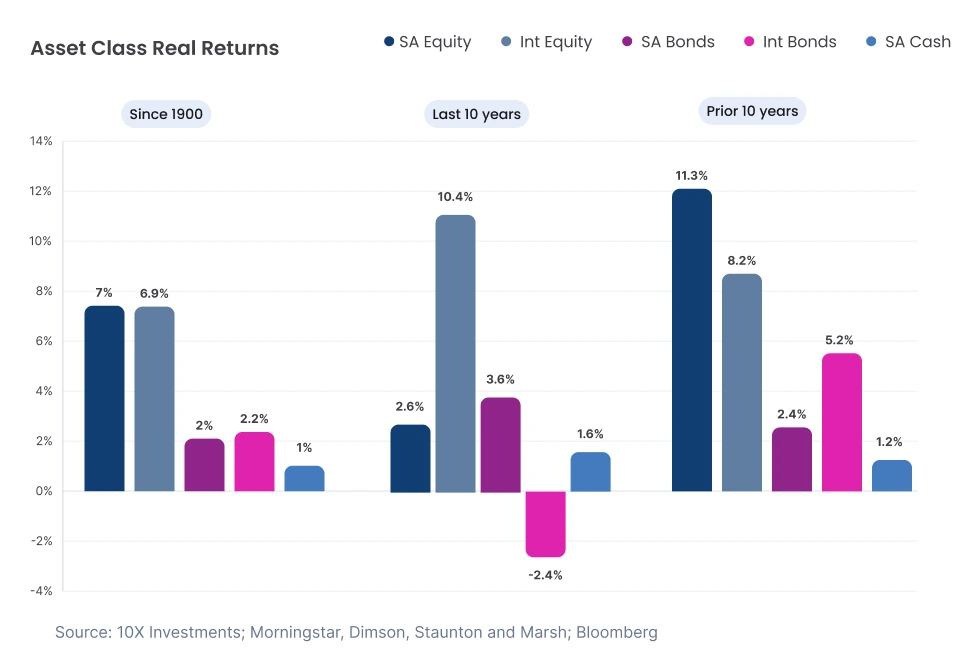
Diversifying offshore can open up further opportunities for the investor, due to the larger size of the international market, which would then include more access to a greater variety of industries and companies. Offshore diversification may act as a hedge against any local market volatility or depreciation of the Rand. At 10X, we offer investors a wide range of funds that have been carefully selected to offer you access to both local and offshore assets. This allows you to find a fund that best suits your investor profile and long-term financial plan. Please visit our funds page for the most up-to-date fund information.
Transparency and simplicity
You may want to opt for a service provider who keeps things both simple and transparent, as this can put you at ease and reduce potential frustration. Let’s look at the two main areas this may cover:
Clear fee structures
All fees and fee structures should be clear and simply explained, ensuring that all investors can see exactly what they are being charged. Fees should not be opaque, and there should be no hidden fees.
Simple, understandable reporting
All statements should be easily accessible, and the information displayed should be easy for investors to understand. It should also be easy for investors to transact online, and the online platforms should be intuitive to navigate.
Quality of service and support
As an investor, you want to know that you always have quick access to a client servicing team who are efficient, helpful and responsive. Administration processes should be well-organised to ensure that there is no frustration experienced on your part.
All communication should be clear, and any queries that you have as an investor should be dealt with quickly and efficiently. Providing feedback or resolving issues should happen timeously and not leave you waiting. You would ideally want this kind of experience all the time, and especially during events that may come with heightened stress levels, such as during a job change.
How 10X measures up as a preservation fund provider
When choosing a provider, it can be helpful to look at how different providers compare on key factors like fees, investment philosophy and transparency. At 10X, our approach focuses on keeping costs low, maintaining clear and transparent pricing and following a disciplined investment strategy designed for long-term retirement outcomes. Here are a few of the key areas where we aim to deliver value to our investors:
Low, transparent fees
Fees at 10X are kept low and transparent. Our fee structure is simple, and it is easy to see your fees; there are no surprise fees or unexpected costs. This allows for more returns to be reinvested and, therefore, more potential growth of your funds over time.
Even seemingly small differences in fees can have a major impact on long-term retirement savings when compounded over many years. By keeping fees low and clearly disclosed, investors can better understand what they are paying and how those costs affect long-term outcomes.
Evidence-based investment strategy
We use an index-tracking investment strategy alongside a more active approach to asset allocation, which includes well-diversified funds. Due to the fact that there are fewer activities associated with an index tracking investment strategy, we are able to keep costs lower, which means fewer fees should be passed onto you, as the investor. We focus on the long-term and excellent returns for our clients.
The Hare and the Tortoise: The perfect parable for your investments in 2026
When it comes to your retirement investments, should you be chasing fast returns or steady growth over the long term? And do you know a bubble when you see one? Read more

Our investment approach is built around broad diversification across asset classes and markets, which helps manage risk while capturing market returns over time. By focusing on long-term investing rather than short-term market movements, we aim to provide investors with a disciplined strategy that supports retirement goals.
A quick checklist: How to evaluate a preservation fund provider
Here is a quick checklist which will help you to evaluate service providers. Let’s have a look:
- What is the Effective Annual Cost presented by the service provider?
- Are fees simple and transparent to understand for all investors?
- Does the provider offer access to a range of well-diversified funds, including offshore exposure?
- Does the provider offer a user-friendly and intuitive online platform?
- Is there easy access to client consultants, and is the level of service of a high standard?
- Does the service provider have a good name and track record in the industry?
Conclusion: The right preservation fund provider can make a big difference
When it comes to your preservation fund, choosing the right provider can make a big difference to both your potential retirement outcomes and your overall experience in the long term. Differences in key factors such as fees, investment strategy, customer service and asset allocation can have an impact in the long term. A service provider who is cost-effective, transparent and offers access to well-diversified funds may have the effect of improving your retirement outcomes.
The 10X preservation fund looks at cost-effectiveness and transparency, which aims for consistent and long-term returns for our clients. You can also expect an excellent level of customer service and satisfaction from our investment consultants, who are here to answer any and all of your queries. Get in touch today and enjoy the benefits of our low fees and transparent approach.
Related articles



How can we 10X Your Future?
Begin your journey to a secure future with 10X Investments. Explore our range of retirement products designed to help you grow your wealth and achieve financial success.