Advice-led retirement annuity fee structures: Charging you for a person who may or may not be useful
8 July 2026
The Living Annuity Masterclass: How to maximise your retirement income


The views and opinions expressed in this article are those of the author and do not necessarily reflect the official policy or position of 10X Investments.

This series began with a single finding. Two investors putting the same R500,000 into retirement annuities that look almost identical on a marketing page can retire with savings that differ by around R1.8 million.
The cause was not the headline percentage you see up front. It was the fee architecture beneath it: the quiet machinery of how each provider chooses to charge. I asked five South African providers what they would charge on a R500,000 investment and ran all five through the same thirty-year compounding model under identical assumptions. No two charged the same way. What came back was five different fee structures for the same product. This piece takes a deep dive into the first of them.
The advice-led model announced itself more loudly than the rest. Firstly because it’s the model that most South Africans find themselves using, whether they know there are other options or not. And secondly, before a single rand of an investor's money goes to work, it charges an upfront advice fee. On the benchmark R500,000 investment, that fee is R14,400. It’s real, once-off, and impossible to miss.
But, perhaps counterintuitively, it’s also not the fee that costs you the most. The fee that shapes the next thirty years is smaller, charged every year, and quiet enough that most people never notice it sitting there. By the time three decades have passed, the R14,400 upfront fee accounts for a little over 1% of the total fees paid. The big initial number was never the one to watch.
Build the retirement of your dreams with our
Retirement Annuity calculatorThe anatomy of the advice fee
This particular advice-led model charges in three parts, and only the first can be seen where the investor is looking.
- An initial advice fee of 2.88% including VAT, charged once on the amount invested. On R500,000, that is R14,400, deducted before the capital goes to work. The provider’s own brochure caps initial advice fees at 2.5% excluding VAT, which is where the 2.88% including-VAT figure comes from.
- The ongoing administration fee is 0.52% a year including VAT on the first R1 million, tiering down to 0.29% on the next R1.5 million and lower above that. On R500,000 that is R2,600 a year.
- An ongoing advice fee of 0.86% per year including VAT, charged monthly on the value of the investment, but only if the investor keeps a financial adviser in place. Most investors keep it, because the adviser is not a bolt-on in this model. The adviser selects the portfolios, manages the investment, and is the relationship through which the product is reached.
There is no performance fee. Platform and fund management costs are folded into the ongoing administration fee, with the underlying investment fee built into the portfolio’s unit price and varying by the portfolio chosen. In the first year, on R500,000, those parts add up to roughly R17,000. That is R14,400 upfront and R2,600 in administration in the first year alone. It is the highest Year 1 cost in the comparison by a wide margin and is more than six times the cheapest structure's opening charge.
Retirement Annuity vs Tax-free Savings Account vs Bond: Where Should Your Extra Money Go?
Got extra money to invest? Compare three powerful options: Retirement Annuity, Tax-Free Savings Account (TFSA), or paying off your bond faster. Learn the pros and cons of each to make an informed choice for your financial future. Read more

The bill arrives over thirty years, not in year one
The Year 1 number is dramatic, but it is not the bill. Run the same benchmark used across this series, 10% gross a year, no further contributions, fees deducted yearly, thirty years, and the upfront fee turns out to be the smaller part of the story.
| Headline (Year 1, all in) | 2.88% upfront + ~1.38% ongoing |
|---|---|
Year 1 cost | ~R17,000 |
Total fees over 30 years | ~R1,138,000 |
Final portfolio value | ~R4,795,000 |
The R14,400 upfront fee accounts for only a small portion of the total fees paid across the period. The 0.86% advice fee does the rest. Charged monthly against a balance that grows year on year, it compounds in the provider's favour for three decades, and the investor never sees it arrive as a single line.
This is the R1.8 million the series opened with. Set against the cheapest of the five structures, the advice-led model finishes roughly R1.8 million behind at year thirty. The structures are not priced like-for-like, and that itself is the finding. Some fold the cost of the underlying fund into the headline, others leave it out, so the gap measures the architecture itself, not any one fee inside it.
What the fee actually buys
Here is where the advice-led model earns a fairer hearing than its price tag invites. It is the only one of the five that charges for something other than access and administration. It charges for a person. The adviser builds the plan, picks the portfolios, and rebalances when markets move. Ultimately, the fee buys a relationship, and the relationship is meant to keep the investor on track when their own judgement would not.
- Advice can add measurable value Vanguard’s Advisor’s Alpha framework estimates that good advice can add up to roughly three percentage points a year in net value. The framework stresses this is irregular rather than annual, concentrated in moments of market stress when investors are tempted to sell.
- The largest part of that value is behavioural The single biggest component in Vanguard's estimate is not clever portfolio construction or tax efficiency. It is behavioural coaching, involving the unglamorous work of stopping someone from abandoning a sound plan at the worst possible moment.
- Better decisions, not better markets Where Vanguard estimates the total value an adviser adds, Morningstar isolates planning decisions in retirement, optimised withdrawals, and sensible asset allocation as the biggest advisor value-adds. Its research estimates that those alone can generate the equivalent of around 1.59% more retirement income a year. These are advisor value-adds specifically, the extra value Morningstar attributes to having a professional handle the decisions rather than the investor going it alone.
- The value lands where it is needed most For the investor who would otherwise panic-sell in a downturn, mistime a withdrawal, or never get around to investing at all, advice can pay for itself several times over. The behavioural benefit is largest for the investor least equipped to manage their own money well.
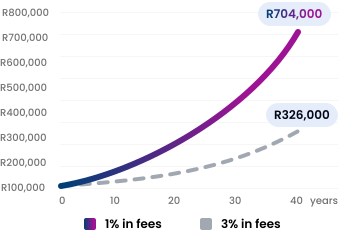
Higher fees very likely means lower returns (and here's the maths to prove it)
Paying high fees on your retirement investments (such as a retirement annuity or a living annuity) almost always means less money in your pocket, and less money for your retirement. Read more
Where the case thins out
The same research that supports the fee also marks its edges, and the structure carries costs the headline never mentions.
- The benefit lands unevenly, the fee does not For the disciplined investor who would have stayed the course regardless, the same fee buys far less and compounds against them just as hard. The structure charges everyone the same percentage for a benefit that arrives unevenly.
- The real cost is the one you don’t see The first thing an investor sees is the R14,400. The fee that takes the most off the table is the 0.86%, charged monthly against a balance that grows every year and never totalled into a single figure anyone could flinch at. The upfront fee shocks once. The ongoing one never announces itself at all.
- Advice is only as good as its incentives The research showing what advice is worth assumes advice given in the client's interest. Where it is not, the picture inverts. A RAND working paper found that advisers were measurably more likely to steer clients toward worse outcomes when their own pay depended on it through commission or an in-house product. It also found that clients were rarely able to tell when it was happening. Good advice and conflicted advice can carry an identical price tag, and the investor has no reliable way to tell which one they are paying for.
The investor experience
Fees are what an investor pays. Experience is what they get.
Say the investor decides this is not for them. They have read the quote, run the sums, and want their money somewhere cheaper. They sign the transfer forms in March. Under this provider's stated terms, the transfer can take up to 180 business days. Not calendar days. Business days. They could be waiting until close to December.
9 out of 10 people do better with 10X
The two cheapest structures in this comparison quote six to eight weeks for the same move. There is no early-termination penalty here, no exit fee to point at. The cost of leaving is not money. It is most of a year, and a year is the one thing a retirement saver tries not to lose.
Then there is what other people say about staying. On the review platform HelloPeter, this provider holds a rating of 1.19 out of 5. That figure rests on 542 reviews, the largest volume of any provider in this comparison, and around 95% of them are negative. The complaints are not about markets or returns. They are about delayed and unpaid claims, communication that breaks down, and cases that drag on unresolved until the customer escalates them.
This is the model that sells a relationship as the thing you are paying for. It is worth asking what that relationship is worth when 542 people have logged on to describe what it was like to feel neglected by it. Getting out, meanwhile, takes the patience of a slow ascent from depth, with no shortcut to the surface.
Who it’s for
This model is built for the investor who wants someone else to hold the plan. That is a legitimate thing to want, and for some investors it is worth the fee several times over, particularly the ones whose own instincts in a falling market would cost them more than 0.86% a year. What the structure does not do is let that investor see the real price. The fee might be defensible. Whether it is visible is the more worthwhile question.
The Hare and the Tortoise: The perfect parable for your investments in 2026
When it comes to your retirement investments, should you be chasing fast returns or steady growth over the long term? And do you know a bubble when you see one? Read more

How it compares
Here is the same R500,000 run through all five structures. The advice-led model sits at the costly end of nearly every line.
| Advice-led | Performance-linked | Single all-in (10X) | Layered | Self-directed platform | |
|---|---|---|---|---|---|
Headline | 2.88% upfront + ~1.38% ongoing | 1.69% | 1.04% | 0.81% | 0.55% |
Year 1 cost | ~R17,000 | R8,450 | R5,200 | R4,373 | R2,750 |
Total fees, 30 yrs | ~R1,138,000 | R1,110,000 | R842,000 | R694,000 | R766,000 |
Final value, 30 yrs | ~R4,795,000 | R5,122,000 | R6,092,000 | R6,592,000 | R6,343,000 |
Adviser | Central | Optional | None | Optional | None |
Transfer out | Up to 180 business days | 6–8 weeks | 6–8 weeks | Not specified | A few weeks |
So the verdict comes down to a single trade. The advice-led model is the most expensive of the five by almost every measure, and it is the only one that puts a person between the investor and their money. For someone who would otherwise sell at the bottom, freeze at the wrong moment, or never start at all, that person is worth paying for, and the research says so plainly. For someone who would have held their nerve regardless, the same fee is the most expensive habit they never needed.
Whether the advice is worth the fee is a question each investor has to answer alone. Whether they can even see the fee they are answering for is the one this series keeps asking. The R14,400 is shown in full and braced for. The 0.86% that quietly outgrows it over thirty years is never put in front of them as a number at all.
The same structure runs through this provider's preservation fund and living annuity almost untouched. The product on the quote changes. The way it charges does not.
Next, paying for performance. The model that costs the most in a normal year, and has the returns to argue it earned every cent.
Related articles


How can we 10X Your Future?
Begin your journey to a secure future with 10X Investments. Explore our range of retirement products designed to help you grow your wealth and achieve financial success.