Living Annuity Inflation Risk: Why Today’s Income May Not Be Enough
6 August 2026
Building blocks to a lasting Living Annuity
Our panel of experts discusses living annuities, sustainable drawdown rates, offshore investing, and everything else one might need to consider to ensure a comfortable retirement. Read more
![Building blocks to a lasting Living Annuity [webinar + transcript]](/_next/image?url=https%3A%2F%2Fimages.ctfassets.net%2Fyqvz0zwovkbq%2F4dZzwtwSkZ19hmRrVa6Zyb%2F770741ecc4b2ae3deda48fa06da42718%2FWebinar_recording_cover_1920X1080.webp&w=828&q=75)
As a living annuity investor, it's important to consider inflation for effective planning and capital management. While inflation risk might seem less significant in early retirement, its impact widens over time, affecting your income and purchasing power. Since an annuity is a long-term investment, potentially lasting 30 years or more, and you are withdrawing from its capital, inflation can further influence its sustainability.
You must carefully evaluate your income and drawdown rates, along with fees and investment growth in your portfolio. It’s essential to account for inflation's effects and determine if your living annuity can support your lifestyle over the years. This article explores inflation, purchasing power, drawdown rates, asset allocation, fees, and annual reviews.
Plan for a comfortable retirement with our
Living Annuity calculatorWhat is a living annuity?
A living annuity provides an income during retirement by converting your saved retirement capital into a market-linked investment. Retirees can withdraw a fixed percentage at intervals of their choice, while the remaining capital stays invested. You select an annual drawdown rate within the legal range (2.5% - 17.5%) and choose your investment funds. This offers flexibility, but investment returns, fees, and withdrawal amounts impact how long your capital lasts.
The good news is that if you maintain a sustainable drawdown rate (around 2.5% - 5%) and pick appropriate funds, your capital may last throughout your retirement and can be passed directly to nominated beneficiaries, outside your estate. You may also select the frequency of your income payments from annually, bi-annually, quarterly or monthly, depending on what suits your needs best.
What is inflation risk?
Accounting for inflation should be a standard part of your financial planning. As an investor, it's important to incorporate inflation into your living annuity strategies. Inflation diminishes the purchasing power of your money, meaning you'll need more money to buy the same goods and services. Over time, as prices increase annually, your income will buy less, illustrating inflation's effect.
Inflation will reduce the goods and services that you are able to buy with a certain income from one year to the next. You would therefore want to ensure that your living annuity is sustainable and able to cover your income withdrawals, as well as keep up with inflation. Inflation risk is an important factor for retirees to anticipate.
This becomes especially important over a lengthy retirement. Even a modest annual increase in the cost of living can have a meaningful effect over 10, 20 or 30 years. For investors, inflation should therefore be considered alongside your drawdown rate, fees and investment returns, as all of these factors can influence whether your income remains sustainable over time.
Solving the inflation equation (without higher grade maths)
Personal Finance journalist Nicola Mawson isn't good at maths, but she's found a way to do her retirement investment sums, and it might help you do yours, too. Read more

The drawdown decision: balancing income now with income later
As touched on above, your drawdown rate can be amended each year prior to your policy anniversary date. Your drawdown rate refers to the percentage of your living annuity that you draw as income each year. Every drawdown decision is a balance of two needs: income for the present and capital for the future. The idea is to choose an income level that supports you, as a retiree, without placing too much strain on the investment and putting you at risk of your capital running out too soon.
A lower drawdown rate can help retain more of your capital in the market, potentially allowing it to grow through compounding. Conversely, a higher drawdown rate may lead to more capital being withdrawn, which could limit the growth of your annuity. Generally, a 4% drawdown rate is recommended as a sustainable guideline for your annuity, following research by William Bengen in 1994. However, other considerations such as fees, expenses, investment growth, and your specific income requirements should also influence your choice of drawdown rate.
The golden equation: inflation is only one part of the puzzle
The golden equation (Drawdown rate + fees + inflation ≤ investment returns) is a useful planning lens when managing your annuity. It takes more than inflation into account. Ideally, your investment returns should exceed your drawdown rate, fees and inflation to see growth in your portfolio. If your drawdown rate, fees and inflation exceed your investment returns, you may see your capital decline over time. The golden equation is a guideline that can be applied, but of course, there are no guarantees.
How to Avoid Running Out of Money in Retirement
The golden equation for your retirement investments is that inflation + fees + drawdowns must be equal to our less than the return on your investments. Read more

Why growth assets may still matter in retirement
It's tempting to shift your portfolio towards a more conservative approach during retirement. However, your annuity should aim to consistently beat inflation by a healthy margin, since it might need to support you for many years. When considering asset allocation, focus on different asset classes such as cash, bonds, real estate, and equities.
Cash is the most liquid and stable of the asset classes, but you may see it struggling to keep up with inflation, which could then impact the purchasing power of your capital. Bonds can provide income, diversification, and a measure of stability within a portfolio. They are usually less volatile than equities, but they are not risk-free. Real estate provides exposure to real assets and economic activity, while generating income through rentals and distributions. It may contribute to long-term portfolio growth. However, listed property can be volatile and may be affected by interest rates, economic conditions, occupancy levels and changes in the property market.
Equities are generally included in a portfolio to provide long-term capital growth and the potential to earn returns above inflation. Equities give investors exposure to companies and economic growth, but they may also experience significant market declines. Value may fluctuate considerably over shorter periods, which means they are generally more appropriate for investors with longer time horizons and the ability to tolerate volatility. Equities have historically delivered returns above inflation by approximately 7% annually over long periods (based on JSE All Share Index performance versus CPI from 1960-2020).
You may wish to include equities in your portfolio to help target growth and outperform inflation over time, whilst maintaining a well-diversified portfolio across the various asset classes.
You may also wish to further diversify your portfolio offshore. This may provide you with more exposure to a broader range of industries, businesses, currencies, and economies located outside of South Africa. This can help to improve diversification and reduce reliance on the performance of the local South African market.
At 10X, we offer clients a range of well-diversified funds, giving you exposure to a variety of asset classes, as well as local and offshore assets. Please explore our funds for the most up-to-date fund information.
Understanding your fund fact sheet
A fund fact sheet, also called a Minimum Disclosure Document (MDD) or fund report, offers a regular overview of an investment fund's structure, objectives, and performance. It helps investors understand their holdings and compare various funds using consistent data.
First, examine the fund’s objective, risk profile, and suggested investment period. These details show what the fund aims to accomplish, the level of volatility an investor might face, and the ideal time to stay invested. A growth-oriented fund typically has a longer recommended timeframe compared to a defensive or income-focused fund.
The asset-allocation section illustrates how the portfolio is distributed among investments like equities, property, bonds, and cash, including the split between South African and offshore assets. The holdings section might also highlight the fund’s major underlying investments. These details assist investors in understanding their investment allocation and assessing whether the fund has appropriate diversification.
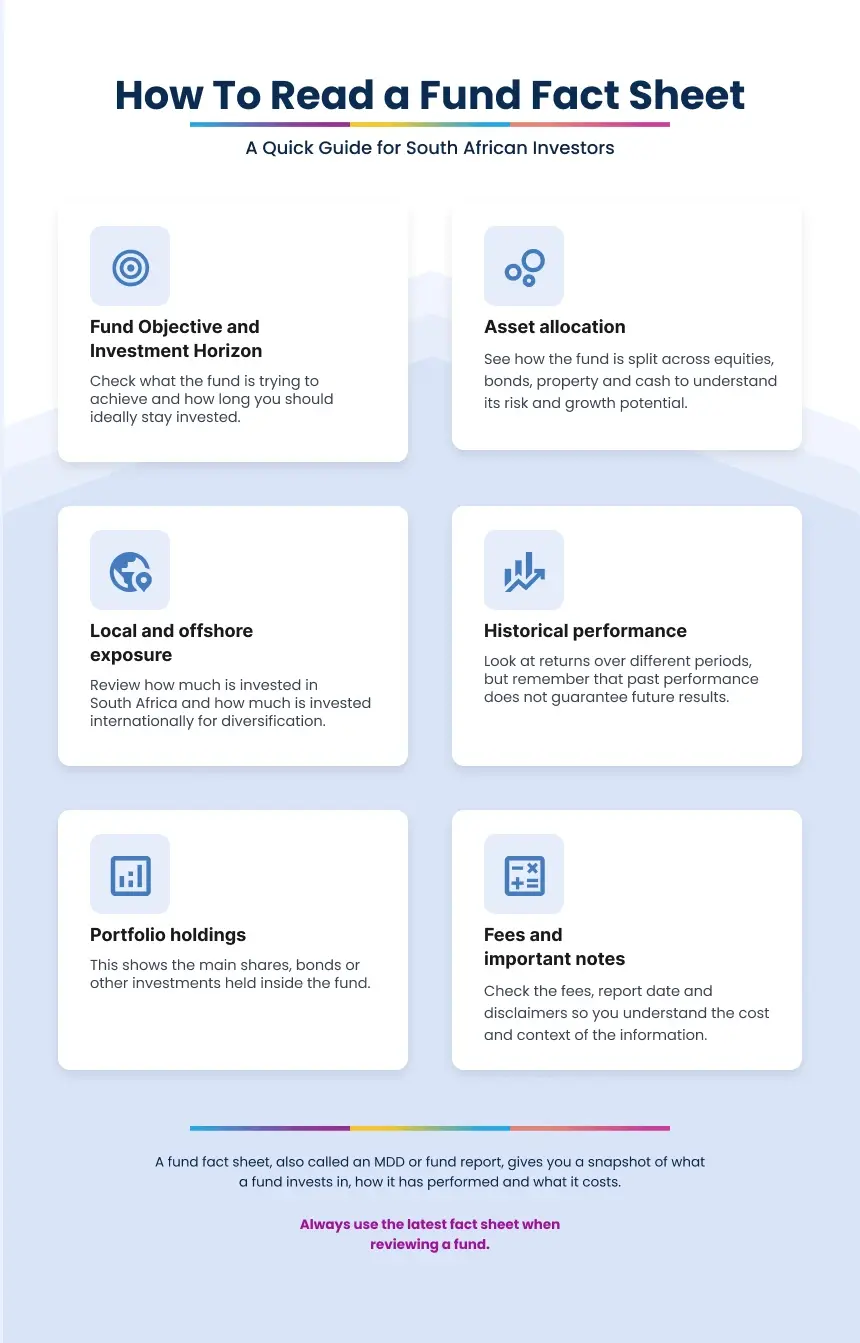
Performance figures typically display returns over various periods, including one month, one year, five years, and ten years. These figures should be evaluated in conjunction with the fund’s benchmark, investment objective, and suggested time horizon. Investors should verify whether the data reflects actual or simulated historical returns. Keep in mind that past performance is not indicative of future results.
The fact sheet should also detail the fund’s fees and key conditions. Investors need to verify the reporting date, since allocations, holdings, fees, and performance data can fluctuate. Rather than fixating on a single figure, the document should help determine if the fund’s objective, risk level, asset allocation, costs, and investment horizon still match the investor’s needs.
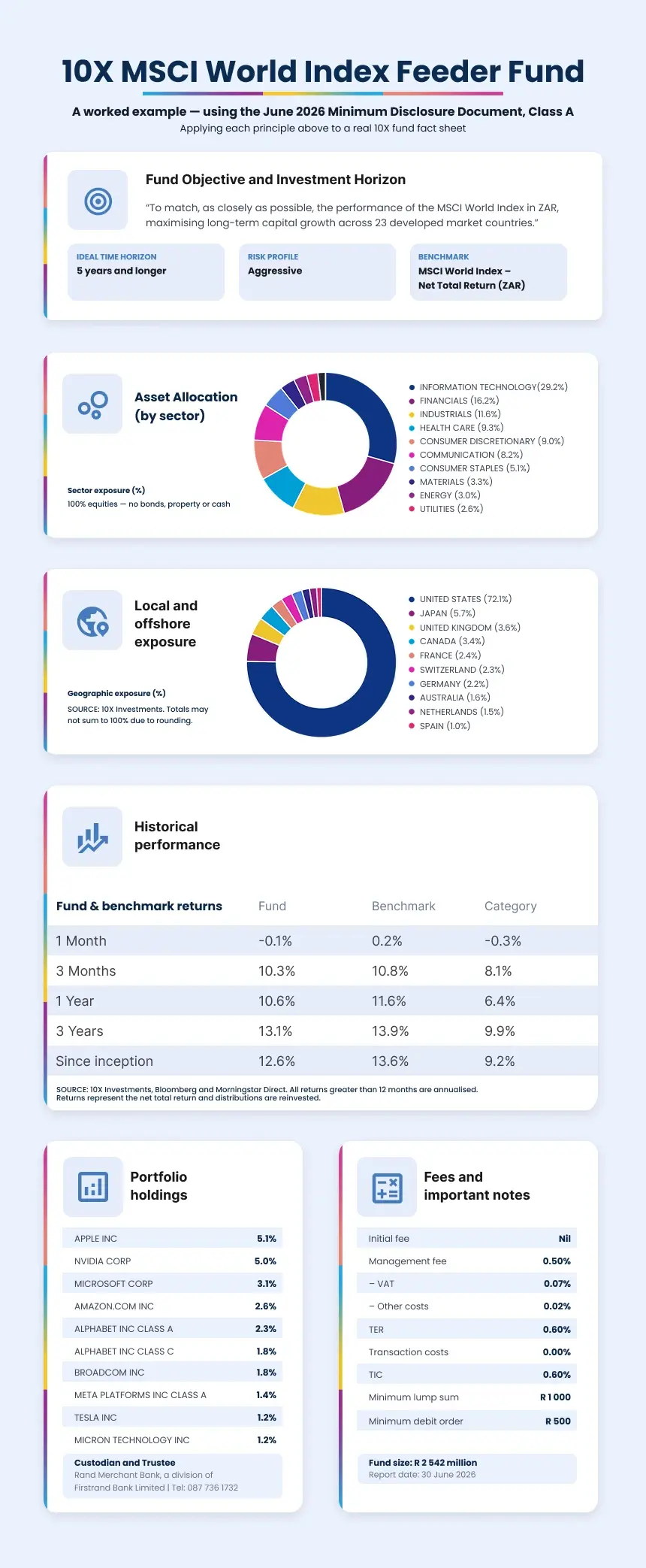
You can use these considerations to properly assess and review the MDD, such as the 10X MSCI World Index Feeder Fund below:
Fees can make inflation harder to beat
Your annuity needs to provide you with an income, cover fees, and also cater for the effects of inflation. Fees can be even more important in the retirement years as you are also drawing income from your capital and you are not adding any further contributions to it. Lower fees may mean that more of your returns remain invested and potentially compound.
It’s important that you review your fees annually to ensure you are aware of what you are paying in fees.
There are a few different kinds of fees and costs that you should look out for, and it is useful to understand what each is. Let’s have a look at some of these:
TER (Total Expense Ratio): Ongoing expenses within an investment fund, calculated according to the applicable standard. (A way to compare the operating costs of similar funds, but it is not the final cost)
TIR (Total Investment Charge): The total investment charge, which combines the TER with transaction costs within the fund. (A way to compare the full cost of the investment portfolio itself)
EAC: An annualised estimate of the impact of product, investment management advice, administration fees, and all other applicable charges.
The Effective Annual Cost (EAC) is a metric which was introduced by ASISA. It gives investors a standardised way to understand the full cost of holding an investment over time. The EAC combines a variety of different charges into a single annual percentage. This may include investment management fees, administration costs, advice fees, penalties, guarantees and the effect of loyalty bonuses, depending on the product that you are invested in.
Investors can use the EAC metric to compare the costs of different products offered by different providers more consistently. You may like to make use of this handy EAC calculator, as offered as a part of our free online suite of tools available on the 10X website. Assuming all other factors are equal, a lower EAC generally means that a larger portion of your money remains invested and available to potentially grow over time. A higher EAC may place greater pressure on net returns as fees accumulate over time. You will be able to view your TER, TIR and EAC on your investment statement. Let’s look at some of the fees you should look out for:
- Administration fees: Admin tasks such as compliance, tax and reporting will also incur fees.
- Advisor fees: If you are using an advisor, they are likely to charge you both an initial and an ongoing fee for the advice and other services that they provide.
- Investment management fees: There will be fees charged for the running of the fund.
Let’s look at an example to help highlight the effect of fees. We will assume the following information:
- Starting capital: R2 million
- Investment period: 25 years
- Gross annual return: 10%
- Inflation rate: 5% per annum
- Annual drawdown rate: 4% of the opening value each year
0.86% Fees: After 25 years, the living annuity would have a value of around R2.1 million. The investor would have received approximately R3.89 million in total income over the period.
3% Fees: After 25 years, the living annuity would have a value of around R1.2 million. The investor would have received approximately R2.92 million in total income over the period.
Fees are for illustrative purposes only, and real results may vary. You can learn more about fees here. 10X focuses on low, simple and transparent fees for our clients. You can expect one clear and simple fee structure for your particular product. Please explore our products for the most up-to-date fee information.
The importance of annual reviews
Each year, you should spend time reviewing your living annuity. This is best done before the policy anniversary date, allowing you to change your drawdown rate if necessary. It’s important to determine whether your current income remains appropriate, or whether it needs to be amended to meet changing needs or circumstances. You should also review your fund selection to ensure it still aligns with your investment timelines, risk profile, and retirement plans and goals. You should then review your portfolio performance, fees, and inflation to get a clearer, more accurate overall picture of your living annuity. Here is a handy checklist to assist you with your review:
- Has your cost of living changed?
- Is your selected drawdown rate still sustainable?
- Is your portfolio keeping up with inflation?
- Are the fees you are paying reasonable?
- Is your asset allocation appropriate for your current circumstances?
How 10X helps living annuity investors plan for long-term income
At 10X, we use an index-based approach to achieve greater market exposure and reduce unnecessary management costs. We also take a more active approach to asset allocation decisions. Our portfolios are created using a long-term view, rather than chasing short-term wins, and should be well aligned with your long-term retirement goals. We pride ourselves on transparency when it comes to fees, portfolios and our investment reasoning, so you can be sure there is no uncertainty or vagueness. Feel free to read more about our investment approach here.
If you need assistance with any aspect of your living annuity, don’t hesitate to contact the experienced and efficient 10X investment consultants who are just a phone call away.
Final thoughts: Protecting your income from inflation takes planning
Inflation is unavoidable, so as a retiree, it's essential to incorporate it into your decisions regarding your living annuity. Prices will inevitably increase, and you must assess whether your annuity can support your lifestyle long-term. Several key factors influence your annuity, and they should be carefully managed.
These include maintaining a sustainable drawdown rate, strategic asset allocation with a suitable portion of growth assets, low fees, annual reviews, and disciplined investment behaviour. If you haven’t reviewed your drawdown rate recently, now is the perfect time to ensure it remains appropriate for your situation.
Discover how 10X can help you get the most out of your living annuity. Get in touch with one of our consultants today.
Related articles

How can we 10X Your Future?
Begin your journey to a secure future with 10X Investments. Explore our range of retirement products designed to help you grow your wealth and achieve financial success.