Preservation Fund Direct Investing: Can You Manage Your Preserved Retirement Savings Yourself?
21 August 2026
The Living Annuity Masterclass: How to maximise your retirement income

The uncomfortable truth about retirement in South Africa - Rands and Sense by 10X [video]
We sit down with 10X Investment Consultant lead Andre Tuck and discuss the retirement savings crisis in South Africa. We also delve into living annuities, retirement annuities, TFSAs and everything in between. Read more
![The uncomfortable truth about retirement in South Africa - Rands and Sense by 10X [video]](/_next/image?url=https%3A%2F%2Fimages.ctfassets.net%2Fyqvz0zwovkbq%2F5ipSTnRq5Dp25fyghm5kGQ%2F02c801c78d5e1ca9280bfd34d7602368%2FAndre_Tuck_podcast_cover_image__1_.webp&w=828&q=75)
You might find yourself changing jobs and need to decide whether to transfer your accumulated savings from your employer-sponsored provident or pension fund into a preservation fund. This type of fund allows you to keep your savings intact until retirement, rather than withdrawing them early, which could negatively affect your retirement benefits.
Some investors prefer to use a financial advisor to handle the transfer and provide ongoing guidance, while others may choose to manage it themselves. This article explains what a preservation fund is, considerations before taking over the transfer process, fund selection, fees, and how 10X can assist investors.
See your pension savings grow with our
Preservation Fund calculatorWhat is a preservation fund?
A preservation fund is a long-term savings option for retirement, allowing you to retain savings previously invested in an employer-sponsored pension or provident fund. This option is particularly useful when changing jobs and wanting to keep saving for retirement rather than cashing out. Transferring your savings to this type of fund generally does not trigger a tax event, which helps your investments grow without interruption.
Additionally, growth in the fund is tax-free, meaning no dividend tax or capital gains tax is payable. It’s crucial to select the appropriate preservation type: a provident fund must be transferred to a provident preservation fund, and a pension fund to a pension preservation fund, to avoid incurring tax.
What does direct investing mean?
Direct investing means managing your investments and investment decisions yourself, without using a financial advisor. This means selecting your preferred service provider, understanding the applicable rules, choosing the appropriate underlying funds, reviewing your fund annually, and being aware of the fees you are paying.
If you are a direct investor, you take responsibility for overall decision-making while using the various tools and support available to assist in managing your fund. You may find that direct investing appeals to you if you feel confident making decisions about your investments, enjoy having control over your investments, and/or prefer paying no advice fees (which can be a big saving and mean more in retirement).
Switching jobs? The maths shows that preserving your pension is much smarter
Thinking about cashing out your pension when you move jobs? The maths shows that preserving your retirement savings is much smarter. Read more

The benefits of direct investing
Direct investing means managing your investment decisions without appointing a financial advisor to provide ongoing advice. This may involve choosing the investment product, selecting a fund, monitoring fees and reviewing the investment over time. For investors who are comfortable taking on this responsibility, it can offer greater involvement in financial planning and may lead to much lower fees.
This does not mean that you need to manage everything without support. With the right tools, clear information and access to knowledgeable support, direct investing can become a far more approachable option for a broader range of investors. At 10X, direct investors can make use of our free range of online tools, transparent fee information, fund information and experienced investment consultants who can help explain products, funds and processes at no additional cost.
One of the main benefits of direct investing is that it gives you greater visibility over your retirement savings. You can understand where your money is invested, what fees are being charged, and whether your chosen fund still aligns with your long-term goals. This can help you feel more informed and confident about the decisions you are making around your preserved retirement savings.
Direct investing generally removes advice fees. This can be especially important with preservation funds, as you are not able to make further contributions once the money has been transferred. The capital you preserve, the fund you choose and the fees you pay can all play an important role in the long-term growth of your fund.
The key decisions investors need to make
If you are thinking of going direct, there are a few areas that you will need to consider. These decisions are manageable when you understand what to look for and make use of the tools and support available to you.
- Research the various service providers and choose the one that best aligns with your needs.
- Review the requirements and paperwork needed to transfer your savings into the new fund.
- Look at the different funds on offer and choose a fund that matches your risk profile, investment timeline and long-term financial goals.
- Check the fees charged by the provider and make sure you understand what you are paying for.
- Review the applicable rules, including how withdrawals, tax and retirement options may apply.
These funds do not allow for further contributions, so factors such as fees and fund selection are extremely important when it comes to the potential growth of your fund over time. It’s also vital that, as a direct investor, you understand the rules regarding your fund. The benefit of using a provider like 10X is that you are not expected to make these decisions blindly. You can use the available fund information, online calculators and fee tools to guide your thinking, while also speaking to 10X investment consultants if you have any queries. This makes direct investing more accessible, while still allowing you to remain in control of your investment decisions.
The Hare and the Tortoise: The perfect parable for your investments in 2026
When it comes to your retirement investments, should you be chasing fast returns or steady growth over the long term? And do you know a bubble when you see one? Read more

Fund selection and asset allocation
Your savings will be invested in the market, so you will need to choose the underlying funds for your portfolio. At 10X, you can select from a curated selection of funds that include a variety of asset classes. The investment portfolio is allocated across different asset types like equities, bonds, real estate (property), cash, and offshore investments. The optimal mix for you depends on factors such as your time horizon, income requirements, risk tolerance, and capacity to stay invested during volatility.
These funds are governed by Regulation 28 of the Pension Funds Act. Regulation 28 limits exposure to certain asset classes, including a maximum of 75% in equities and 45% offshore. These limits are in place to encourage diversification and reduce the risk of retirement savings being concentrated too heavily in a single asset class.
Equities are generally included in a portfolio to provide long-term growth and the potential to earn returns that beat inflation. Equities give investors exposure to the stock market and economic growth, but they may also be volatile, causing values to fluctuate considerably over short periods. Equities have historically delivered returns above inflation by approximately 7% annually over long periods (based on JSE All Share Index performance versus CPI from 1960-2020)
Bonds offer income, diversification, and some stability in a portfolio. Although generally less volatile than stocks, they are not without risks. Changes in interest rates, inflation forecasts, and the issuer's repayment ability can influence bond prices. Even though they are considered more conservative investments, bonds can sometimes outperform expectations.
Real estate provides exposure to real assets and economic activity, while generating income through rentals and distributions. It may contribute to long-term portfolio growth. However, listed property can be volatile and may be affected by interest rates, economic conditions, occupancy levels and changes in the property market. Real estate often serves as a good hedge against inflation.
Cash is generally seen as the most liquid and stable of the asset classes. It is less likely to experience the same levels of volatility as equities or real estate. Cash returns may, however, struggle to keep pace with inflation over long periods, which can reduce purchasing power.
You may also wish to further diversify into offshore assets, which may provide you with exposure to a broader range of industries, businesses and economies outside South Africa. This can improve diversification in your portfolio. Being strategic and careful with your asset allocation is crucial, as research by Brinson, Singer, and Beebower indicates that it can significantly influence your portfolio's growth.
Please visit our fund information page to find out more about the 10X funds on offer to you. You can find a range of funds geared towards different investor profiles and each with a different mix of assets. Our consultants can assist you in choosing a fund that aligns with your investor profile.
We've built the 'happy retirement' machine
Understanding the most effective strategy for investing your retirement savings is fundamental to experiencing a happy retirement. We've built an investment machine that gives you a great chance of really golden years. Read more

Understanding your fund fact sheet
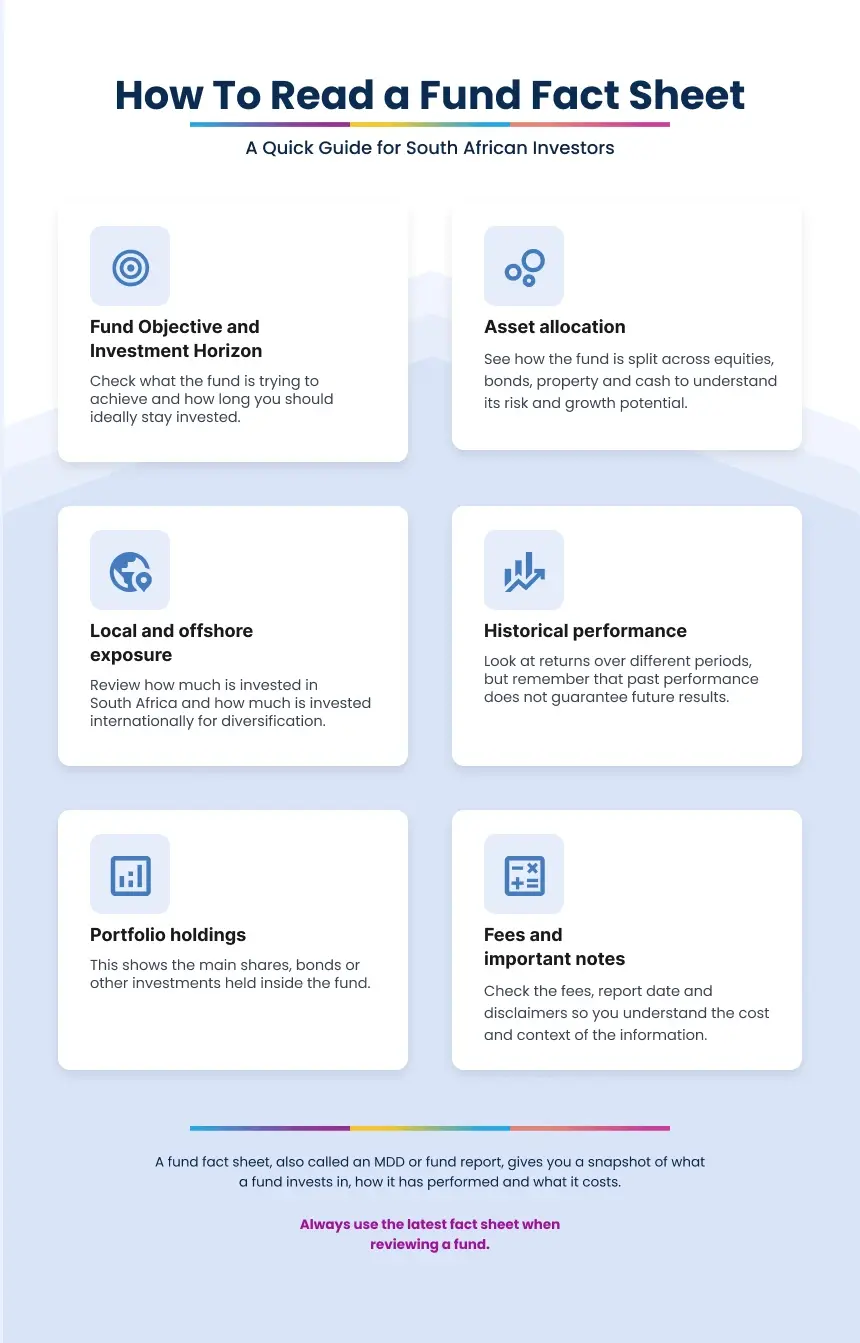
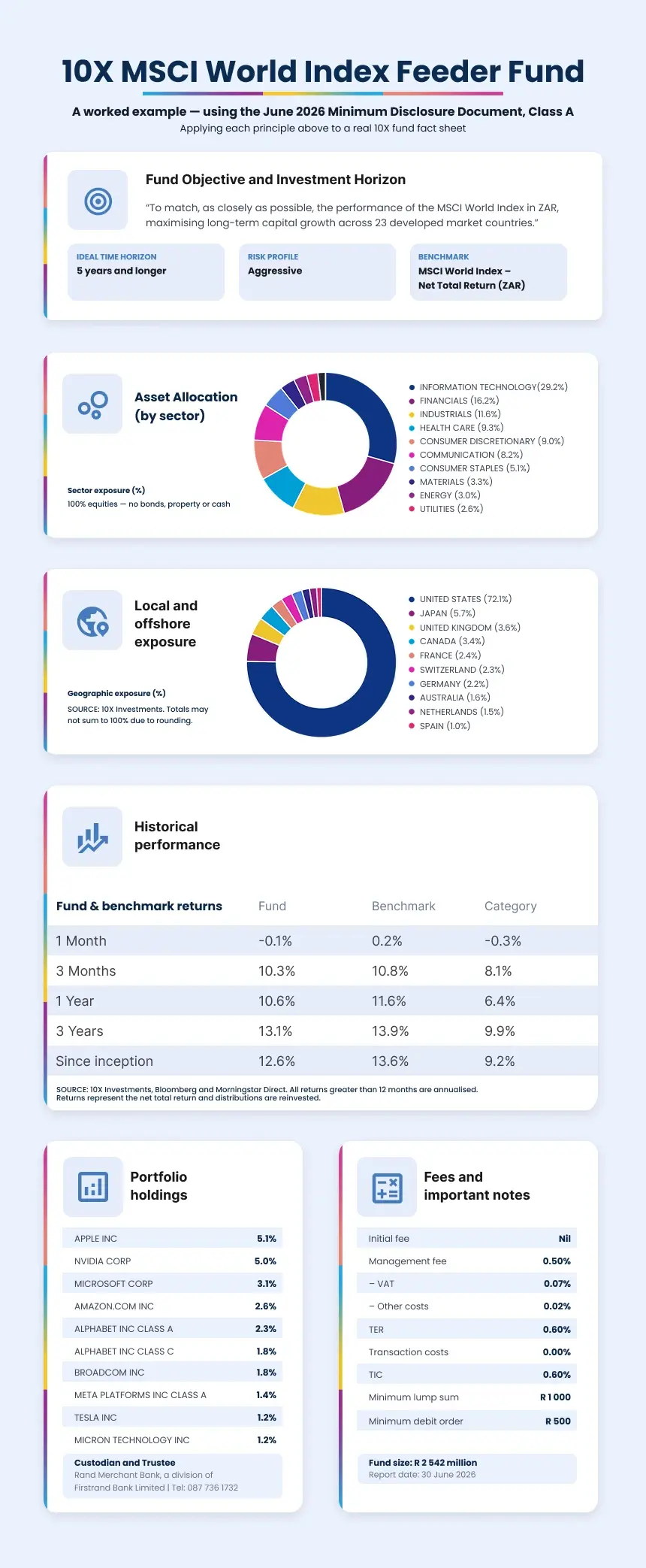
A fund fact sheet, also known as a Minimum Disclosure Document (MDD) or fund report, provides a regular snapshot of how an investment fund is structured, what it aims to achieve and how it has performed. It can help investors understand what they own and compare different funds using consistent information.
Begin by reviewing the fund’s objective, risk profile, and suggested investment duration. These details reveal the fund's purpose, potential volatility, and the ideal investment timeframe. Typically, a growth-oriented fund requires a longer holding period compared to more conservative or income-focused funds.
The asset-allocation section shows how the portfolio is split between investments such as equities, property, bonds and cash, as well as between South African and offshore assets. The holdings section may also identify the fund’s largest underlying investments. Together, these details help investors understand where their money is invested and whether the fund is appropriately diversified.
Performance figures usually show returns over several periods, such as one month, one year, five years and ten years. These returns should be considered alongside the fund’s benchmark, investment objective and recommended time horizon. Investors should also check whether any figures are based on actual or simulated historical returns. Remember, past performance does not guarantee future results.
The fact sheet should also outline the fund’s fees and key conditions. Investors need to review the reporting date, since allocations, holdings, fees, and performance figures can vary over time. Instead of focusing on a single figure, the document should help assess whether the fund’s objective, risk level, asset allocation, costs, and investment horizon continue to align with the investor’s needs.
The infographic below can serve as a guideline when you’re reviewing a fund fact sheet.
Why fees matter
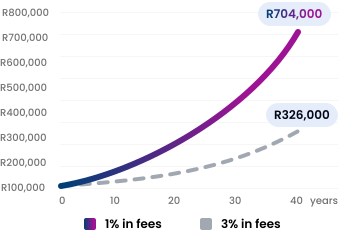
Fees are crucial in direct investing, and it’s important to understand and review them regularly. They can diminish your invested capital and the potential for growth over time, especially when compounded over many years. These funds might also be more vulnerable to fees since no additional contributions can be made. Future market returns are unpredictable, but product charges are visible. This means fees are among the few factors that you, as an investor, can control, allowing you to compare different service providers. Lower fees enable more returns to be reinvested, potentially compounding and growing over time.
Higher fees very likely means lower returns (and here's the maths to prove it)
Paying high fees on your retirement investments (such as a retirement annuity or a living annuity) almost always means less money in your pocket, and less money for your retirement. Read more
It’s also important to understand some of the key terms you’ll encounter when dealing with fees, such as:
- TER (Total Expense Ratio): Ongoing expenses within an investment fund, calculated according to the applicable standard. (A way to compare the operating costs of similar funds, but it is not the final cost)
- TIC (Total Investment Charge): The total investment charge, which combines the TER with transaction costs within the fund. (A way to compare the full cost of the investment portfolio itself)
- EAC (Effective Annual Cost): An annualised estimate of the impact of product, investment management advice, administration fees, and all other applicable charges.
Effective Annual Cost (EAC) is a useful cost measure for investors to look at. It is an annualised estimate of the impact of product, investment management advice, administration fees, and all other applicable charges. It was introduced by ASISA in 2015. Assuming all other factors are equal, a lower EAC generally means more of your money remains invested and available to potentially earn returns and grow over time. A higher EAC may indicate greater pressure on net returns, as the effect of fees accumulates over time. Let’s have a look at an example to show the effect that fees may have. We will assume the following information for our example:
- Starting capital: R500,000
- Investment period: 20 years
- Gross annual return: 10%
- Inflation: 5% per annum
- No withdrawals
1% fees: The fund would grow to approximately R1.07M after 20 years. (Inflation-adjusted value)
3% fees: The fund would grow to approximately R732,000 after 20 years. (Inflation-adjusted value)
We can see how small differences in fee percentage can make a meaningful difference by the time you reach retirement. Note that this example is for illustrative purposes only and real results may vary. If you would like to find out more regarding the effect of fees, this fees article is a great starting point.
You can explore our products to review fee information. Fees are kept transparent, simple and cost-effective. Fees charged are usually 1% or less, depending on the product chosen and the amount invested.
How 10X supports direct investors
At 10X, you can expect plenty of support if you are a direct investor. You will have access to a range of free online tools to assist you with your investing. You can also speak to our experienced and knowledgeable investment consultants at no additional cost.
We use an index-based investment approach that incorporates a more active approach to asset allocation. Our focus is on diversification and long-term, disciplined consistency, rather than trying to time the market and chase short-term wins.
Funds are Regulation 28-compliant and offer exposure to various asset classes, including multi-asset and offshore exposure, which may provide access to a wider range of companies than in South Africa. Our fees are kept cost-effective, simple and transparent, so it is easy for all investors to understand and review.
Our free tools include a preservation fund calculator, EAC calculator and cost comparison report.
Final thoughts on preservation fund investing
As a direct investor, you may have more control over your fund and pay lower advisor fees. However, this increased control also means greater responsibility. It's essential to carefully consider all decisions related to your fund and to use the tools and support available through 10X, including our online resources and investment consultants.
Regular annual reviews of your fund help ensure you understand the product, your chosen fund, and the fees involved. Get in touch with 10X today to get started or if you have any queries.
Related articles


How can we 10X Your Future?
Begin your journey to a secure future with 10X Investments. Explore our range of retirement products designed to help you grow your wealth and achieve financial success.