Layered Retirement Annuity fee structures: Cheap, but really difficult to add up
17 September 2026
The uncomfortable truth about retirement in South Africa - Rands and Sense by 10X [video]
We sit down with 10X Investment Consultant lead Andre Tuck and discuss the retirement savings crisis in South Africa. We also delve into living annuities, retirement annuities, TFSAs and everything in between. Read more
![The uncomfortable truth about retirement in South Africa - Rands and Sense by 10X [video]](/_next/image?url=https%3A%2F%2Fimages.ctfassets.net%2Fyqvz0zwovkbq%2F5ipSTnRq5Dp25fyghm5kGQ%2F02c801c78d5e1ca9280bfd34d7602368%2FAndre_Tuck_podcast_cover_image__1_.webp&w=828&q=75)
Two charges. One for administering the account, one for managing the money inside it. They come from different parts of the business, they pay for different work, and they sit one above the other on the same page of the quote with a total underneath. This is the layered fee, the third of the five structures in our Fee Architecture series.
If you're just catching up, here's where things stand. Five South African providers were asked to quote the same R500,000 retirement annuity, and each quote was then run through the same thirty-year compounding model. Episode one set that benchmark, finding a sixfold spread in Year 1 costs and roughly R1.8 million separating the cheapest from the most expensive by year thirty. Episode two took apart the advice-led model, which charges R14,400 upfront and keeps charging for the advisor relationship long after. Then, episode three covered the performance-linked structure, in which the manager's pay is tied to the fund's performance.
This structure is the most forthcoming of the five. It charges for two things, names them both, and prints the total underneath. Nothing is taken off the top before the money starts working, nothing depends on an advisor being appointed, and nothing shifts when markets do. On the R500,000 benchmark, the effective cost comes to R4,373 in the first year. Over thirty years, it costs less than any other structure in this comparison.
That transparency raises a question the other episodes have not had to ask. Every previous structure kept part of the cost somewhere other than the quote, like inside a unit price, a performance calculation, or a fee that only surfaces once the investment is underway. This one gives the clearest headline disclosure in the comparison. So what does a fee split across two lines do to the person reading it? The research on that is less flattering than the disclosure deserves.
Build the retirement of your dreams with our
Retirement Annuity calculatorThe anatomy of the layered fee
Two lines on a quote. Here is what each one buys.
- An administration fee of 0.40% a year including VAT. This is what the platform charges to hold the account, price it daily, produce statements, and issue tax certificates. Platforms of this kind became standard in South Africa in the late 1990s, when retail investors were routinely paying far higher initial unit trust fees than institutional buyers of the same funds. The platform layer was built to close that gap and administer access across managers.
- A fund management fee of 0.40% a year including VAT. This is what the manager charges to run the underlying portfolio, a multi-asset fund holding roughly 70.10% in growth assets. It is fixed. It does not rise when the fund outperforms or fall when it underperforms. The quote gives the fund's total expense ratio as 0.45%, which adds audit, trustee and other operating costs to the 0.40% management fee.
- No initial fee, no performance fee, and no advice fee. The quotation confirms an initial fee of 0.00%. The full R500,000 starts compounding immediately, where the advice-led model would have taken R14,400 off the top first. There is no performance fee and no requirement to appoint an advisor to access the product. Every rand of the R500,000 goes to work on day one. The advice-led model would have taken R14,400 off the top before the investment existed.
Add the two fees and you get 0.81%. The same quote puts the Effective Annual Cost (EAC) at 0.90% for the first year, and the difference is where this structure stops being fully self-explanatory.
Higher fees very likely means lower returns (and here's the maths to prove it)
Paying high fees on your retirement investments (such as a retirement annuity or a living annuity) almost always means less money in your pocket, and less money for your retirement. Read more
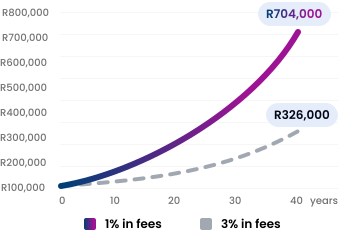
As the standard, built to put differently shaped fees on the same footing, the EAC splits into 0.51% investment management and 0.39% administration on the R500,000 benchmark. That 0.51% is the 0.40% management fee, plus the audit, trustee and operating costs that take the fund's TER to 0.45%, plus 0.06% in transaction costs. Administration comes in marginally below 0.40% because of how the charge falls across the year. Both figures are correct. Add the two fees on the quote and you land nine basis points short. Not hidden. Just not in the sum you were invited to do.
What thirty years costs
Held at its current rate and run through the same model as every other structure in this series, the layered fee produces the lowest total cost and the largest portfolio at the end. That result owes nothing to the fund. It falls out of the fee.
| Metric | Value |
|---|---|
Headline (Year 1, all in) | 0.81% |
Year 1 cost | R4,373 |
Total fees over 30 years | R694,000 |
Final portfolio value | R6,592,000 |
Net of fees, the fund returned 19.34% over the most recent year. Annualised, it returned 14.23% over three years and 11.54% over five. This series measures fee architecture rather than fund selection, but a cheap structure wrapped around a bad fund is a bargain nobody wants.
The case for layered fees
- Everything is visible before the decision, not after it The other four structures in this series each keep part of the cost somewhere the quote does not show it. One buries it in a unit price that moves with performance. One splits it across an upfront deduction and an ongoing charge that never appears as a single figure. One leaves brokerage and the underlying fund's costs outside the headline entirely. Here, both charges are on the first page, the total is printed beneath them, and nothing is added once the money is in. Whatever else it does, the quote does not require the investor to go looking.
- Two prices you can check separately A single blended figure tells an investor what the product costs, but not which part of it is expensive. When divided, the platform charge and the fund charge can each be weighed against what other providers charge to do that specific job. In this comparison, both come in at the low end, and neither is carrying the other.
- Cheapest by year thirty At R4,373, this is not the lowest opening number in the comparison. Over thirty years it is the lowest total, R694,000, which leaves R6,592,000 at the end, more than any other structure here. Nothing sits outside the two quoted fees except 0.06% in transaction costs. Where a headline excludes brokerage or the underlying fund's own charges, those costs keep compounding for three decades without ever appearing in the quote.
- Nothing on the price tag is conditional No advisor to appoint, no performance hurdle to clear, no capital taken before the money starts working. The quote is the price.
Retirement Annuity vs Tax-free Savings Account vs Bond: Where Should Your Extra Money Go?
Got extra money to invest? Compare three powerful options: Retirement Annuity, Tax-Free Savings Account (TFSA), or paying off your bond faster. Learn the pros and cons of each to make an informed choice for your financial future. Read more

The case against
- Two numbers feel smaller than one Split a price in two and many people never add it back together. found that buyers shown a base price and a separate surcharge remembered paying less than they actually had. Only a fifth worked out the real total. Nearly a quarter left the second charge out of their sums entirely. Percentages were the worst offender, ignored more often than figures in rands and cents. has not shifted that. Nothing here is concealed. But this quote asks its reader to add 0.40% to 0.40%, and the evidence says most will not.
- Familiarity dulls scrutiny A meta-analysis of twenty years of partitioned pricing research found that buyers accept a split price most readily when splitting is normal for the category. An administration fee on a retirement product is exactly that. It raises no question because it is what the category looks like, and a charge that raises no question is one nobody checks.
- Neither charge moves with performance The performance-linked structure, for all its complexity, at least moves with results. This one does not. Management is charged at 0.40% whether the fund leads its category or trails it. Administration is charged at 0.40% whether the platform runs well or badly. A fixed price is a promise about cost, not about service.
- No timeline on the way out Asked how long a transfer to another provider takes, the provider confirmed that transfers are permitted but named no timeframe. Two of the four other structures in this comparison commit to six to eight weeks in writing. On the way out, the transparency thins.
A fixed deposit? No thanks!
Moneyweb regular Jimmy Moyaha discusses the problems with that old bank favourite, a fixed deposit, and what else you can do with your money. Read more
The investor experience
Fees are what an investor pays, and decent returns and good service is what they expect.
The provider holds 1.28 out of 5 on HelloPeter, drawn from 46 reviews in the twelve months to April 2026, and more than nine in ten of them are single-star. Its Net Promoter Score sits at -59, and it ranks 105th among financial services businesses on the platform. What the reviewers describe isn’t that the platform ignores them. This provider replies to every complaint logged against it, and it does so within 14 hours on average. It’s that withdrawals arrive late, or fail to arrive at all, and no reply time fixes that. The clarity that runs through the fee table stops at the point where the money is supposed to come back.
Sample size is worth holding onto here. Forty-six reviews is a fraction of the 542 behind the advice-led provider in Episode 2, and a rating built on the smaller number carries proportionally less weight. It is a signal rather than a verdict.
Who it's for
This structure suits an investor who would rather see the parts than trust the sum, who is content to choose and monitor a fund without an advisor, and who is measuring cost across many years rather than the first twelve months. It asks for very little in return, beyond the willingness to add two numbers together and the curiosity to ask what the total leaves out.
It is a poorer fit for anyone who wants a person built into the price or a fee that answers for its own performance. And it carries a caveat the numbers cannot express. A provider can be entirely honest about what it charges and still be difficult to deal with when something goes wrong.
How it compares
The same R500,000, run through all five structures.
| Layered | Advice-led | Perf-linked | All-in (10X) | Self-directed | |
|---|---|---|---|---|---|
Headline | 0.81% | 2.88% upfront
+ ~1.38% ongoing | 1.69% | 1.04% | 0.55% |
Year 1 cost | R4,373 | ~R17,000 | R8,450 | R5,200 | R2,750 |
Total fees, 30 yrs | R694,000 | ~R1,138,000 | R1,110,000 | R842,000 | R766,000 |
Final value, 30 yrs | R6,592,000 | ~R4,795,000 | R5,122,000 | R6,092,000 | R6,343,000 |
Advisor | Optional | Central | Optional | None | None |
Transfer out | Not specified | Up to 180 bus. days | 6–8 weeks | 6–8 weeks | A few weeks |
On cost alone, the layered fee wins this comparison outright. Less charged over thirty years, most left in the portfolio, and both components on the page before anyone signs anything. The research on split pricing does not undo that, but it does qualify it. A fee disclosed in two parts is not hidden, but it is not absorbed the way a single number is. That distinction sits with the reader rather than the provider.
What the quote cannot tell an investor is what the relationship feels like once the money is in. The structure with the clearest price in this series belongs to the provider with one of the weakest service records in it. Visibility at the surface says nothing about the conditions at depth. Disclosure and service are separate commitments, and one does not vouch for the other.
Next in the series, doing it yourself. The structure that removes the fund manager's judgement from the price by handing the decision to the investor.
Related articles



How can we 10X Your Future?
Begin your journey to a secure future with 10X Investments. Explore our range of retirement products designed to help you grow your wealth and achieve financial success.